
Freelancers! Don't Be Intimidated By High Demand
Being recognised for your skills and work ethic and contribution as a freelancer or small business owner makes it feel like all that hard work you put in over the years is finally coming to fruition. But when that high demand comes it might be very overwhelming. You may have gotten by quite well so far treating your freelancing as a nice little paycheck on the side or something that builds up your portfolio. Now, with big clients coming in asking for your services, the responsibility can seem quite intimidating. This is only natural! Fighting against fear and carrying through, though, can mean the difference between success and failure.

Plan, plan, plan and plan some more
Even if you have gotten by without really trying in your other projects so far, that doesn’t mean this behaviour should continue. With a big client offering vast compensation for your time, you want to ensure that you get everything as perfect as possible.
Therefore, planning is essential towards your success. Not only will a lot of planning make the assignment easier, but it will also show in the final product and stand you in good stead for further referrals.
Break big projects down into sections and plan when to tackle each chunk. Be sure to give yourself a little extra time to finish, too, just incase something unforeseen (like a computer malfunction) comes up.
Expand
With this newfound recognition, you may also want start thinking about expanding. Expansion is excellent for spreading awareness about your brand. While you don’t need to be running a multinational with thousands in turnover, you can still demonstrate your professionalism by adapting to the growth you are experiencing.
Here are some expansion ideas:
Move your home office somewhere else (if you can afford it).
Build up your online business through your website. (Doing this requires researching colocation to handle increased server traffic that will no doubt come your way should things start to really blow up.)
Make some new business cards that highlight the names or logos of some of your high-profile clients.
Hire an assistant.
Get the assistance of a marketing professional to help get you on radio and television shows as an expert. Here's one of my radio interviews.
Know your options
Knowing your options is essential to avoid being taken for a ride by someone who probably has far more experience than you. Research what they are asking of you to better negotiate prices as well as helping you with organising contingency plans should they decide they don’t want to pay.
This happens to many freelancers. Clients sometimes don’t understand that even if they are not happy with the work, they still have to pay up. You put your time and effort into it after all. Here are some tips for invoicing your clients properly.
Keep in contact
This is essential both during and after the project. Staying in continual contact with your clients allows you to understand what they want and saves miscommunication. This is especially important if English is not their first language.
Furthermore, following the completion of the project, you can stay in touch with them for further work or even referrals to other companies seeking freelance business. This will expand your network and allow you to build your portfolio with ease.
I Won The Writer's Awards' Top Author Websites for 2017

What an amazing way to start the new year! This site has won a top spot in the The Writer's Awards' Top Author Websites for 2017. This alinabradford.com was chosen as one of the top 45 out of thousands of websites that were nominated.
Here's what the group of volunteer writers that started the contest had to say:

Here's the list of everyone who won. Click to move through the slideshow.
How Freelancers Can Benefit From Qualifications

Freelance writing can be an incredibly freeing pursuit. Taking on jobs of variance and becoming more adept at managing clients are both very valuable skills to learn in the online marketplace. Those who gain a taste of freedom, especially those who do it well, often find themselves building their own portfolio and testimonial base by themselves. This can yield them excellent jobs in many areas, and even one day lead to a salaried position with a firm. Depending on your comfort levels around risk and stability, you may have different goals in mind.
However, no matter if one person's goals vary completely from another fellow freelance writer, the benefit of being qualified can greatly impact them both for the better. Freelance work is not seen as something that requires qualifications. This is because you might not feel it can be used as a gateway pass into an industry quite like it can when entering the job marketplace.
Freelance writers often work from home, and as such are good at managing their time. We’re here to show you how taking a small part of your time from your schedule and investing it in studying a degree online can help you in the long run.
Specialization
Some writing gigs will simply desire those qualified to speak about it.. For example, writing copy for the medical industry will require some real scientific and medical knowledge, so you know how to source medical papers, refer to them and reference others in the correct way. When it comes to offering important business advice for a popular online blog, having an MSC international management online degree can truly help add authority to your words.
Remember, the power of words is important. It shapes minds, perceptions, and leads people into avenues of thought that they might not have otherwise connected with. It’s your job as a freelancer to have responsibility for the articles you author, meaning that having a basis in truth is the best thing to start and maintain.
Reliability
Sometimes the world of freelance writing can be difficult. While it’s a rewarding and deeply creatively charged career to have, preparing for a lack of work can be important. This is especially true if you’re having issues getting jobs because your portfolio is struggling to grow.
Working at a firm and writing in your spare time with actual industry knowledge, utilizing the degree to the best of your potential, will give you special insight that many other writers cannot match. As you dedicate yourself to this your portfolio will grow thoroughly, and likely with impressive clients.
Making the transition to a writing career then can be much less difficult. It’s often thought that the only people who can ‘write freelance’ are people who desire to be writers, but not so. Writing and language is a tool, not a specialism.
It is open to everyone, which is why it’s so far-reaching. Gaining some practical experience outside of freelance and then translating that to the words you write everyday can inform your writing, not hinder it. It could even improve your style, especially in areas where accurate technical jargon is important to get right.
So yes writers, even if freelance writing is an enviable career to have, and you may desire the lifestyle to become your own boss in a sense, you can still greatly benefit from outside achievements.
Free Writing Workshop: The No-Fluff Workshop
Okay everybody! Super excited! Starting
January
8th, I'll be having a free week-long workshop for all the members of my
No-Fluff Freelance Writing Group
. All you need to do is join the group, grab a copy of my my book
The Fluff-Free Freelance Writing Master Course
(the ebook or paperback works great) and follow along here:
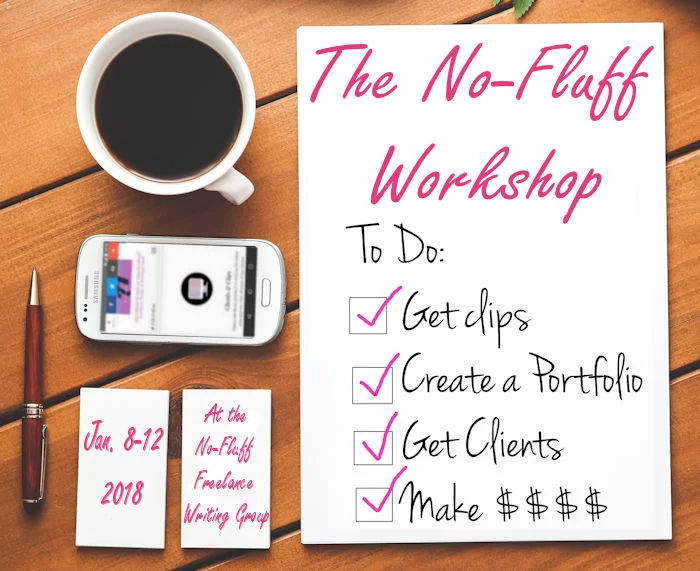
The No-Fluff Workshop will cover:
Day One: Easy tips on how to find high-paying freelance jobs.
Day Two: Portfolio tips to help you look more professional.
Day Three: Tips on creating a resume, even if you don't have any writing experience.
Day Four: Hook potential clients with your opening email.
Day Five: A look at my day. An exclusive behind-the-scenes look at my life as a freelance writer and some tips for replicating my success.
No Up-Sale, Promise!
Don't worry! I won't try to up-sale you to buy a course or anything. This is free for all members because I want to help you guys create a freelance career that you love and that makes you big bucks in 2018. Let's start the New Year's off right!
Are You In?
If so, comment below and let me know! Also, leave any questions you would like for me to answer during the workshop.
The 12 Steps to Becoming a Freelance Writer

how to get writing clips
Not sure how to start your new career as a freelance writer? In my book, The Fluff-Free Freelance Writing Master Course, I go over how to become a freelance writer in detail. I thought I'd do a post, though, on what steps to take, without the detail, so you can get quick overview of how to get started.
Write posts on all of your favorite topics. You'll need at least three. Make sure they range between 500 and 1,000 words.
Edit the posts until they are easy to read, spelled correctly and make sense.
Post the articles on your own blog, LinkedIn or Medium. Congrats! You're a writer. Now, time to get some clients.
Choose a niche, or two or three. Here's how.
Create a resume. You may not have any publishing credits to list, so be sure to highlight any work experience that pertains to your niche. Also highlight things like typing speed, skills like being able to use Word and WordPress, turn-around speed, knowledge of SEO and anything else writing related.
Start applying to ads looking for freelance writers in your niches. I post ads in my Facebook group to get you started and here are some other great places to look.
Set up a business PayPal account. You may have heard horror stories, but PayPal is the easiest way I've found to take payments from all over the world.
Plan for taxes. I run as a sole proprietor and use my name as my business name. If you want to use another name you'll need to register your business with the IRS. Either way, you'll also need to get an EIN assignment.
As you garner more clips, be sure to save the links in an online portfolio that you can send potential clients to. I recommend creating your own site and posting your portfolio on the site. Here are some tips for making your website wow.
Ask for referrals. Get clients to refer you to friends, business contacts and more to get new business.
Get testimonials. After a project, ask your client to write you a testimonial and send it to you as an email. These testimonials can be used on your business' website to draw in more clients and make you look super professional.
Be active in your community. Get out of the house and get involved in local charities and events. When people ask what you do for a living, tell them you're a freelance writer. Word will get around that you're a local writer and jobs will start coming to you. (Plus, helping others is a good thing!)
Need more help? Grab a copy of my book, The Fluff-Free Freelance Writing Master Course.
I'm a Writer That's Lost 100 Pounds

Not so long ago I weighed myself and almost fell on the floor crying. 365 pounds? How could that be? When did this happen?
I had to do something, but I thought getting healthy was impossible since I'm a writer and literally sit all day at the computer. While my fingers got a workout, the rest of me sure as hell didn't.
I needed to do something, though.
After one year, I have lost over 100 pounds. Here's how I did it.

lose weight for writers
I thought I was fat when I wasn't
I started out my body hatred at 150 pounds, size 12 and age 13. People told me I needed to lose weight. No boy would like me if I didn't lose 50 pounds. I had a 28-inch waist, 32-inch hips and 35-inch chest. I was toned. I was fit. I had huge muscles. My calves and thighs were like granite.
I thought I was a glob of lard.
Looking back now, I realize I wasn't fat. I went down a self-destructive road that led me to be 365 pounds. I wasn't fat, but I got there by believing I was. It's amazing what a poor self image can do to you.
Plus size models get a bad rap. I wish I had seen size 12 models back then. I would have believed that I could be curvy, strong and healthy and there wasn't anything wrong with that. I'm so glad girls today have better role models.
The Guidelines
I've written hundreds of health articles in my career, so I know a lot about what you should do and what you shouldn't do to lose weight. I broke everything I've learned over the years down into some simple guidelines that are working for me. I'll go over them.
By the way, this is just what worked for me. I am not a medical professional and you should always consult a doctor before trying to lose weight.
Here's what I learned.
You're okay, I'm okay
It's okay to have fat on your body. That doesn't make you a bad person! You have fat, you aren't fat.
There are no bad foods
Eating "fattening" foods is okay, as long as you make sure to stay in your calorie range-ish. I used MyFitnessPal app (it's free!) to figure out how many calories I need for my height, weight and activity level.
Surprisingly, I wasn't eating enough on most days. Uhh, what? Lol! Apparently my body was in starvation mode and was storing fat like it was the apocalypse. Sigh. I would go off on benders because I was so hungry and my body packed it away like a bear getting ready for winter.
Don't skip meals
If you can't eat a healthy meal, guzzle a yogurt smoothie (they come prepackaged and have active cultures, which is good for the tummy) or a bottle of 100% juice/vegetable smoothie (no sugar added!).
Pig out on veggies and fruit
You can't go wrong filling up on these. Find your faves and stock up. I'm a glutton for berries, so I stocked up on grapes, strawberries, blueberries and raspberries while they were in season.
Soda... only sometimes
Cut back on the soda and replace it with black coffee. No sugar and you'll still get the much needed caffeine!
Get off your rump
Find projects that make you get up and move. This one is a little harder, but it's fun if you make a game of it like I did with my laundry.
Food is f-ing delicious
Don't deprive yourself, just don't go back for seconds! Savor it, go slow and keep a close watch on your tummy. When it feels full, stop eating.
Change your sitting arrangement
I switched out my office chair for a yoga ball and stand. I bounce up and down on it while I'm thinking. My butt looks great!
You can't get better if you're depressed
I hate pills, but sometimes you've got to suck it up and take medicine to make you better. I'd tried everything to overcome my OCD, depression and panic attacks naturally. I finally had to admit I needed help. I'm on Prozac today and I'm not ashamed of taking care of my mental health. I'm no longer eating to make myself feel better and I'm happy. That's a win on its own!
Get up and play
When your kids want to have a dance party, have a dance party with them. When the dog wants to play. Play! Having fun doesn't feel like work, but it does burn calories and build muscle.
Be positive
This is going to sound a little woo-woo, but being positive is a huge key to my success. Everyday before I get in the shower I say, "You're getting thinner every day," or "You're getting healthier every day." Hey, it works! You can't lose weight if you're down on yourself.
One bad day (or two!) doesn't mean anything
You're human. You have cravings. Who cares. You do you, boo.
What this all means
I think you may be sensing a pattern here. My main mantra was, "Be good to yourself." When you start to take care of your body and mind like you would the loved ones in your life, changes start to happen.
I may not be bikini ready, but I'm healthier and feel like a new person. I can breath! I can walk into the grocery store without wheezing! You can see my neck muscles and collarbone! My back doesn't hurt all the time! I can see a light at the end of the tunnel and it's working.
Avoiding and Dealing with Writer's Block
Please enjoy this guest post by Marie Miguel.
A freelance writer who can't put out words simply doesn't earn. Another reality is that editors and clients typically rely on you to meet deadlines, and a writer who doesn't meet due dates can delay the progress of an entire project. Yet some days, as Neil Gaiman says, the blank piece of paper wins, and there's little you can do about it. What's worse is that you might think things are progressing even if at a painfully grinding pace, only to realize the next day that you've produced nothing but insipid drivel. While every writer has their own approach and flow, the good news is that certain things do help most people overcome writer's block, most of the time.

Organize your Working Life
Even if working from home, it's essential to have your own office or space where you can keep distractions to a minimum while surrounding yourself with everything you need. Having a defined starting time each day and some kind of timetable can be immensely useful in the long run. This primes you to work when you have to instead of procrastinating. Many writers find it useful to work an hour or two as soon as they wake up. At this point in the day, your conscious and unconscious mind will work together most effectively, often allowing you to circumvent sticking points with less effort.
Locate any Emotional Blocks
Particularly when writing fiction, a writer often comes up against a truth they'd prefer not to face, or a character trait they'd prefer not to recognize. This is normal. The tricky part can be that our minds shy away from these points to the extent that we often don't know what's bothering us.

Stepping back and practicing mindfulness may help in identifying what's holding us back and in learning how to confront it. After all, writing is often an exercise of self-discovery, which is why many people find it useful to keep a journal. If you can't surmount this hurdle on your own, getting an outside perspective is sometimes the quickest way to get back in the saddle. Sometimes, we’re afraid, perhaps of receiving bad feedback or not putting out something quite as perfect as we imagined. At other times, our mental picture of what we want is still too inchoate to do much with. These are all examples of our feelings getting in the way of our work.
Take a Break, Do Something Unusual
“A change is as good as a holiday.” Well, whoever said that either has fantastic changes or lousy holidays, but the principle is sound. If you're unable to produce any output, taking the day off might be just what you need. Visiting friends, going for a nature walk or doing anything that might inspire you is good. Breaking your routine is like rebooting a computer and can help you get out of a rut.

Alternatively, admin and marketing are rarely exciting, but need to be done anyway. If you can't be productive in the way you'd like, you might as well be productive in the ways you can.
Keep at It Anyway
This may seem like the most pointless suggestion possible while you're staring at a blank screen and an immobile cursor stubbornly blinking at you. Still, you can't edit anything. Tapping out random stream-of-consciousness sentences, making notes or spending some time planning isn't actually wasted effort. It's a warm-up exercise. Even if you just spend some time sitting in front of the keyboard without resorting to Facebook or cat videos to cure your boredom, the random thoughts passing through your head will often coalesce into an avenue you can follow to get unstuck.
Writers! This Multitasking Tip will Make You More Productive
Okay, I have a bad habit of sitting on my bum all day. I mean, I'm a writer, so it's hard not to. I sit until I finish my article, or my blog post, or my whole day's worth of work. Research shows, though, that taking regular breaks make people more productive. Also, sitting all day can make you sick. I know it's given me a plumpness never seen before on this body! So, I've found one multitasking solution that gets me up and makes me more productive. You'll find this tip particularly helpful if you are a work-at-home mom or dad.

work at home
Set a timer!
You've heard this one before, I'm sure, but my tip has a twist. Be sure your timer is connected to something important. For example, before I start a work project, I throw a load of laundry in the washer. When the timer goes off, I make myself get up and put the laundry in the dryer. When the dryer buzzer goes off, I get up and put the laundry away. Then, I start the whole process over again.

multitasking for writers
This works with cooking, too, if you're a home chef. After you put food in the oven, sit down and start a task. When the oven timer goes off, get up and check your dish.
This way, I get stuff done around the house, plus I give my mind a break and give my body a break from sitting.
Do you have any tips for getting up out of the office chair?
December Contest for Writers

I hope you are having a great holiday season.
Time for another contest! For the December contest I've got a mystery box full of writing books and writing related goodies to give away!!!

To enter:1. Read my book - https://www.amazon.com/dp/B06XTCGDVF (ebook, hardcopy, whatever)2. Add a review on Amazon (good, bad, whatever)
That's it! You'll be entered to win! I will announce the winner on New Year's Day.
A Couple Things Your Small Business Needs in Its Marketing Arsenal
As a small business, you need to market yourself as frequently and as fervently as you can. If you don't, no one else will! So, sell your business by packing its marketing arsenal full of things that will help it to both reach consumers and entice them. Here are a couple tips.

Knowledge on your part
Even if you are not your business’s marketing manager or even in its specific marketing team, you should still have knowledge on the subject.
To obtain this marketing knowledge, consider taking accredited online MBA programs without GMAT that teach of the marketing basics. By taking such a course you wouldn’t have to bend your schedule too heavily to accommodate it as it is taken 100% online, plus you wouldn't have to go through the very time consuming GMAT entry test to obtain entry onto it in the first place.
And, once on the course, you would be able to learn all the marketing knowledge needed to provide you with a strong understanding of the subject; you can then use that knowledge to build your business with a strong marketing backbone.
Marketing tools
Tools are vital for creating, implementing, and managing a marketing campaign, and it’s always worth investing in these as early as possible. Analytics software is the most obvious part of this, but it’s also worth looking into content creation tools, too.
These tie directly into your marketing campaigns, since you’ll need quite a bit of high-quality content for them. There are plenty of these you can go for, such as cloud-based AI options like Nano Banana.
With the right tools, creating, implementing, and refining your marketing could be noticeably more straightforward.
A strong online presence
Something else that your business needs to be strong with is its online presence. Simply, a poor online presence can tank your business, and a strong one can bring in clients or customers by the dozens.
To ensure that your business’s online presence is strong, you need to ensure that its online consumer reaching medium, its website, is up and active at all times. This doesn't mean just during the day, either. This means 24/7, 7 days a week.
When it comes to keeping your site up, you should enlist the help of what is known as UptimeRobot. What this ‘robot’ does is watch your website fervently at all times, and if it were to ever notice an instance of it crashing or being down it would notify you right away via email. Your job would then be to get the site up again before any potential customers may try, and fail, to log onto it.
As a small business, your business’s marketing procedures need to be as strong and as hardworking as they can in order to suffice for the lack of exposure it has compared to other, bigger businesses. So, make sure to pack that marketing arsenal full of the hints and tips love!
3 Mistakes All New Freelance Writers Make

You’ve taken the leap and made the decision that could change your life: you’re going to try and make a go of a career as a freelance writer. Getting to this point often takes hours of worry, stress, and dedication to your art-- surely everything after this point is relatively easy by comparison?
Sadly not; in fact, when you’ve made the decision to be a freelance writer, the work is just beginning. Now you have to try and make your choice a viable opportunity. You’ve never done this before, so it’s inevitable that you’ll make some mistakes along the way-- isn’t it?
Perhaps not. Perhaps you can avoid the all-too-common “new freelance writer” mistakes, and launch your career with a bang. If this sounds appealing to you, then read on for the errors you’re going to want to avoid as you embark on this new chapter in your life…
Common Error: Unclear Briefs
When you pitch a brief, it is far safer to give too much information than not enough. Editors can spot a new freelancer from miles away due to the length of their pitches. A seasoned writer knows that editors want detail; they want facts, statistics, and a clear insight into why that writer is the perfect fit to write the piece they are pitching.
A pitch should be at least 200 words, contain at least two links to sources you wish to quote, and a brief background about you as a person. This helps the editor to know that you have the right idea, the evidence to back it up, and are exactly the correct writer for the piece.
Common Error: Not Taking The Financial Side Seriously
When you decide to try to make it as a freelance writer, you have to approach the entire task as you would when starting a business. You have to ensure that you tick all the bureaucratic boxes, register your company via the likes of yourcompanyformations.co.uk (if you're in the UK) or accredited registers (if you're in the US) and be aware of your tax obligations.
When you’re just getting started in the writing industry, going through all of the above feels rather overwhelming. It’s also demands time that you feel would be better spent crafting your latest pitch. However, if you neglect the finances, you could find yourself in a lot of trouble in the future. Put good practices in place at the beginning of your journey, so you can establish good habits.
Common Error: Not Finding Your Own Style
When you’re trying to write professionally, you will likely read a lot of work produced by other people. This is generally good; it’s research, helping to shape the way you write… but it is possible to go too far.
It’s vital that you define your own style; something that is unique to you, and makes any words you produce instantly recognizable. If you (sometimes unwittingly) copy another’s style, or write with a dull “boilerplate” style, then you may struggle to convince clients and editors as to why you specifically are worth commissioning. There’s a great guide to finding your own writing style at oxbridgeediting.co.uk, so read through and take the points to heart.
In Conclusion
If you can avoid the mistakes as mentioned above, you can be sure to get your writing career off to a flying start.
My book shows you how to avoid new freelancer foul-ups and guides you step-by-step. Get it here: The Fluff-Free Freelance Writing Master Course: The only course that gives you concrete, actionable information to building a successful freelance business without any fluff.
Don't Let A Poor Online Presence Tank Your Freelance Business!

When it comes to trying to survive in the cutthroat world of freelancing, it pays to be able to reach as many people as possible. Because of this, the internet could not be more important to your overall success.
Sadly, far too often promising freelancers end up failing simply because they didn't fully understand how to use the internet to their advantage properly. However, just because something can be a challenge doesn't make it impossible. If you really want your career as a freelancer to be successful, then you've got to be able to create the best possible online presence. Here are a few simple and easy ways that you can do just that.
Fix your terrible web design
The biggest issue that many small or independent businesses have when it comes to their online presence is that their websites are often just terrible. There are plenty of things that can ruin a customer's experience of your website.
It could be that it's impossible or confusing to navigate, or that the functionality of the site is pretty broken, or it could simply be that it's incredibly ugly. The fact is that you need to think carefully about exactly what about your website needs improvement. One of the best ways to be sure that your website is always up to scratch is to use one of the many website builders available online.
Sites like https://WebsiteBuilders.com can help you compare different services to figure out which is right for you. Creating a website that people actually want to visit is the first step in building an online brand that people care about.
Start using social media properly
It's become pretty clear over the last few years that not only is social media not going away, it's also an incredibly useful method of engaging with customers. However, far too many freelancers and businesses end up using it totally wrong.
You can't just fill your social media pages with ads and promotions and expect results. You need to create an identity online that people will actually want to follow and share. Otherwise, you're just going to be wasting your time with stuff that your customers simply don't care about.
Give your customers something to engage with
Customers don't want to be showered with advertising and promotions anymore. What they really want is content that they can actively engage in. This means that you have to produce things that will connect with customers on an intellectual or emotional level.
Blog posts are one of the very best ways to do just that since you're going to be able to give customers a peek into the human side of your business that they might not be aware of. That kind of thing can create a remarkable emotional connection that otherwise wouldn't be possible.
Of course, don't assume that your business can survive based purely on your online presence alone. You still need to think about things like connecting with customers in person, attending business and trade events, and focusing on high calibre customer service. Running any kind of successful business is a matter of being able to keep things as balanced as possible as much as you can.
Taking Your Writing to the Next Level
Being a freelance writer is an incredibly rewarding career (I should know, I've been at it for 19 years). You spend your days doing something you enjoy, while also getting to explore a huge range of new ideas, all while getting paid for the privilege. Of course, though, in a business like this, it can be hard to know how you’re going to grow when the time comes. Getting more and more work will eventually stop being a good thing (been there!). Instead of being excited and happy, you become overwhelmed. To help you to avoid this sort of issue, this post will be exploring some of the best ways to further and improve a freelance writing career.
Start Outsourcing
When you have too much work to handle, one of the best options you have is outsourcing. Like you, other freelance writers will always be looking for work, and you can often take advantage of this nice and easily.
Of course, in most cases, you won’t earn as much using a method like this. Instead of doing the work, though, you'll be giving it to someone else, and this means that the money is effectively free.
Websites like Freelancer are great when you’re first starting out. As time goes on, though, you’ll probably want to consider finding some people who you will be able to work with for a long time.
Before outsourcing freelance work, be sure to look at your contract. Some contracts will specify that you are not allowed to outsource and all of the work must be done by you, only.
Get Yourself Published
Passing your work to someone else might not always be the answer you’re looking for. Instead of increasing the amount of work you can do, a lot of writers will look for better work that pays more for less effort.
Getting yourself published can be a huge step in the right direction when you’re trying to achieve a goal like this. Of course you need a great idea and time.
When you’re aiming for a deal for a book or other media method, you will have to go after companies with a lot of tenacity, as this market can be a very fierce one. Having a strong social media following can help you snag that book deal.
Or, you can self-publish using Amazon Kindle Direct Publishing. This is a free service and you have much more control over how your book is priced, how it is advertised and how much of a royalty you receive. This is the route I went with my book The Fluff-Free Freelance Writing Master Course.
Get Paid More
Part of getting paid more and working less is raising your rates. Granted, you'll lose some clients, but you will free yourself up to work with a higher level of clientele. This not only makes your bank account happy, but it will also raise your status as a writer.
Here's a sample email you can send your current clients when you plan on raising your rates:
The good news is my business is doing really well. The bad news is that I must raise my rates to accommodate my business' growth. So, I am letting you know that I will be raising my rates as of (date). Articles will now be (price) and blog posts will be (price). You are a valued customer to me, so I hope we can continue creating fantastic content together.
Thanks so much for your loyalty and business,
Name
Add A New Face
Finally, as the last option to help your freelance writing business grow, it’s time to think about professionalism. It can be very hard to respond to emails, answer calls, and deal with other customer requests when you’re very busy with work. To help you with this, it would be worth researching virtual offices and the next business revolution.
Hopefully, this post will inspire you to start working harder on the time you put into your writing career. Doing anything on a freelance basis will come with its challenges. When it comes time to grow, though, you have to make sure you’re prepared, or you could miss your chance at a better future.
Resources: The Food for Thought in Nourishing Your Business
There are so many essential components to a new business, that it can be very confusing for a budding entrepreneur to decide which avenue they need to go down to ensure a healthy starting off point for their brand new venture. Once the basics are in place, do you start to prioritize your needs according to the products, the employees, or the resources? Every aspect is as important as the other, but which one is the most invaluable asset when you are starting out? Let's make a case for the resources …

For The Workers…
In any industry, regardless of the unique skill sets your employees have, it is the resources available to them that enable them to do their job properly and complete their tasks efficiently. It is a cliché that a shoddy workman blames his tools, but you cannot argue this point when you're working in an industry like writing, where tools are almost as important as the people who use them.
From the perspective of an employee, we now work in an age where the tool, be it a computer, app, server, or the standard hammer and nail, are a important piece of the puzzle for any company to continue with their work.
While many are arguing the point that we are placing an over-reliance on tools, such as the internet, the fact of the matter is now that the industry has progressed so far, that we are unable to function without technological help. So, we are seeing the vitality of what tools and resources are to the employee side of things.

The one resource that benefits the employee more than anything else is knowledge. A lot of industries are addressing the idea of the employee taking their own education into their own hands, which we have seen with e-learning programs, but the employer has to provide these resources. The employee can seek out their own education, but if they are doing this without guidance, they may be veering quite far off course, which doesn't benefit the employer. So if the employee has access to a bank of knowledge, this means that the employee can develop their own skill set, which benefits the company, as well as their own sense of self-satisfaction and that they are doing a good job.
For The Business…
Every company requires a stable structure for it to function, and while every person is reliant on each other to do a good job, it is the resources, from the internal as well as the external, that ensure the business is ticking every box. Every industry relies on a certain set of fundamental tenets to keep the business running on an even keel, and the pool of resources that the company needs to operate from can vary from industry to industry.
The first thing to address as far as resources are concerned is in relation to your physical needs. An industry like the construction industry is reliant on the important tools to do the job, and so with every aspect of a company that relies on each individual moving part to help the company function as one, we've all seen the difficulties that businesses face when one aspect isn't working properly. In the manufacturing industry, the impact of a piece of broken equipment has a detrimental effect on the productivity and the profits of a business, the amount of downtime will equate to a loss of finances based on a lack of productivity.
So this means that a valuable resource in terms of the business is functioning equipment. Inevitably, businesses pick preferred suppliers of equipment and tools. And it is vital regardless of your chosen industry, that you pick preferred suppliers so you can build a positive relationship with them. Look at a company like Construction Trailer Specialists, they provide the most basic of equipment for any labour-intensive industry, trailers, and so whether you are running a building site, working on a farm, or laying sidewalks, some subcontractors provide a more total service based on the product they supply. And it is these businesses and clients that you are better off aligning yourself to.
This goes to show that your resources belie your relationship with those suppliers. While you can state that your relationships are the key part of keeping any business thriving, when you're dealing with contractors, subcontractors, clients and so forth, the relationship is built on these resources. You need certain resources to make sure your business is running effectively, and so your relationship with these suppliers can help you to get a discount on bulk buying certain tools. But at the end of the day, you can head to another supplier because it's your business that is the priority, not your relationship! The resources are the main thing that will keep your business working, your employees productive, and your customers happy.

For You…
You know better than anyone, when you are in charge of a business, the right resources won’t just put you above and beyond your contemporaries, but it adds an extra layer of professionalism. You, as an entrepreneur, rely on these resources, not just to improve your business, but to improve how you lead.
In essence, professional resources are your bread and butter as a business owner. We've seen the importance of LinkedIn influencers, and we've seen the big names in business delivering their twopenny worth on pressing issues of the day, from Richard Branson to Bill Gates, to Tony Robbins, and anyone else you would care to think of.
The great thing about being an entrepreneur now is that there are more and more apps and resources cropping up on a daily basis, such as Shapr, intended as the Tinder of business networking. By swiping left or right, based on your ideal colleagues and industry influencers, you are in the driving seat as to who you would like to align yourself with to build up your network, and by proxy, your pool of resources.

how to be a freelancer
Resources for the modern entrepreneur isn't just a good quality workforce, it is the people you are building relationships with. You cannot underestimate the power of who you know when you are in charge of a company, especially when you are starting out. While it can be argued that more companies are going out of business now than ever before, especially in the fickle nature of the startup industry. But the onus is now on the entrepreneur to make sense of the infinite amount of resources available to them, and to distil them into which ones will benefit the most.
The most difficult thing in any industry now, is to make sense of these resources. Lots of business owners hurtle forward into an industry they know almost nothing about, relying on their passion and heart to lead the way, and while the importance of taking risks in something that should be communicated to every single entrepreneur in the world, some people will act upon this impulse, without having done the relevant research.
This is where your resources come in handy. You also have a number of resources at your disposal that you can share to your contemporaries, and we've seen a lot of skill swap meetings, where people get to share different skills, and so we can all build up our basic skill set. But this is part and parcel of the networking game now. As an entrepreneur, you have to be willing to share your skills so you can receive more knowledge, and resources to help build up your company.
Finally, you are the well of knowledge in which people will come to. So, you have to make sure that you are consistent, that you have an unending amount of curiosity, and have an infectious passion for your industry. People are going to be coming to you for ideas, inspiration, advice, a shoulder to cry on, how to cook the books, and the list goes on. You are a fundamental resource for your business, so you'll have to make sure that you are adequately fueled in this respect.
People talk about money being the ultimate resource, but this is only one piece of the business puzzle. These three aspects of the company, your workers, the business itself, as well as you, require the right resources. We are all aware of how to nourish ourselves so we can feel adequately fueled, but do you do the same for your business? Look at these three aspects, and begin to ask if you are giving each part the right resources. Resources needn’t be expensive, or complicated, but when you are looking to implement a structure, fund a company, or just to clue yourself up in the relevant business practices, it's the resources that need to be put in place.
The Health Hazards of a Writer... and How to Work Smarter
Writing might not seem like a perilous job on the surface. Our profession doesn’t require us to fight fires or catch criminals. We don’t have to deal with toxic materials or dangerous machinery. Meanwhile, the heaviest load many of us have to carry is a mug of coffee. But that's not to say that writing isn’t hazard–free. While us writers may not have to deal with many of the immediate dangers that other workers face, there are still many long-term health risks to look out for. Here are some of the biggest dangers a writer must face and how to overcome them.

how to be a healthy writer
Your keyboard
Writers no longer have to deal with writer’s cramp now that we’ve swapped out pens for computers.However, typing on a QWERTY keyboard can still cause a different type of repetitive strain injury (RSI)– one that has been linked to tendonitis and arthritis in the wrist and fingers.
I know. After more than two decades at the keyboard, I have carpel tunnel in both wrists. I don't want you to become like me, so here are some preventative measures:
Take regular breaks. You may want to download software that will tell you when to take a break from typing, preventing your from developing an RSI.
If you're using a laptop, buy a stand for it that raises the keyboard to an angle. This will really make a difference on the strain on your wrists.
Adjust your seat height so your hands hover above the keyboard and are parallel with your elbows.
Get an ergonomic keyboard with a soft wrist pad that lessens the strain on your muscles. If you use a mouse a lot, be sure to also get one that fits your hand well and a mouse pad with a padded wrist support. This type of mouse pad made a world of difference for me.

my office setup
Your keyboard could also be upsetting your stomach. Few of us clean our computer keyboards, yet studies have found that on average computer keyboards contain 20,000 times more germs than a toilet seat.
If you share a keyboard, or you just don't wash your hands as much as you should, your computer can be a great way of spreading illness-causing bugs. Take the time to clean your keyboard every few months. Use double-sided tape to get rid of any crumbs and dirt beneath the keys.
Your computer screen
Many writers spend their days staring at a bright white Word document on a monitor. Unsurprisingly, this is bad for our eyes. It’s particularly bad when you're in poor lighting or in the sunlight when there is screen glare.
Get the lighting to the right level by turning on a lamp or drawing the blinds. You may even be able to buy an anti-glare filter or download software that can automatically change the brightness of your computer screen depending on the time of day.
Another good option is GUNNAR, which is the only patented digital eyewear recommended by doctors to protect and enhance your vision, according to the company. As writers, our devices expose our eyes to stress and harmful artificial blue light. Blue light may lead to trouble sleeping, cataracts, macular degeneration, dry and scratchy eyes and headaches. Staring at a computer screen before bed is also something to avoid as this can cause insomnia. The bright light of the screen tricks the brain into thinking it’s still day time and so reduces its ability to produce melatonin (the sleep hormone). Start trying an hour of no screen time before bed if you’re having sleeping problems – this includes TVs and mobile phones too. Read a book, take a bath or listen to some music.
Yah, I didn't believe it either, at first. I've found these GUNNAR glasses, which comes in several different styles, take a lot of strain off my eyes. As soon as I put them on I can feel my eyes relaxing.

GUNNAR glasses
If anything, you should be making sure that you’re taking regular breaks from the screen to help give your eyes a rest.
Your chair and desk
That’s right, your chair and desk may also be destroying your body. Many writers like to type while sitting down. This can result in a sedentary lifestyle that’s bad for our joints, our heart and our muscle development. Too much sitting down can wear away our abs completely over time and result in us getting a flabby belly. Constantly bent knees from sitting down can meanwhile bring on joint problems.
The best defence against this long-term health deterioration is to get up more often and stretch your legs. Some writers have even taken steps to buy a standing desk, forcing them to work upright. For example, I have a standing desk made by VERIDESK and I love it. I did have some questions for the creators. Here's what Jason McCann, CEO of VARIDESK had to say:
Me: If standing is better than sitting, why does it hurt so much more to stand up for long periods of time?
Jason: Our bodies weren’t made to stay in one position for long periods of time. Biologically, our bodies are made to move. The products VARIDESK has developed are height-adjustable, and were specifically designed to promote movement between sitting and standing throughout the day.
Me: Standing while typing and doing other tasks can seem awkward at first. Are there some tricks to getting used to using a standing desk?
Jason: The best trick is to not stand too much when you first start. You should listen to what your body is telling you – if you feel any discomfort, you should sit down. We’ve actually developed the VARIDESK standing desk companion app that gently reminds you to change your position. Our customers tell us that once they’ve used a standing desk for a while, they feel more productive and have more energy throughout the day.
Me: I've been to large companies that have added a standing option to their work areas. Do you find that this is a growing trend?
Jason: As office workers are focusing more on their health and wellness, we’ve seen them gravitate toward the idea of more mobile and collaborative work environments. Fortunately for us, VARIDESK has become an integral part of these active office setups, both here in the United States and globally. We’re energized by the prospect of helping people enhance their time in the office and live happier, healthier and more productive lives.
Alternatively, there are plenty of exercises while you sit down (known as deskercises) that can help you to flex these body parts and reduce the risk of long-term damage. Take breaks from writing to do a few of these exercises and keep your body healthy.
If you use a regular desk you need to take some precautions. A low desk could be causing you to slump, causing a strain on your spine. This can result in debilitating back pain. Make sure that your desk is the right height so that you don’t have to crane over it and combine it with an ergonomic chair. You can buy adjustable desks that can allow you to change the height to match different seated positions and even a standing position.
With my desk I use a yoga ball chair that cushions my spine, helps me sit up straighter and allows me to bounce and do exercises while working.
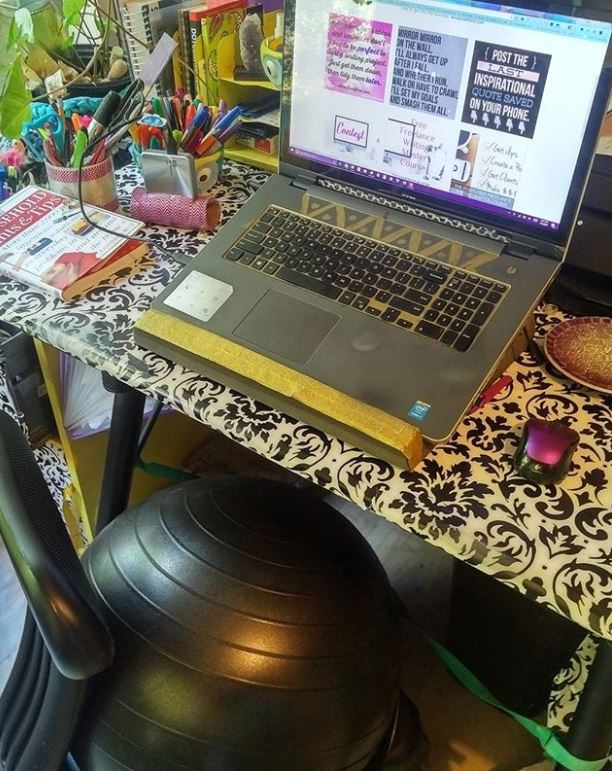
my yoga ball chair
What if you don’t use a desk? If you regularly place a laptop on your knees, this may also be causing some unwanted bodily damage – particularly if you’re a guy. Heat from laptops is thought to damage the testicles and affect fertility. Start using a desk or propping up your laptop somewhere where it isn’t in direct contact with your groin.
Your workspace
Most freelance writers work indoors. Even with a laptop, it’s hard to predict the elements outdoors in the winter, while the screen glare in the summer can make it impossible to look at the screen. An indoor workspace may be more practical, but you should still aim to keep the space well ventilated and work by a window to give you some natural light.

A lack of vitamin D from the sun can cause many a writer to get depressed and a lack of fresh oxygen can cause fatigue and dullness of the mind. Protect your mental health by getting some UV rays and opening a window. Taking regular breaks and going outside (not cigarette breaks) can be healthy, too, and could even help your productivity when it comes to writing tasks.
Modern technology has allowed many writers to work from any location, so try switching it up as it could be good for your brain and your body. Taking a trip to the library or your local coffee bar to work for a bit will give you a new inspiring environment to work in, while also forcing in some physical activity into your day – much needed if you regularly work from home.
8 Ways To Market Your Freelance Writing Business Online

As a freelance writer, your job is more than just writing. Although the bulk of your work, and the way that you actually earn your money, is through writing, it’s not the only thing you have to do. In fact, you tend to wear many hats. From being the finance department and administrator, you also have all things sales and marketing to cover, too. And that can often make you break out in a cold sweat (I hear you!). But you have to become okay with it...at least until you can hire an assistant.
So if you’re ready to start pushing your business forward and make sure that you’re able to do it in the best ways possible, you’re going to want to start marketing yourself. As a copywriter or website writer, the bulk of your work is done online, so it’s also a great idea to market yourself online. You can do that using these eight methods.
With Your Website

The first thing that can act like a great marketing tool for your writing business is your website. So if you don’t already have one, you’re going to want to think about getting one. Your website can be your hub for samples of your work that can show prospective clients, listings of your awards, you blog and more. Here's more about building your website.
And Your Own Store
You may even want to go one step further and have a website that is transactional too. With the right kind of website, like Tank Prints setup for network marketers, you may be able to offer a streamlined services to your customers like package deals.
SEO
While we’re talking about your website, you’re then going to want to think about the SEO, too. If you’re not currently ranking too well in search listings, this is going to be something that you need to start working on.

Whether you choose to do it yourself, or work with an agency, you will find that doing your keyword research and populating your site should help you to gain more organic traffic and custom.
Here's an in-depth SEO guide to get you started.
Guest Blogging
Another side of SEO is also guest blogging, and this can also aid with your traffic too. If you’re new to guest blogging, then you’re going to want to come up with a strategy that you can work with in your own time. Again, this is something that you can choose to work on yourself or hire an SEO expert to help you with.
Social Media

advertising on social media for freelance writers
You’re also going to want to think about promoting yourself and your writing business on social media. This doesn’t always feel that easy to do, so coming up with a social content calendar can help you here. Not only should you look to identify what platforms you should work on, you should also try out different kinds of content to see what is going to work the best with your audience.
Advertising
Up next, there’s also advertising to think about. And when it comes to online advertising, you’re going to find that there are lots of different methods that you can work with. So, it may be in your interest to trial out a range of different methods. You may find that display advertising doesn’t give you as good results as PPC advertising. But you’re not going to know this until you try.
Affiliate Marketing

Then, you could also think about working with an affiliate marketing strategy. As a writer, it’s easy to see affiliate marketing as something that you should be making money from as a publisher. But when you’re a business, you can also set up your own campaign to help generate sales. This can be particularly relevant if you do sell your services as products on your site, or even if you have products such as ebooks and courses that you’ve created yourself.
Here's my ebook on how to become a successful freelance writer, step-by-step.
Influencers
Finally, you may also want to consider working with influencers. Influencer marketing is proving to be more and more effective in the online world - so why not get in on the action? You will find that there are influencers in your particular industry, such as bigger bloggers than yourself, that you can work with. This can often be a great way to promote your freelance writing business and harness the influence and audience of big players in the industry.
Struggling to Make Your Name as a Writer? Here are Some Boosts
No matter how talented you are, there will be times when being a freelance writer can be tough. There's a lot of competition out there, and one fact of the writing life is that you have to accept rejection as part of the process. Still, there are always things you can do to improve your standing. With that in mind, let’s look to a few examples of how you can boost your writing career.

Bring in More People to Your Website
If you don’t already have a website for your writing business, you should absolutely get one. I use WordPress, but Wix is also a good option.
Your site should actively promote your writing with samples and examples, and also act as a determiner of your brand to a certain degree. Keep your colors consistent with your logo and keep your writing style consistent as well.
If you are starting to struggle with your writing career, one of the best things you can do is to bring in more people to your website. You can do this by employing the help of SEO services or just ensuring that you have plenty of interesting and original content on there. An email newsletter could also help to achieve the same ends.
Find an Agent
If you don’t already have an agent, you really might want to consider finding one. This is one of the best ways you can give your career a little boost, especially if you write fiction. Having an agent can make the whole process of getting your name out there and getting published much easier, and most writers find that it really is worthwhile.
You do need to make sure that you don’t settle, and that you find the right one for you. This means an agent who appreciates your type of writing and someone you can get along with on a personal level. You'll develop a relationship with them perhaps over many years.
Branch Out
It’s perfectly possible that you have spent too long writing on one subject, or that you could do with changing it up a bit with a new niche. While you might have one major love in writing, you are probably adept at more than one thing.
It is absolutely worthwhile trying to branch out every now and then, even if it's just to give yourself a break on your usual niche. It also allows you some practice, which is good for your craft, anyway. What’s more, it might well be that a publisher decides to take you up after seeing something slightly different in your portfolio. It’s always worth a go if you are struggling to get where you want to go.

Make Handling Your Finances Faster With These Tips
As a freelance writer, you probably list money management as one of your biggest concerns. You’re in charge of all those financial matters, and it can drain a lot of your time if you’re not careful. Clearly, that’s not a positive thing because you want to be spending time on your actual work, not tracking numbers. It can be tempting to bite the bullet and hire an accountant, but that can be incredibly expensive. Instead, you should make use of these financial management tips.
Everything Should Start with Budgeting
Budgeting is where everything should begin for you when you’re trying to speed up your financial management. That might sound strange because your this takes up extra time, but it will save you a lot of time in the long-run. You have to be patient and play the long game if you want to be successful with all this.
Work Out Your Hours Worked
If you charge customers for the work you do by the hour, you need to have a way of accurately and efficiently tracking your time. Tools like Hourly offer you the perfect way to do that. You won't have to spend time thinking about what rate you should charge, and there will be no disagreements between parties because it will all be tracked.
Don’t Mix Personal and Business Money
This is the golden rule of running a business. If you’re not completely focused on keeping your personal money away from your business money, you’re going to run into some pretty serious problems before long, especially when filing your taxes.
Use the Latest Methods of Taking Payments
There are so many ways to take payments these days, you should make the most of everything that modern technology has to offer in this regard. If you don’t take payments correctly, you will find that you get left behind. So, read this mobile payments guide and find out where the latest trends are headed and where things are heading next. It will definitely pay off for you.
Tackle Late Payments in a Forthright Way
You can’t afford to allow clients and customers to pay you late. For a freelance, this kind of thing can be disastrous. To tackle this problem rapidly and stop it from becoming a common occurrence, you need to tackle it head on. Send reminders to your clients. Also, take payments upfront as much as possible.
Managing your money in a fast and efficient way is essential for freelance workers like you, so be sure to make use of these tips as soon as possible.
Long-Distance Relationships: Making Them Work in Your Freelance Business
Tech is evolving the business in big ways. One of the changes that many are still adapting to is the accessibility of work from far, far away. Not only does the internet allow opportunities to start working for yourself from home (as freelancers know!), but it can even allow you to start running a team from home, too, scattered across the country (or even the world). This is essential when your freelance business grows beyond your ability to handle it alone. Additional freelancers, virtual assistants and web designers can all become potential long-distance team members.Remote working comes with its challenges, however, and many businesses have failed to meet them. With both clients and employees, here’s how you make the long-distance thing work.

freelance writing long distance
Stay on the same page
There’s a lot of information that’s going to be easy to share from person to person. Certain sites they can use, certain rules of employment, and updates to old processes can be easily transferred. Some information might be a lot harder for your team to acquire, however.
For instance, the specifics of certain work processes and responsibility might not be so easily conveyed by sending an email every time you get a new team member. Instead, it might be best to create an online employee handbook that you can share much more easily than having to explain it anew every single time.

how to make an employee handbook
While you want to avoid making it like an instruction manual, your handbook can contain all the necessary information on how to do jobs, so newbies spend less time asking you questions. You will always have questions to answer, of course, but a well-written handbook can make them a much less frequent occurrence and in the form of an ebook, it will be very easy to send to new employees.
Set clear expectations
Your employees need to know what exactly they should be accomplishing in a day. If you have repeating goals day-in, day-out, then posting deadlines can make sure everyone’s working on the same schedule as you. Otherwise, it might be worth having weekly conversations with team members to establish the specifics of their duties for the week and to set clear goals.
Communication is key
Whether you’re running a team or simply dealing with many clients for home, making communication as efficient and cost-effective as possible is going to save you a lot of headaches. Using online project management software or even a Google Sheet document can make it easier to share objectives with the whole team, for instance.
Meanwhile, if you have to make a lot of phone calls, then using video conferencing software or VoIP business phone systems can save you a great deal on your phone bills. It’s a good idea to set certain guidelines for which communication lines to use in which case for your team.
If they have a single question, for instance, an IM might be the best way to get a prompt answer. If they need help with a more involved part of their workload, then a call might allow both parties to exchange details more dynamically.
When to hire and when to outsource
The switch from an independent contractor to a business with employees usually comes when your responsibilities become too much for you to take on your own. However, it’s wise to really determine those additional needs before you decide whether going through the hassle of a new hire is worth it, or if outsourcing the extra work as a temporary solution might work better.

how to outsource
For instance, you’re not likely to have constant need of a website designer so it might make more sense to outsource them. On the other hand, if you’re running a content marketing team and you find you’re no longer enough to create all marketing content yourself, then it’s probably more cost-effective to hire an extra copywriter.
Get together once in awhile
Both with clients and with customers, the internet is a useful tool for providing a way to connect from afar, but it can’t quite match the positive impact of a face-to-face meeting.

meeting with employees and clients
Take the time to travel to long-term clients, showing them that they have the attention and dedication they need from a business and build a good relationship by putting a face to the name. Hosting team conferences with your employees can be a great way to build something of a company culture, a feature that’s easily missing when every individual works in isolation. Without that feeling of workplace bonding, they might not feel like a member of a team, and thus have one less reason to continue working with you.
Working remotely might be convenient to your team, but without some sense of belong in the business and some sense of team unity, it’s all too easy for them to feel like their job isn’t as fulfilling as a more traditional setup might be.
Make use of the flexibility
There are several factors of flexibility that remote working allows over the traditional working environment. The most obvious one is that it allows all members of the team to work from wherever they want, whether it’s their home, a café, or they might benefit from a co-working space. Unless you’re willing to buy them all their devices, it allows for a choice of hardware, as well.
But one extra element of flexibility to make more use of is the time they actually spend working. If having everyone stay on the same schedule isn’t as crucial to your business, then offering them the ability to work when they see fit, so long as they meet a certain deadline, can be a perk that many other businesses aren’t likely to earn. Not only can it help retain employees, but it might help you hire from further afield, where different time zones might otherwise get in the way of a team’s cohesion.
The Best Job Sites for Freelance Writers


awesome website content
Finding high-paying gigs as a freelance writer is hard. Luckily, you have me! Forget Craigslist. Here are some of the best sites for finding high-paying gigs.
FW: Be sure to sign up for FreelanceWriting.com's Morning Coffee Newsletter
Freelance Writing Jobs: This is one of my favorite places to look for high-paying gigs.
Problogger: This is an amazing place to find blogging gigs that pay well.
LinkedIn: If you're serious about making big bucks, this is where you go. Make sure to type "freelance writer" in the search bar.
Writers Weekly: Angela Hoy updates her jobs page regularly and you can find some gems there.