
Get Paid: A Freelance Writer's Guide to Invoicing
When you work as a freelancer, it might take a while for you to get used to the throughout of having to handle your own invoices and chase up payments if they don’t come on time. Here are some tips.
This is one of the things I hate most about being a freelance writer. It took me a while to get used to the thought of handling my own invoices and chasing up payments if they don’t come on time. It’s not as hard as it sounds, though. Here’s my quick guide to help you out.

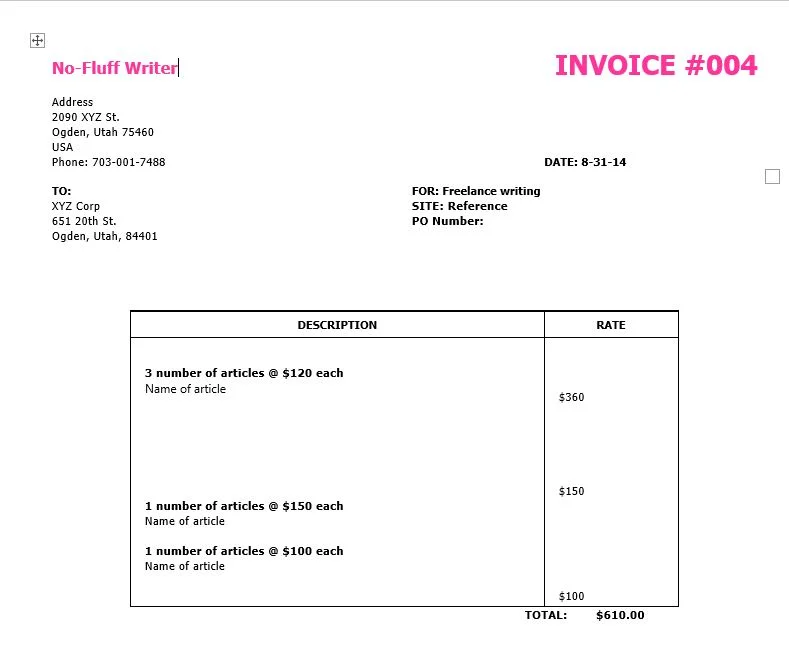
What needs to be on an invoice?
If you have never made your own invoice before, you’re forgiven for thinking that you simply write down the price for the work and the clients details. It's not that easy!
Here are all the elements that need to be added on to the invoice to make sure you get paid:
The clients order number if they have purchased a physical product
The name of the project or product which was purchased by the client
Details about the work completed, including hours worked, if needed
The total sum which needs to be paid to you by the client
Your payment terms- add a payment deadline
You bank details or Paypal info so that they can transfer you the money over
Your client's name and address
Your name and address
Invoice number and date
Registered business number and address
Contact information
How to create an invoice
Now that you know what should be on an invoice, how do you wrap it up into a professional looking package that screams ‘pay me’? You can use an automated invoicing system like chaserhq.com or PayPal’s invoicing system to make sending out invoices and receiving payments easier.
I like to use PayPal’s invoice system when my clients agree to pay me through PayPal, but for checks or direct deposits, I use an invoice template I created in Word. You can use my template. Here’s the download. (If you’d like more templates like this to make your job as a freelancer easier, be sure to check out my No-Fluff Freelance Writing Starter Pack.)
How to chase up your invoice
When it comes to chasing up the payment of your invoices you might feel a little uncomfortable. Don’t worry, it is totally normal for you to feel a little weird about demanding money from your client, but just bear in mind that you need the money to finance your business and your life. Plus, you did the damn work, so you deserve it!
If you have several freelance jobs going on at once, it would be helpful for you to create a calendar with reminders on when certain payments are due. (I use Google Calendar.) If the due date comes and the invoice has not been paid, you will need to contact your customer to find out what is going on.
It could be that they simply forgot, or they have another reason for not paying you. Send a gentle reminder and a copy of the invoice in an email.
If they ignore you, I've found that sometimes it helps to send a notice to a client's boss in the company to get things moving. For example, if you usually send your invoice to your editor, contact HR or the editor’s boss.
What to do when a client won’t pay
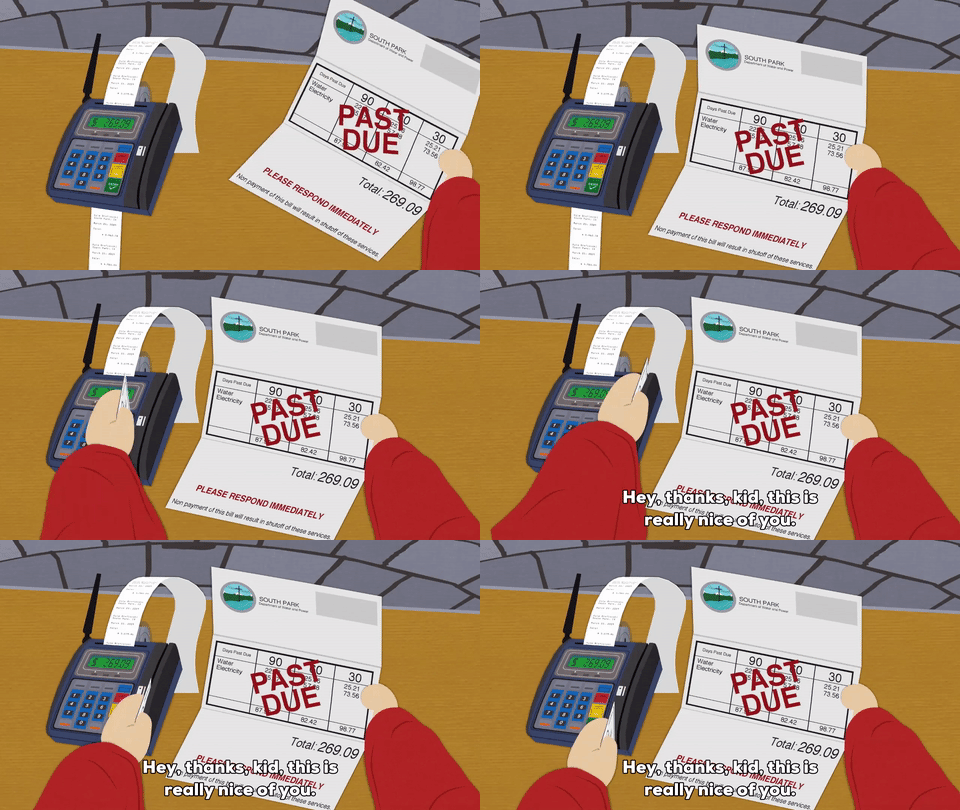
If they refuse to pay, there are several things you can do. Pick the option that feels right to you:
You can get the law involved since you sent them an invoice with a payment agreement on it. Send them a certified letter stating that you intend to take them to small claims court if they don't pay by a certain day. Typically, clients will get scared into action.
You can open a payment dispute with PayPal if you sent the invoice through their services. All you need for proof is a screenshot of the email you used to send the finished article, blog post or whatever. A screenshot of the finished work on your client’s website and a copy of your contract are also good things to send over to PayPal as proof of services rendered.
Use the non-payment as a tax write-off. Be sure to contact your tax professional for more information on this option.
For more advice, here’s my guide to dealing with clients.
How to Manage Your Finances as a Freelance Writer
Get your finances in order with these tips.
It’s often said that freelancers don’t like doing the boring stuff. While it may be true, unfortunately, for the freelance writer, putting off the task of money management is not an option if you want to keep bringing in the cash and stay on top of your financial game. Managing your finances can be daunting at the best of times. Still, don’t let these stresses keep you from achieving your freelancing goals! Here are some tips to help you get your finances in order, from creating a savings account to saving on your taxes.

Identify your regular expenses
To stay financially fit, you need to know what most of your money is being spent on every month and trim the fat.
The most common expenses are:
Rent or mortgage costs
Phone bill
Car note
Insurance
Utilities
Don’t forget to figure out your business expenses! These include:
Internet
Office supplies
Website hosting
Domain costs
Now that you know what you’re spending, trim the fat. The less you pay in bills each month, the less you will be stressed during lean times in your business. Compare the prices of utility companies, website hosting, insurance, and internet services to see if you can find a lower-cost provider. Then, consider refinancing your cars and mortgages to find a better interest rate to save even more in the long-term.
Once that’s done, look into additional expenses, such as eating out, going to the movies, or going out to get a coffee every morning. Are there things that could be limited or done at home to save money?
Set goals for your finances
Any successful business will need to set and meet financial goals. The same goes for freelance writers, too. To start out, figure out these three numbers:
How much money is needed to pay all the bills
How much money is needed to pay the bills and have a little extra to play with
How much money is needed to live the dream life
Once all of these numbers have been identified, you can plan on how much work you’ll need to get to achieve your financial goals.
How do you determine your rates? Here’s a good guide to help you figure it all out.
Save smart
When squirrels hunt for acorns and such during the fall, they will take the nuts and bury them away to come back to later when food runs out. This is what we should be doing with our finances. Having enough money stashed away to cover any incidentals, or as an ‘emergency fund’ is just smart, especially if you are a freelance writer.

Freelance writing is unpredictable. The ‘feast and famine’ nature of the freelancing world could mean several months of drought where you can’t quite meet your financial goal for that month. With an emergency fund, you won’t need to worry about how you’re going to pay your bills and keep food on the table.
For example, on average, you make around $3,000 per month, but in August you only made $2,500, you can loan yourself $500 from your savings to cover the cost of those extra expenses. You have to keep track of what you borrow, though, and then pay yourself back when you make any money over your financial goals.
Here’s some ways to maximize your freelance profits.
Work on improving your credit score

Many personal loan calculators and banks will ask for your monthly income as part of the application process and, for us, income can be unpredictable. I’ve found that when I’m getting car loans, a good credit score can mean the difference between getting a loan and going home without a car because the banks recognize the unsabilitity of freelancing as a negative. Can’t really blame them on that one, but it means that we need to keep our credit score strong.
These are some simple ways that you can work to improve your credit score over time:
Set up an auto payment for your credit cards, so you never miss a payment- missed, or late payments will lower your credit score.
The more available credit you have, the better. Don’t be afraid to ask your credit card companies to increase your limit. An increased limit that isn’t used will make your score increase.
Pay off debt. Paying off car loans, paying your student loans, paying your mortgage, and paying down on your credit cards all make your score go up.
Pay some regular payments through your credit card, such as your phone bill and pay them back within a few days of paying your bill to bring your available balance back up.
Limit spending because you see the money is there. Credit card money is not your money to be spent but is a backup option. Budgeting properly is essential, so you don’t use your credit card as additional spending money!
Over time, you will begin to see your credit score creeping up. Here are some more tips for bettering your credit from Experian.
Work out deductions
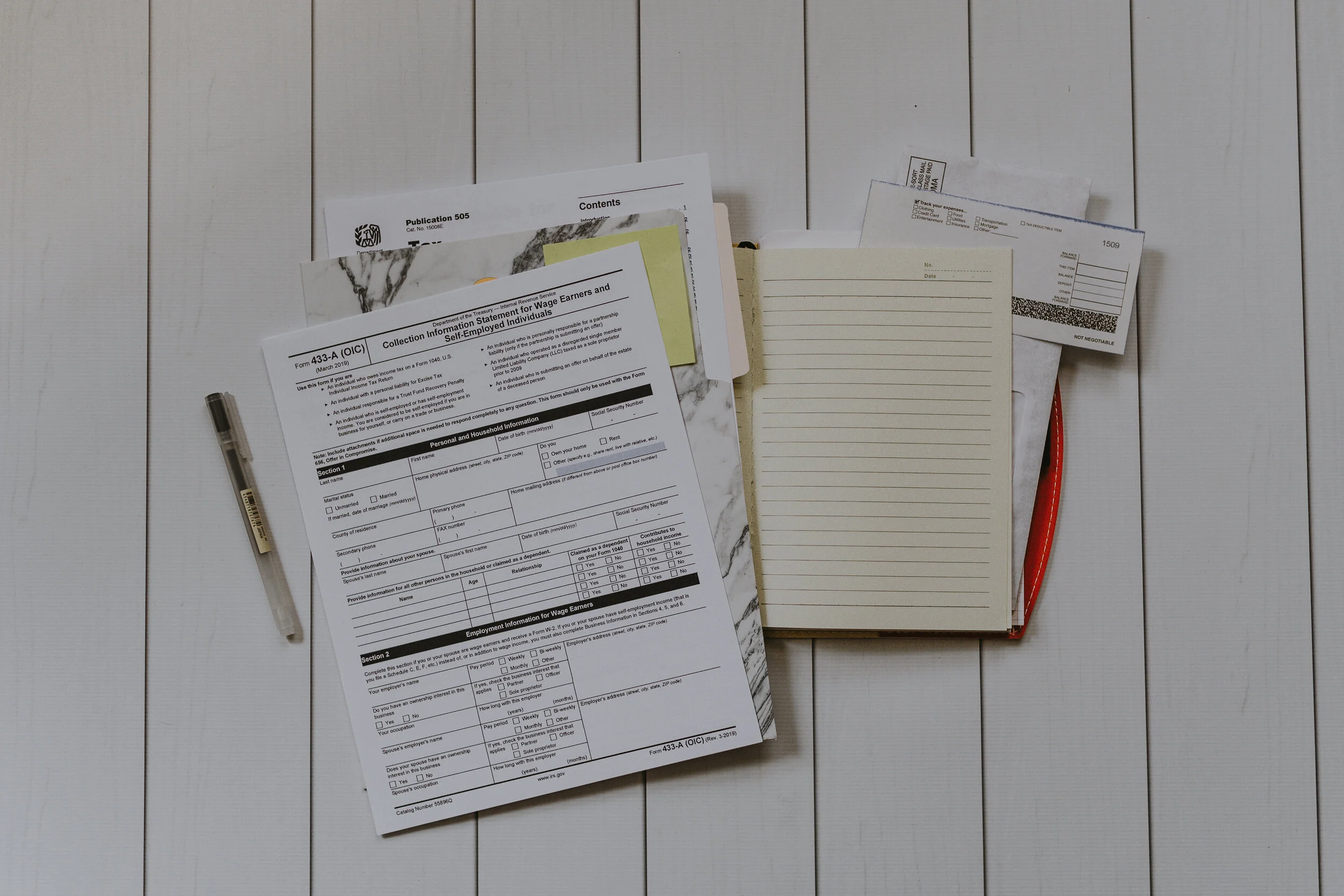
Working for yourself will often mean getting the lovely surprise of being hit with that extra tax rate due to your self-employment. Stay on top of your business expenses and use them as deductions to avoid paying more in taxes than your should.
First, use a business expense tracking app, like BizXpenseTracker, Smart Receipts, or Expensify, to store pictures of your receipts, and then work with an accountant who will help you to sift through to see which purchases could be claimed as a business expenses.
You’d be surprised at how much of your spending is for legitimate business reasons! Many freelancers don’t take advantage of the fact that their mileage, internet usage, and office equipment even though all count towards tax savings!
Here are some potential deductions:
Office supplies
Clothes you buy to wear at meetings with clients
Part of your mortgage to account for your home office
Desks, office chairs, filing cabinets, and other office furniture
External hard drives, mice, keyboards, routers, and other computer equipment
Computer or laptop
Internet service
Magazines, books, and courses you use to learn about freelance writing or to manage your business
Mileage on your car used to meet with clients or to go to seminars
Website and domain hosting costs
PayPal or other money service fees
Bank fees

Smart Ways To Maximize Your Freelancing Profits
How to make more without getting more clients.
There are many benefits to working as a freelancer. Not least, getting to be your own boss and knowing that all the hard work you put in is lining your pockets with profits rather than someone else's. However, ensuring your business is profitable is not always easy. The good news is that you can get some helpful suggestions on how to maximize profit below.

Keep your costs low
It's simple math, but keeping your outgoings as low as possible will ensure that your profits remain high. In particular, drop any unnecessary costs like:
Sharing an office when you can just as efficiently work from home
Buying tech you don’t really need like expensive cameras for photos or fancy printers
Traveling to do an interview when you can Skype or email
Buying reference guides when you can look the information up online
Getting a fancy desk when grandma’s old desk will do
Avoid being scammed
It's not a lot of fun to think about, but there is a heck of a lot of people out there that do not recognize the hard work and hustle that freelancers do to survive. Unfortunately, it is these people that see freelancers as an easy mark for fleecing and scams.
In fact, freelancers tend to be scammed in several ways, from clients refusing to pay once they have completed the work to clients using rough drafts and proofs rather than settling the full invoice.
One way to avoid this is to use freelancer websites that will broker payment for you. However, if you go it alone, be sure to ask for at least a 50% deposit before beginning a job. Then, have specific completion points where the remainder of the fees are paid. Also, share drafts as locked Google Docs or PDFs that can’t be copy and pasted onto a scammer’s website without payment.
Oh, and if a client won't agree to this, it's best to walk in the other direction, because you will usually end up spending precious and profitable time chasing them for payment!
Invest any additional profits
Many people think of their profits from freelance work as an end goal. However, this isn't necessarily the case. After all, you can make your money work even harder by investing it wisely.
For some people, this will mean investing in their business or even getting more training to do what they do better. While for others, investing in the stock market is the most profitable option.
Of course, before you even consider financial investment, it's wise to take some time to familiarize yourself with all the different types of products from Share CFDs to penny stocks. Only then, once you understand the market and the particular types of investment you will be using, should you start to use your hard-earned freelance profits.
Subcontract the extra work
If you think that being a freelancer is about doing everything yourself, you are in for a shock. After all, it's standard practice for those freelancing to subcontract out work or parts of projects that they either do not specialize in or do not have time to do.
The great thing about subcontracting extra work is that it can help rather than hinder your profits. The reason is that you can offer a much more comprehensive service to your client, thus making you much more likely to get more significant and more profitable contracts. Plus, hiring out saves you time and time equals profits.

Personal Finance Tips Every Business Owner Should Know
Financial management is one of the top skills every business owner should develop before starting their business. If you’re unsure how to do it, these personal finance tips for every business owner should help.
Guest post by Michael Deane
You may excel at managing your business and knowing where every dollar goes but you might not think much about your personal finances. Maybe it’s simply not something you enjoy doing, unlike running your business, which is your true passion.

We understand. In fact, many home business owners are in the same position. This is because the line between your business and your personal life is easily blurred when you work from home. But keeping your personal finances in good shape is a priority if you want to avoid trouble later. Financial management is one of the top skills every business owner should develop before starting their business.
If you’re unsure how to do it, these personal finance tips for every business owner should help.
Never Mix Personal Finance With Your Business Finance
We start with the most obvious tip precisely because business owners make this mistake all too often. Mixing personal and business finance almost never ends well.
Separating your personal and business finances requires setting up separate bank accounts, keeping business expenses separate from your own, giving yourself a fixed salary every month, etc.
This may sound difficult when you run a home-based business and you basically live and work in the same place. But even so, you should try to separate the two.
The benefits of keeping your finances separate go far beyond tax purposes, although this is reason enough to stick to this rule. You can take advantage of various tax deductions to reduce the tax bill for your business. Additionally, you can write off most of your spending as business expenses.
Now imagine the added stress of having to go through all the expenses, personal and business, trying to calculate your taxes? This would take significantly more time. Keeping your business expenses separate makes everything much easier. Also, if you happen to be audited, the authorities will audit both your records: personal and business. Naturally, you want to avoid this.
Give yourself a fixed salary every month, even if you are running an online business, and don’t use your business credit card for small personal purchases now and then. You’ll be thankful later.
Manage Your Spending
Unless your business is bringing in millions every year and finances are the least of your worries, you need to be careful with your spending. Even though you run a business and may want to keep certain appearances, you should really try to keep track of how much you spend and where your money goes.

Creating a personal budget helps. It enables you to live within your means and gives you structure. You know how much you make every month, you know how much your mortgage and bills are, and how much you can splurge on luxuries. Clear and simple, no philosophy about it.
You’re already managing a remote team so you’re saving money on rent and office supplies. Think about how else you may cut your spending. Perhaps quit that gym you paid for in advance if you don’t really use it. The idea is to see whether you’re spending more than you earn every month and how to remedy that. Putting everything on paper gives you perspective.
There are countless practical ways to manage your spending, such as budgeting apps. You can download one to help you track your expenses. Many of them are completely free so take your pick.
Create a Strategy for Your Debt
If you’re in debt, you should tackle that as soon as possible. Debt can prevent you from meeting your financial goals and can really hinder both your personal and business efforts. As long as you’re in debt, you can’t focus on your retirement plans, purchasing a bigger home for your family, etc.
Choosing a debt strategy is extremely helpful in this situation. For example, you should strive to make at least minimum payments towards your debts every month, regardless of how small a payment we’re talking about. As you pay off a debt, you can use that money and put it towards your next bigger debt. This method is called a debt snowball strategy.
This is another reason why budgeting is such a smart choice. Include your debt payments into your personal monthly budget to ensure that you make payments toward the debt every month.
Seek a Financial Professional

You may think that hiring financial professionals is reserved for big companies and not small home-based businesses. But if you’re really not eager to delve deeper into money management or you’re simply overwhelmed, you can skip our tips and talk to a professional. They’re likely to give you some guidance when it comes to managing your finances and you’ll be able to get confirmation that you’re doing everything right.
One purposeful talk with a financial advisor can make a huge difference in your life. It’s a small investment compared to the benefits you will get.
Start an Emergency Savings
We all might be one emergency savings away from a disaster. There have been too many examples of failed businesses and bankruptcies all because these business owners and individuals didn’t bother to set up an emergency fund. Or they believed they couldn’t afford it.
But given the importance of having emergency savings, you can’t afford to not have it.
You might be a huge medical bill away from bankruptcy. We need not look further for examples than what’s going on right now in the world. The COVID-19 pandemic has swept the world leaving countless small businesses with their doors shut and even managing to jeopardize some of the big names.
If your business happens to fail and you don’t have any savings, you’re in trouble. However, if you manage to save at least three months’ worth of expenses, you’ll have the time to think about your next move without pressure.
About the Author
Michael has been working in marketing for almost a decade and has worked with a huge range of clients, which has made him knowledgeable on many different subjects. He has recently rediscovered a passion for writing and hopes to make it a daily habit. You can read more of Michael's work at Qeedle.

How Much Can You Make as a Freelance Writer?
Indeed has released information they have collected on this very topic. Here’s a look at what they shared and some other insights.
I’m asked a lot about how much income someone can expect as a freelance writer. I always say it depends on how much time you put in, your skill and niche. I know that answer doesn't satisfy most people. Interestingly enough, Indeed has gathered some information on this very topic. Here’s a look at what they shared and some other insights.

How much does a Writer make in United States?
Here’s what Indeed had to say about writer pay in the US:
The average salary for a Writer is $23.38 per hour in United States. Salary estimates are based on 1,159 salaries submitted anonymously to Indeed by Writer employees, users, and collected from past and present job advertisements on Indeed in the past 36 months. The typical tenure for a Writer is less than 1 year.
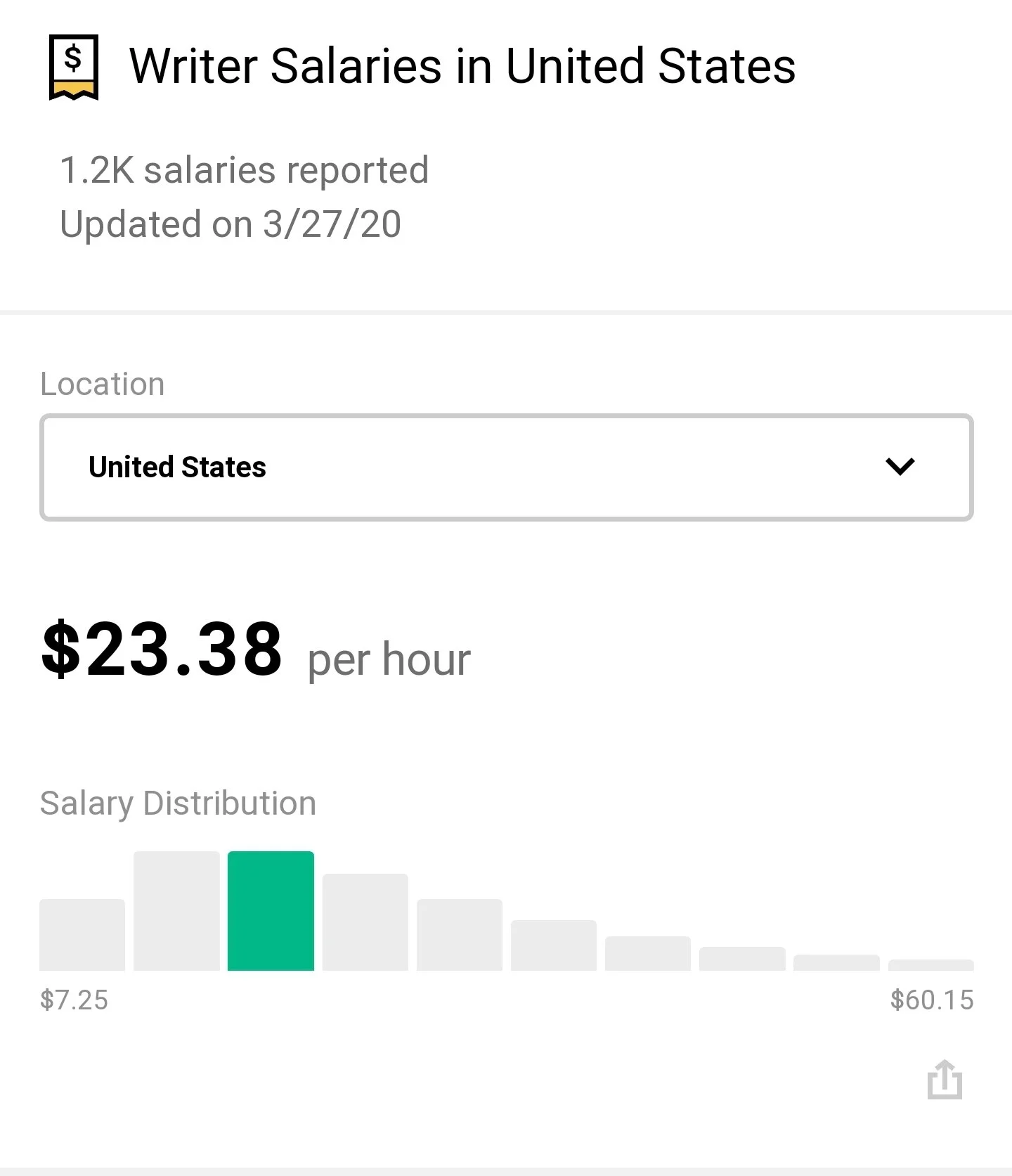
I think this is pretty accurate for beginners. Many writers (including myself) make much more. I tend to make $100 to $200 an hour. Also, what type of writing you do plays a role. For example, Indeed found that content writers (people who write articles or blogs) tend to make $16.97 per hour. Copywriters make around $57,152 per year on average and technical writers tend to make $33.24 per hour.
How to raise your rates
Overall, Indeed says that writers in the United States generally earn between $10.50 – $56.05 per hour based on 5,014 salaries shared by writers and employers in the United States. How much I earn is 311.84% above the United States's average. So how did I get here? Glad you asked. Here’s some tips:
Read articles, blogs, whitepapers, or whatever in your niche and take notes.
Write, write, write! You can’t improve without consistently working on your craft.
Apply for high-paying gigs and be confident!
My No-Fluff Freelance Writing Pack lays out all of the steps for you. Get it for just $29.97.

How Freelancers Can Protect Their Finances in 2020
Here’s how to make your finances as stable as possible so you can be less stressed.
Running a freelance business is a lot of flying-by-the-seat-of-your-pants feast or famine. This can play havoc with your finances, especially if you aren’t prepared to handle emergencies when they arise. Here’s how to make your finances as stable as possible so you can be less stressed.

Insurance
Nothing can be worse than having a disaster strike your family – a costly one – that you’re unable to pay for. It’s a tragedy that all too often befalls freelancers that have neglected to get the right insurance. I know, I know, you don’t want another bill to pay, but insuring all areas of your life can literally be a lifesaver.
Look into getting insurance for:
Vehicles
Pets
Health
Home/Rental
Funeral (life insurance)
Business
Coverage for if you get hurt and aren’t able to work for a short amount of time (like Aflac)
Be sure to check the small print before you sign up and beware of companies that raise rates and deductibles without warning. Sometimes the company with the lowest price isn’t the right one for you. Check out a company’s reviews and talk to your friends and family to find an insurance company you can trust.
Budgeting
The current economic climate has millions of freelancers struggling to put food on the table and living from paycheck to paycheck every month. To make your money go a little further, create a stringent and all-encompassing budget so that you can see exactly where you’re spending cash unnecessarily, and where you could save on weekly purchases in the long-term.
To get started, write down all of your monthly expenses, including coffee, gas for your car, utilities, clothes, food, etc, for a month. Yes, I’m telling you to grab a notebook or journal and write down every single purchase for a whole month. You’d be shocked at how much you purchase in a month, even if you are already very budget contentious.
Then write down your monthly income. See how they match up and cut or scale back on any unnecessary expenses like cable or eating out.
Put the extra into a savings account that collects interest so you have something to fall back on during slow times. Those with the healthiest financial situations can save cash every month – to the point that they’re able to invest some of their wealth in new assets, like stocks or property, too.
Pro tip: Save money on your budget by switching to more affordable utility services. There are many tools online that can help with this. Simply search something like “electricity plans in Houston” to find a tool that will find you the best deal.

Avoid debt collectors and repo men
We’ve all been there. A client fails to pay and an emergency has wiped out your savings. Suddenly you don’t have enough money to pay your bills. This scenario can leave you hopelessly lost – unsure what to do. Whether you’re struggling to pay your rent, your mortgage, or your loan repayments, you need to find ways to avoid debt collectors and the late fees that can rack up, making your debt spiral out of control. Here are some tips for when you fall behind.
If you fall behind on your car payment, call your lender and ask if you can take the missed payment and add it to the end of your loan. Many companies will be happy to do this and it gives you some breathing room.
A lot of companies like banks, utilities and credit card companies will also let you break a missed payment up into chunks. Then, they will add a little to future payments until you’re caught up. This is much easier than trying to pay a missed payment and your current payment at the same time.
When you’re falling behind on student loans, ask for a forbearance. The interest will still build up, but your payment requirements will be paused until you get back on your feet.
By the way, be sure to watch out for illegal debt collecting practices. A lawsuit related to unfair debt practices can take on the debt collectors if they try to process your case wrongly or illegally.
Prevent the famine
Most freelance writers will tell you, you’ll have times of feast and famine. One month you’ll have work flooding in, and then the next month you’ll be sitting around, panicking that your freelance career is over. One of the best ways to prevent those lean months is to pitch consistently. 12 at play keeps the bills at bay! I explain the 12 rule and how to pitch properly here.
Another thing you need to do is to have a backup plan. When it looks like you’re going to have a slow month, don’t just sit around. Contact old clients and see if they need anything written. Work on your blog so that you can have an alternate source of income. Come up with a side-hustle that’s related to what you already do (here are some good side-hustles for writers). Keep the momentum going and you’ll pull through until more clients come along.
Want to learn how to make a successful living as a freelance writer? Get the No-Fluff Freelance Writer Starter Pack. Only $29.97.

A Freelance Writer's Guide to Dealing with Digital Contracts
Here’s how to sign and send digital contracts for freelance writers.
Say you land a new freelance writing client and they send you a digital contract. How do you sign it and send it back? A few days ago, I got this email from a No-Fluffer with similar concerns:
Hi, Alina!
I'm one of your email subscribers and fans. I wanted to ask a question regarding freelance contracts:
How do these contracts work? I mean, how do you actually send them? Do I need a fax machine as a freelancer? When a client says I have to sign a contract, how exactly do I do that?
Full disclosure: I don't own a fax machine.
Thanks for reading!
Tara
Those are all great questions, and I bet many other new writers want to know the answers, too. So, I decided to whip up a post about how to deal with client contracts.
How You’ll Receive a Contract
There are a few ways that clients will send you a contract. There’s the DocuSign, PDF or a Word document.
The easiest way to deal with contracts is through DocuSign. Basically:
Your client sends you a DocuSign link in an email
You sign up for the site’s free account
The site will add the client’s contract to your account automatically
You sign everything digitally
Now, not all clients will be this easy. Typically, you’ll get your contract as a PDF or Word document. This makes things much harder because you would need to print it out, sign it, scan it and then email it back.

How to Skip the Steps
I hate the print, sign, scan process (mostly because my printer/scanner is always on the fritz), so I came up with a work-around.
If the contract is a PDF, there are two ways you can fill it out. Sometimes I take a screenshot of the page I need to sign, then use a photo editing app to add my signature and date. I keep a jpeg of my signature that I can place on any contract using the layering tool, then I use the text feature to add the date. To finish, I save the page as a jpeg and email the it to the client.
If you don’t want to fool around with photo editing software, you can also use an online site called PDFEscape. It makes the document editable (meaning your can add your signature, dates, etc.) and it’s free. Once you’re done, the site lets you download a copy that you can email to your client. I used PDFEscape for one of my last freelance client contracts.
If you get a Word document, the process is much easier. You can use the insert tool on any word processor app (like Google Docs) to add your saved signature jpeg and then just type in the date. Save the document as a PDF and you’re good to go.

How to Create a Signature Jpeg
Okay, may be a little lost when I say I have a signature jpeg. It’s literally just a photo of my signature. You can make a quick one of your own by writing your signature on a piece of white paper and then taking a photo of it with your phone. Crop your signature image very closely so there isn’t a lot of white space around the letters so it is easier to place on contract signature lines. Finish off by saving the image as a jpeg.
You can also open a new, white canvas using a drawing or photo editing app and write your signature using your finger or stylus on the touchscreen. Then, just crop and save it.
Email the image to yourself so you can download it onto your computer or laptop for whenever you need it.
What About Faxing?
Thankfully, most people don’t ask you to fax anymore. If they do, you can always go to Office Depot or FedEx and they will fax your contract for a small fee.