Scaling Start-Ups Without Crashing: Why Growth Demands More Than Speed
Start-ups are born to move fast. Launch, build, pivot, raise, repeat. But speed only gets you so far before the mechanics begin to grind. Scaling is the part that looks like growth but often feels like chaos dressed in opportunity. Founders quickly discover that what worked for ten people breaks at twenty. What thrilled early adopters might fail to move mainstream users. It is not a question of whether problems will surface but whether the company can outpace them with structure before the pressure multiplies.

Hiring is Not the Solution if the System is the Problem
Most founders think growth means hiring. And they are right, to a point. But adding headcount without a clear process is like pouring water into a cracked bucket. You end up with more chaos. Scaling exposes how fragile early decisions can be. Hiring fast can slow you down. Too many people, poorly onboarded, chasing unclear metrics is how funded start-ups stall.
Culture strains. Roles blur. Accountability disappears. The fix is not another round of interviews. It is often the harder work of documenting, prioritizing, and making early decisions scalable before new hires walk through the door.
Product-Market Fit Doesn’t Mean Market Readiness
A product that works for one audience does not automatically work for five. As companies scale, they often assume that more users mean less friction. The opposite is usually true. Expansion requires reevaluating assumptions that were once safe. A pricing model that worked with early customers may collapse under enterprise pressure. A feature that seemed brilliant may confuse larger segments. Suddenly, the product needs to do more for people who are less forgiving.
Operational Debt Is Real
Start-ups often defer decisions in favor of speed. They patch systems instead of building them. They ignore documentation. They run on favors, duct tape, and adrenaline. That works for a while. Then it doesn’t. Operational debt accumulates, and when scaling begins, it demands to be paid in full. Systems fail under volume. Customer service breaks. Sales teams lose track of leads. The business creaks under its own weight because the foundation was never built to last.
The Funding Paradox
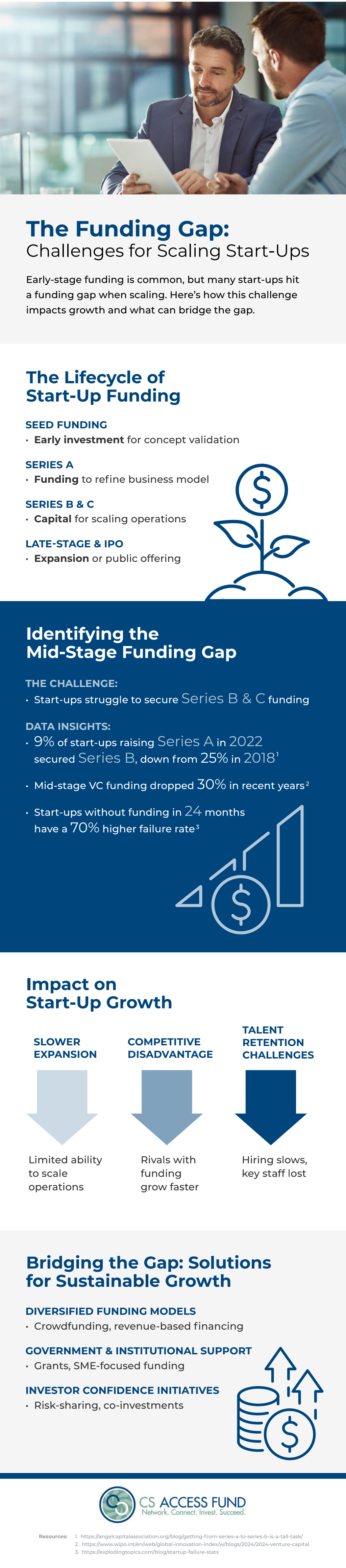
Raising a large round can feel like victory. It is often the start of a new pressure cooker. Investors want scale, fast. That usually means headcount, markets, and marketing. The paradox is that with more money comes less room for failure. Decisions become less flexible. Vision gets pulled toward revenue instead of innovation. Founders must now balance growth with sanity, and ambition with realism. Clean tech investing, for example, has seen a wave of start-ups struggle not from lack of innovation, but from misjudging how quickly capital demands returns.
Scaling is never just a function of growth. It is a test of structure, leadership, and judgment under strain. The companies that make it through are the ones that do less guessing and more building. Not faster, but smarter. Not louder, but clearer. Growth that lasts is rarely the fastest. It is the most deliberate. For more information, check out the infographic below.