

What You Need to Know About Reviews as a Freelance Writer
If you’re a woman writer that wants to build a successful career writing online articles, blogs, and whitepapers, then one of the most important things you should consider are reviews. They can be positive or negative, but you need to know how both can help your writing career and how to get online writing reviews.
If you’re a woman writer that wants to build a successful career writing online articles, blogs, and whitepapers, then one of the most important things you should consider are reviews. They can be positive or negative, but you need to know how both can help your writing career and how to get online writing them in the first place.

Social Media Can Be a Help
Social media is everywhere these days. From teens all the way up to the POTUS, everybody's on Facebook, Twitter, and so much more. As a freelance writer, you can get your name out there and start building your own particular writing brand by engaging all of the benefits of social media (and ending up with some great reviews).
According to Make a Living Writing, “Once you’ve gotten acquainted with some influential people, start sending them stuff and asking them to share it with their audience.” Start with one and then continue on to find your place on all of the current social media platforms for the most in positive exposure.
Here are a few basic social media pointers to get you started:
Learn all of the proper social media etiquette
Make some new friends
Be a good listener
Be helpful to others
Search for like minds on all platforms
Bring your A-game
Don’t waste a lot of time on social media (half an hour a day and no more)
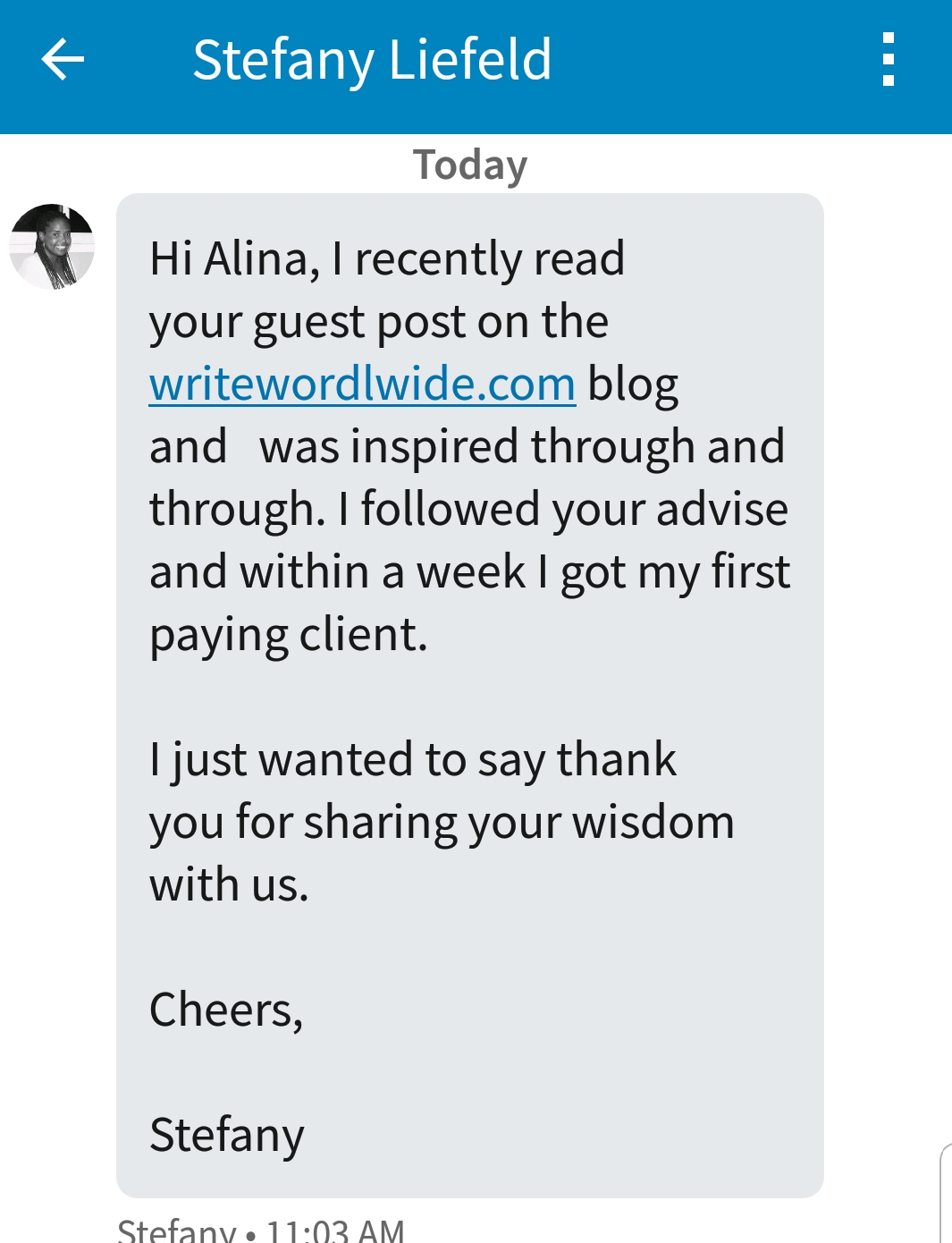
I get the bulk of my reviews on social media. I always screenshot them so I can add them to testimonial pages on my site or on my product pages.
Make Sure to Ask for Positive Reviews
According to Podium, “It's a fact that 91% of people read online reviews, and 84% of people trust reviews as much as personal recommendations, so don't underestimate the impact of a few 5-star reviews.”
Here's some advice on how to gain online reviews. The first and most important piece of advice is simply "Ask for positive reviews." Don't be shy and don't think that you're bothering your oh-so-busy clients. A positive review will only take a few minutes for them and, although many clients will post a positive review without you even having to ask, some need to receive a request from you to follow through.

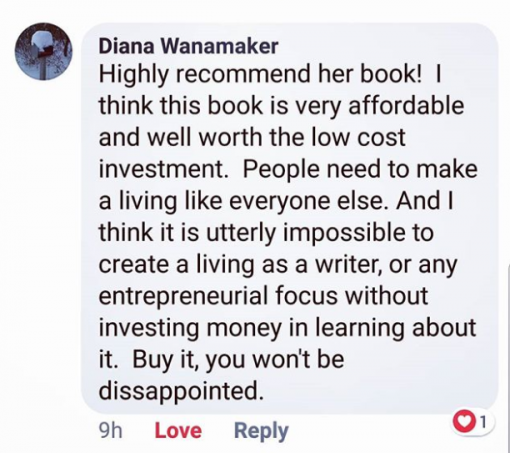
A couple of reviews for my book The Fluff-Free Freelance Writing Master Course Workbook
Follow Instructions
Following directions to the letter is the first thing to remember. When a client wants something written in a specific way, give it to them. If you don't understand those instructions perfectly, don't be afraid to ask. It's better to get the answers you need up-front than it is to have to rewrite the piece or get a bad review.
The better you understand the task at hand, the better it will turn out. Knowing how to follow a client's instructions can be improved by learning what goes into a good set of instructions for a writing job. You do your best and they will do their best to help you when you need a review. ;)
Handling Negative Reviews
You probably already know that not every review will be a positive one. According to Website Planet, “Well, one bad review doesn’t just obscure hundreds of positive reviews, but it can hinder your chances of future collaborations. Testimonials and social proof build trust in the freelance market, which is key to success as a freelancer or the hiring party.”
Sometimes you may have asked all the right questions about the instructions, done major research, and then given it your all, but still get a bad review. Sound familiar? Just like in a tennis match, when you miss the ball, forget about it and focus on the next ball.
On the other hand, if your client actually offered some useful comments, take them into consideration and save them for later. There's always bound to be a writing job in the future where you could use those comments to make your writing better. Make a file on your computer and organize those comments in it for later.
My worst reviews? “Congratulations on writing a completely useless article.” “This article could be considered criminal negligence.” Oof!
Averaging Out Reviews
Remember, although five-star reviews are the goal, others can also add to your overall writing level. Many writing sites and places like Amazon average out the number of stars to come up with your niche in their writer lineup. You can go from beginner to expert faster the more reviews you have under your belt.
Something else to remember about writing sites is that the clients often have reviews, too. A client who posts a job that looks pretty good but has a 25 percent acceptance rate is probably not a good bet.
Don't Ever Get Discouraged

Just as there's no crying in baseball, there's no getting discouraged in writing. According to Writer’s Digest, “Writing is a process and as writers we are constantly evolving. We don’t get good overnight. There are a lot of road bumps along the way and many times (perhaps even once a day?) you may want to throw the towel in.”
One week, you may encounter a bunch of clients who don't seem to be happy with anything no matter how good your writing may be. And, some weeks nobody seems to be paying much and you have to write a ton of small jobs to get paid an acceptable amount. Don't get discouraged, however, because right around the corner is a more flexible client and some that even pay a higher rate. The key is to move on and continue building up those positive reviews!
Now that you know a little something about reviews as a freelancer, you're armed with additional knowledge to help you to succeed with your writing. Remember, you're one of the lucky few who can make a living at home in your PJs. No gridlock, no horrible bosses, no catty co-workers, just an excellent way to make a living while expressing yourself. Let reviews and social media help you to climb the ladder toward higher-paying jobs as a reviewer who is in constant demand from clients.
What is the best — or the worst — review you’ve ever gotten?

Use this Website Checklist to Make Sure You're Ready for the Masses
Confused about how to start — and finish — your website? Humans form impressions within seconds, and the look of a site can impact the way we feel about a brand long before we give the owner a chance. Make sure your site looks the professional, then go one step further and make it useful and easy to find.
Confused about how to start — and finish — your website? Humans form impressions within seconds, and the look of a site can impact the way we feel about a brand long before we give the owner a chance. Make sure your site looks the professional, then go one step further and make it useful and easy to find.

Here is a checklist that you should use to optimize your site:
Use a simple color scheme and use it throughout. (You'll notice my color scheme is grey and pink/purple.)
Make sure you have a Contact Page, About Me page, Policies page and a Clips and Clients page.
When was the last time you put yourself in a customer’s shoes? If it’s been a long time, take a tour of your site, make notes and consider how you could improve the user experience.
Are there broken links? Fix them. A good plugin can do the work for you. Broken Link Checker is my favorite.
Have you got pages that are out of date? Update them and give them a new publishing date to put them back on the search engine's radar.
Are there images or video clips that aren’t loading properly? Use a photo compression plugin like Smush.
Is the site slow? Use a speed booster plugin. I use Speed Booster Pack.
Use the same font family throughout your site. Avoid comic sans.
Stay on topic. Pick what you'll write about and keep at it. Use Don’t know your niche? Here’s a guide to help figure it out.
Avoid long paragraphs of text and use different types of content, such as images, videos and virtual tours.
Focus on creating engaging content that is informative and useful.
It’s useful to include an FAQ section and a live chat feature to enable you to respond to queries.
Use social media, email marketing and search engine optimization to market your web address and encourage more people to visit your site and take a look around.
It’s all very well having a website, but if nobody knows where to find you, you’re going to struggle to make a splash. Check out this SEO guide for writers to make sure you're on point.
Include your website address on any merchandise you sell or hand out at events or trade fairs. Many people prefer to shop online now, so providing this information is key.
Make sure your blog posts show up on the homepage. Everytime you add a new post, the site will look fresh to search engines.
Use call to action buttons (CTAs).
Make all of your main subheadings H2.
Use pictures, videos and gifs to add visual interest to every post and page.
Feel free to let your personality shine. What makes you special is what will make your business stand out from the rest.
If your site isn’t slick, you have concerns about online security, or it doesn’t make life easy for the client, consider seeking advice from experts like those at Total Tech Team to make improvements.

How to Fight Imposter Syndrome
One of the biggest challenges for writers isn't finding clients. It isn't perfecting a sentence. It isn't even getting paid what you're owed. The greatest challenge that holds you back in almost every area of your freelance writing business is imposter syndrome.
One of the biggest challenges for writers isn't finding clients. It isn't perfecting a sentence. It isn't even getting paid what you're owed. The greatest challenge that holds you back in almost every area of your freelance writing business is imposter syndrome.

You know what I'm talking about.
Some days you just feel like you're pretending to be a professional writer. It doesn't matter how much success you've had or how hard you work, you still feel like a fraud. Imposter syndrome is common for creative types.
It’s even a problem for the magnificent AOC:

I get struck with it at least once a week, even though I've been running my business for 20 years. My stomach starts to ache. My head feels fuzzy. A tiny voice says, "Hey, they're going to find out you're just a big faker. You're going to lose everything."
There's no justification to feel this way, I know, deep down.
On days like this I know I need to push through, because clients aren't going to wait for me to feel good about myself, right?
Here's how I do it.
Stand back
First, you need to step away from the blank Word document for a few minutes. Walk around in your yard. Go for a jog. Pull some weeds. Scrub your bathtub. Dance around to a favorite jam. Anything that will get your blood pumping for a few minutes is a good idea. Happy chemicals will start to flow and your anxiety will lessen.
Get Hyped on Yourself
This is kind-of embarrassing, but I keep a three-ring binder full of good reviews, awards and emails from happy clients. After 20 years, it's pretty huge. When I feel really off, I just thumb through to remind myself that people do enjoy my writing and I'm not a fraud.

Don't have any accolades yet? Take out your trusty notebook and write down what you're good at and why. Also, write down any accomplishments you've made in your career. Even if it's just a published article or a client contract, that's a big deal!
Get Fancy
Another way to boost your confidence is to get out of your pajamas and dress up for work, even if you're just heading to the recliner with your laptop. Dressing up can make you feel like a professional. Be sure to take some selfies!
Want more tips for becoming a successful freelance writer? Grab a copy of my book:
The Fluff-Free Freelance Writing Master Course Workbook

How Do You Create High-Quality Content?
I've been around the block (over and over again) for almost two decades, so I know what content ranks and what content typically gets drowned out in search results. I also know what readers love. Let me clear up some misconceptions and clue you into what's up with quality content.
If you've read anything about content marketing lately, you've probably seen it: article after article proclaiming that the new SEO tactic is filling your site with content that your readers will love. They are 100% right, but what is high-quality content? You probably think you've been posting quality content all along. It may not be stellar, but you think that it does the job, right?

content help for your website
The problem is you need to be more than adequate to secure a spot in search engine results. Even more important than SEO, you want people to share your articles and blog posts. You don't want to leave your site's future up to the whims of the search engine gods. So social media shares should be a big part of your traffic strategy. It takes a fantastic piece to get shares, though.
I've been around the block (over and over again) for almost two decades, so I know what content ranks and what content typically gets drowned out in search results. I also know what readers love. Let me clear up some misconceptions and clue you into what's up with quality content.

long form content
Long Content = Good Content, Most of the Time
There've been quite a few studies that discovered Google loves long form content. Long-form is any article or blog post that ranges from 700 words to 2000 words. Long articles are beloved by Google and the population at large because they give in-depth, nitty-gritty, wonderful details about a subject that people want. They aren't just a generic overview that most short article offer.
For example, I do a lot of writing for Live Science. A typical reference article for the site is broken down into sections that will cover every angle of the subject. Take this article on Earth Day that I wrote. Before I wrote it, I brainstormed all of the things a person might ask about Earth Day, such as what is Earth Day, who started it, how successful it's been, who celebrates it now, etc. Then, I answered those questions in my article. It has been one of my most successful articles with more than 7,000 shares in just a little over 24 hours.
[bctt tweet="Long-form = good #content...Most of the time! Here's when it's not:"]
While I agree that long content does get a lot of search engine love and it gives readers what they want most of the time, you shouldn't get stuck on just adding long-form content to your site.
Why? Here are just a few reasons:
People love variety. Your regular readers are going to get bored if you continually serve up articles that take 10 to 15 minutes to read.
People love infographics! Sometimes people want an informative infographic they can skim, and search engines tend to rank infographics, too.
There are times when people are just looking for a simple answer to their question. Don't go too short, though. Google sees pages with less than 200 words as "thin content."
Layer Your Content to Create Quality

what is in quality content
Rand over at Moz says that to rise to the top, you need content that's 10x better than everyone else's. I wouldn't go that far, but you do need to offer up content that no one else is serving.
Think about your favorite restaurant. You go there because it offers something its competitors don't, like better atmosphere, juicer burgers, tastier pasta or a finer selection of wine. It wouldn't be your favorite if it didn't stand out. Website content is the same. People, and search engines, love content that feeds their needs in a way that others can't.
To create content that stands out, you need a process that I call "content layering."
You start with a layer of beefy content. Pepper the text with helpful links, facts and data. Salt it with Click to Tweet quotes to make sharing easy.
Chop up some long text and turn it into a bulleted or numbered list for easy reading.
Slather on a layer of images rich with colors and interesting subject matter that's relevant to the text.
Finally, slap on a layer of audio or video content that will make visitors linger and savor your message.
The end result is a site post sandwich that satisfies and excites your visitors and search engine bots.
Mmm, mmm, good!
Photo credit: quality via photopin(license), Almost 3.5 feet_4120 via photopin(license), and Quality always via photopin(license)

5 Tips For A Perfect Blog Headline — One That Gets Clicks
How do you make yours more effective? What goes into writing winning blog headlines? To help answer these questions, here’s a look at five tips for creating blog headlines that work.
Whether you’re talking about building authority on your blog or crafting compelling posts for an SEO company client, you can make your it more powerful by creating strong headlines. What makes a headline strong? The perfect blog headline will communicate quickly, capture a visitor’s interest and make the post easier to find by search engines. It acts as an accurate and interesting teaser for the rest of the post.

How do you make yours more effective? What goes into writing winning blog headlines? To help answer these questions, here’s a look at five tips for creating blog headlines that work:
Be specific. The more laser-focused your headline, the better it communicates to readers what it will cover. Take this post, for example. If the headline had been, simply, “Blog Headlines,” you would have had a general idea of the subject matter — but you wouldn’t know if the post was about the history of blog headlines, examples of good headlines, examples of bad headlines, tips on writing headlines, or none or all of the above. A specific headline gives readers specific expectations — so it attracts the people who are interested in what it truly provides.
Clarify and categorize. If your blog post fits into a specific type of content, such as a new report, an interview, an infographic or a slideshow, add that clarification in brackets after your post title. If you’re writing about a new study on infant formula, for example, the headline might be: “How Infant Formula Boosts Brain Development [New Study].” Why is this worth trying? According to research from HubSpot, headlines with bracketed clarifications perform 38 percent better than those without them.
Keep it short. When it comes to blog headlines, more isn’t always better. Stuffing a headline with extraneous words only makes it easier to lose readers. What’s the sweet spot? It depends. According to research from CoSchedule, the ideal length is 11 words — but it’s not a hard-and-fast rule. Other research, from Content Marketing Institute, says to stick to no more than 10 words. In different industries or for different audiences, shorter or longer headlines may perform best. So, whether you’re writing for your site or a client’s, test different headline lengths with different posts, and observe click-through rates.
Include relevant keywords. To optimize a blog post for search engines, you want to include relevant keywords in both the headline and body copy. What keywords are best? Think about words or phrases your audience is likely to be searching for, as these will be the keywords that bring them to your post. For best results, put keywords at the beginning of your headline to catch the attention of search engines.
Use numbers. The human brain likes numbers, which organize information into a logical order. When you want a headline to grab the attention of readers who are quickly scanning and deciding where or where not to click, include a number. Note, also, according to FastCo Design, round numbers typically work best, as they’re how humans naturally group amounts.
Blogs are a mainstay for freelance writers — so when you’re crafting copy for your next post, keep the five headline tips above in mind! By writing headlines that draw attention and get more clicks, you can generate more traffic to your content and improve your writing results.

Author bio: Shanna Mallon is a contributing writer for Straight North, one of Chicago’s top Internet marketing agencies. She’s also been a freelance writer since 2007.

No-Fluff Guide to Building Your Freelance Business Brand
Your brand is what makes you stand out from the crowd, writers. So, as you build your freelance writing business, you need to focus on what makes you you and how you’re going to convey that to the masses. This No-Fluff guide will walk you through the process.
Your brand is what makes you stand out from the crowd, writers. So, as you build your freelance writing business, you need to focus on what makes you you and how you’re going to convey that to the masses. This No-Fluff guide will walk you through the process.
What is Branding?
Branding is a huge buzzword right now, but it is so much more than a trend. No matter what you call this type of marketing, companies big and small depend on it to compete in competitive markets.
Branding definition: Making your brand stand out from competitors with marketing that is consistent and recognizable as belonging to only your company.
Keeping a consistent message, tone and feel to your marketing makes people remember you and that is a HUGE part of selling. Content on your website plays a big part in this image.

Businesses Are Going About Their Branding Process All Wrong
Life isn't a contest, though. Often, when freelancers start to visualize their brand they think about all of the other competitors out on the market. They wonder how they can be the best.
Each night I try to write an inspirational quote or a tidbit of knowledge that I've gleaned along the way on the bathroom mirror for my girls to see before they head off to school the next morning. One night, I wrote:
There is always going to be someone smarter, prettier, faster, etc. Be the best YOU can be. Life isn't a contest.
I think too many people get caught up in what everybody else is doing and they don't focus enough on what makes their brand special. Notice I said "special" and not "better."
Proving your better than someone else is like trying to prove you love your spouse to someone who doesn't know you. You can show them all the proof in the world, but they still won't be 100% sure. That's because all humans are just a little suspicious of each other. In the back of our minds we're wondering if that guy really loves his wife or if he's cheating with Ms. Robertson next door. It's the same with businesses. They say they're the best, but are they just full of hot air?
When people look at your branding, don't make them wonder if you're just full of hot air. Give them a positive feeling and you are off to a great start. Get them to laugh, or feel nostalgic or feel at home. That's what branding is all about. Conveying a feeling right off the bat and threading that feeling through everything that you present to your customer.
Assignment: What’s Your Brand?
I'm going to ask you some questions. Answer them as honestly as possible. Let's get started.
Will you be the face of your freelance business? For example, I am the face of my company. In fact, my company name is my own personal name. My company is 100% my voice and no one else's. Another example would be Dave Thomas of Wendy's. The restaurant was named after his daughter and her face was the logo, but he was the one that stared in many of the early commercials. His face, voice and sense of humor were what cemented Wendy's brand.
If you don't want your freelance business to center around you, no problem. We can work with that! You just need to know how you are going to present your business to the world. Will you have a logo instead of a professional photo to represent your business? Will your business be your name or will you come up with something else to call it? What colors will represent your business? Remember, branding needs consistency.
What do you think is special about you? For example, do you have a passion for the environment and want to be seen as a “green” freelancer? Could your former job give you an interesting insight into your niche that you could capitalize on?
(This is an excerpt from my book: The Fluff-Free Freelance Writing Master Course Workbook)

Do potential clients hate your brand?
Ring, Ring, No One's Answering: Poor Content = Sucky Conversion Rates
If your bounce rates are high and your conversion rate stinks, one thing is pretty clear: your website visitors hate you and your brand is sucking. Don't take it personally. It happens to the best of us. You just need to fix the problem and build your branding platform.
Your visitors hate you primarily because your content sucks. The number one key to good content is answering your visitor's needs, which is a huge part of getting your brand right.
Many websites draw in visitors from social media sites with sensational headlines, but then fail to deliver in the content. This is called click-baiting and it results in loss of trust from your visitors. They bounce before clicking on anything else on your site. This, in turn, impacts your conversion rates.
You don't need to have a sensationalist headline to let your readers down, though. Any content that doesn't answer the specific question that the headline promises is poor content.
Why Great Content is Essential for Branding

branding image
Content Branding Makes People Like You
Remember how your visitors probably hate you? As I mentioned before, content not only draws in traffic from search engines, it also makes visitors get a feel for your brand. Crap content makes them feel crappy about you.
Let's take a look at an example:
Web copy #1: At XYZ, we focus on producing quality soda that tastes good and is good for you.
Web copy #2: Hey, we're XYZ and we love to tingle your taste buds with soda that provides antioxidants and minerals your hard working body needs.
The copy in #1 is yawn worthy. The copy in #2 lets visitors see into the company's personality. The company seems fun, which is great if you are targeting a younger demographic.
Which company would you like to spend your money with? One that's bland or one with a personality and a point of view?
Getting Content Right
Many businesses start their content production by studying keywords and then building content around the keywords.
Wrong!

Fixing online customer service
This is a horrible practice because they are creating content for search engines, not people. Sure, most people will get to the content using a search engine, but it's the human that clicks on ads, call to action buttons or the next article, not the search engine.
So, you want to appeal to search engines, but you need content visitors will love. To get a home run, follow these steps:
Do your keyword searches, but look for keyword phrases with more than 20,000 monthly searches and low competition. These keyword phrases are the questions that people are asking and no one is answering. That's where you swoop in and save the day!
Use the keyword phrase in the title of your post and pepper it once in the article and once in an H2 headline. Remember, Google and other search engines are smart. No need to keyword stuff.
Write a fantastic article that not only answers the question at face value, but also goes above and beyond to give the reader some extra morsels of information about the subject. This makes for happy readers. Also, be sure to use your brand's voice throughout the piece of content.
Add some great visuals that mimic your brand and you're done.
Creating fantastic content that satisfies your reader is tricky. When you do it right, though, you will see your bounce rates and conversion rates get much better. Bottom line, happy readers equal content leaders. Now that you have that covered, it's time to consider content and branding.
Combine these branding strategies with great content and your brand identity will start to bloom. Best of all, people with GET you. That translates to customer loyalty and sells.

giving your brand personality
Keep the Personality Train Moving
Don't just stop the personality in the copy, though. Blog posts and articles should also contain the same personality your copy employees. This is where a lot of businesses fall short. They think that content is solely for driving conversions or drawing traffic and they forget about the people reading the words. People want to be entertained and they want to get to know your brand. Fantastic content can do all of the above. Give them what they want!
Get the Sizzle: 5 Steps for Building Your Brand Identity with Your Website
Building your brand identity starts with your website. Everything you add to your site will affect how visitors will feel about your company. Revamping your site to create a more cohesive brand is the best way to boost sales and make consumers remember you. Once you have this down pat, then you can move on to creating content that your audience loves and that drives conversions.
1. Branding with Colors
Step one is the most visual way to brand your site. Using one or two colors throughout your site, marketing items and packaging creates is more than just making things matchy-matchy. It gives consumers a visual cue as to who you are. It has even been proven that colors can influence purchases. So, choose one or two colors that will represent your business, ideally colors already used in your logo.

branding
2. Branding with Font
Like colors, you need to pick two to three fonts, tops, that will be used on your site. Mimic the font used on your packaging or in your logo for headers or H1 titles. Be sure that your page text is easily readable, though.
3. Branding with Your Logo
Now, your logo isn't just for the header of your website. Use it throughout. Watermark images with it. Use it on your about page. Use it in the footer. Be sure that you use it throughout your site.
4. Branding with Images
Have you ever been to a website that uses images that all seem to go together? That theme is their image brand. If you visit my site often, you'll probably notice that I use a lot of GIFs and fun images. I like to keep things light while talking about serious subjects. That's my brand.
You can do it, too. Come up with a theme for your images and be consistent. For example, product images could all have the same background or images could all work together in a common theme such as nature, modernism, zen, etc.
Here are some free places to find images.
5. Branding with Content Tone
Once you have the visuals in place, concentrate on the tone of your text. Every article, blog post, content description, etc, should have the same tone. Don't bounce from fun and peppy to straight-laced and staunch. Stay the same. Let consumers know who you are. Build a personality through your text.

Attention Getting Tips for Your Brand from 3 Experts
My goal is to get eyes on my client's brand. If you write marketing emails or website copy for clients, then you do, too. I got to wondering how other writer/marketers do the same. So, I sent out a call to people in the industry for their best tips.
Here are some great lessons from three experts.
My goal is to get eyes on my client's brand. If you write marketing emails or website copy for clients, then you do, too. I got to wondering how other writer/marketers do the same. So, I sent out a call to people in the industry for their best tips.
Here are some great lessons from three experts.

Get Shocking
This is the very first response I got:
Subject: I STOLE YOUR DOG
Alina,
I didn't really steal your dog. In fact I don't even know if you have a dog. But I did see your post on Profnet about getting the attention of people for your blog, website or marketing purposes and I felt that this use of a subject line (which is what I do for all reporters and publications, though usually not with stolen dogs) is a perfect example of my approach to getting your attention and that of our target audiences.

There are a bunch of ways to get eyes on your business' brand.
Shock them. Then tell them you're pitch. We have garnered a large number of articles in publications using this method. My favorite subject line is - PRINTER INK IS MADE FROM UNICORN HORNS or some variant of this.
[bctt tweet="My favorite subject line is - PRINTER INK IS MADE FROM UNICORN HORNS or some variant of this" via="no"]
Let me know if you would like to learn more about my guerrilla marketing tactics and I will expound.
Have a nice day. And cuddle your dog for me if you have one.
- Al
Al Ruggie, Public Relations Director
Go Local
Elizabeth had a different approach:
I’ve published ebooks for more than 30 authors and I have extensive knowledge and experience in building and selling a business from the ground up. As an author, the best strategy I've used to build a following was the simple idea of starting local. I created my Facebook profile initially unsure if anyone from my home town would even remember me, as it had been years since my last visit. It only took a few weeks before the word got out of my new memoir, Long Blue Line, which is based on my teen/young adult experience growing up in South Lake Tahoe, CA.
I began getting several friend requests and I quickly built a solid fan-base to begin my career as an author. Now that I've reflected back and thought about why it was so easy to build my following, I've come up with a couple of theories:
People need to have the ability to relate. Whether it be relating to a book, article, product or service, if the person feels a sense of belonging they're much more likely to take an active interest.
It only takes a few good followers to help get the ball rolling. I always make sure to respond to every message that I get from my fans. This aids in the word of mouth strategy. If you can get just a few people to actually talk about your product, you're going to be at an immediate advantage.
-Elizabeth McNew, (author of Long Blue Line and Digital Publishing,National E-Book Association Founder), featured on BellaOnline, Tekk3.com, and Flippa.com to name a few.
Build Relationships

You don't have to give them a hug, but relationships build long-term results.
After numerous years working (and teaching) integrated marketing communications (IMC), Bonnie Harris, founder of Wax Marketing, Inc., says one of her top tips for generating long-term interest is:
"Find out who the influencers are within your genre and build authentic relationships with them. Follow them on Twitter and other networks. Curate their articles, retweet their tweets, comment on their blog posts and interact with them whenever an opportunity arises. Do this in a thoughtful manner with smart commentary. The attention you generate from these interactions can lead to substantial promotion of your own blog/site or company, and links back to your content. This tactic works better than any 'get followers fast' type scheme and it lasts."
Do you have any tips? Do share! Leave a comment below!

Your Cat Might Just Make You More Entrepreneurial
Is your cat making you a boss? Maybe.
Just thought my No Fluffers would be interested in this study. BTW, I have two cats! lol
Infection from the globally prevalent parasite Toxoplasma gondii may increase a person’s likelihood of pursuing entrepreneurial and business-related activities, new University of Colorado Boulder research finds.

The Study
In a study of 1,495 undergraduate students, CU Boulder researchers found that T. gondii-positive individuals were 1.4 times more likely to major in business and 1.7 times more likely to pursue a pursue a management and entrepreneurship emphasis. In an additional survey of 197 adult professionals attending entrepreneurship events, infected individuals were 1.8 times more likely to have started their own business compared with other attendees.
The researchers also compiled national statistics from 42 countries over the past 25 years and found that T. gondii infection prevalences (ranging from 9 percent in Norway to 60 percent in Brazil) proved to be a consistent, positive predictor of entrepreneurial activity, even when controlling for relative national wealth and opportunity factors.

What is it?
T. gondii, which reproduces in wild and domestic cats, infects an estimated 2 billion people worldwide. While human infections often lack acute symptoms, T. gondii has been correlated with impulsive behaviors and health outcomes such as increased risk of car accidents, road rage, mental illness, neuroticism, drug abuse and suicide.
The explanation behind these altered behaviors is as disturbing as it is fascinating: Because the parasite needs a cat to reproduce, any changes in host behavior that make them more likely to get eaten by a feline are hypothesized to benefit the parasite.
So We’re Not in Control Anymore?
The new study, which was published today in the journal Proceedings of the Royal Society B, highlights the hidden, underexplored role that transmissible microbes could play in affecting human decision-making and cultural behaviors on large scales.
“As humans, we like to think that we are in control of our actions,” said Pieter Johnson, the co-lead author of the study and a professor in CU Boulder’s Department of Ecology and Evolutionary Biology (EBIO). “But emerging research shows that the microorganisms we encounter in our daily lives have the potential to influence their hosts in significant ways.”

Other examples of such parasite-host interactions abound in nature, including the infamous Ophiocordyceps unilateralis fungus that hijacks carpenter ants’ brains and compels self-destructive behavior. More benignly, the human gut microbiome contains bacteria that have been linked to mood, diet and immune system functions.
Economics research has historically emphasized the importance of rationality in explaining human decisions, with individuals considering benefits and risks before acting in their self-interest. T. gondii exposure, however, might nudge individuals toward higher risk, higher reward activities and deviating from economic theory.
No Fear
The study found that nations with a higher infection prevalence saw a lower fraction of respondents cite a “fear of failure” as a deterrent to a new business venture. But that’s not to say that all of those businesses will work out or that T. gondii necessarily deserves credit or blame for any individual outcome, the researchers said.
“We can see the association in terms of the number of businesses and the intent of participants, but we don’t know if the businesses started by T.gondii-positive individuals are more likely to succeed or fail in the long run,” said Stefanie K. Johnson, lead author of the study and an associate professor in CU Boulder’s Leeds School of Business. “New ventures have high failure rates, so a fear of failure is quite rational. T.gondii might just reduce that rational fear.”
Bottom Line
The researchers emphasized that the study is correlational, rather than causal, in nature and that individuals predisposed to high-risk behavior could be more likely to be both entrepreneurial in their attitudes and exposed to T. gondii through animal contact.
“Infectious diseases have strongly shaped human history and culture over millions of years,” said Pieter Johnson. “Today, we like to believe our decisions and destiny are ours alone, but the contributing roles of our microscopic companions are increasingly apparent.”
The David and Lucile Packard Foundation, Colorado State University’s One Health Program, and CU Boulder’s Deming Center for Entrepreneurship provided funding for the study. Co-authors include Marissa Beldon of Leeds; Dana Calhoun of EBIO; Markus Fitza of the Frankfurt School of Finance and Management in Frankfurt, Germany; Daniel A. Lerner of the University of Deusto in Bilbao, Spain; and Elsa Chan of City University of Hong Kong in China.
What do you think about this finding?

Everything You Need to Run a Successful Writing Business is On Sale
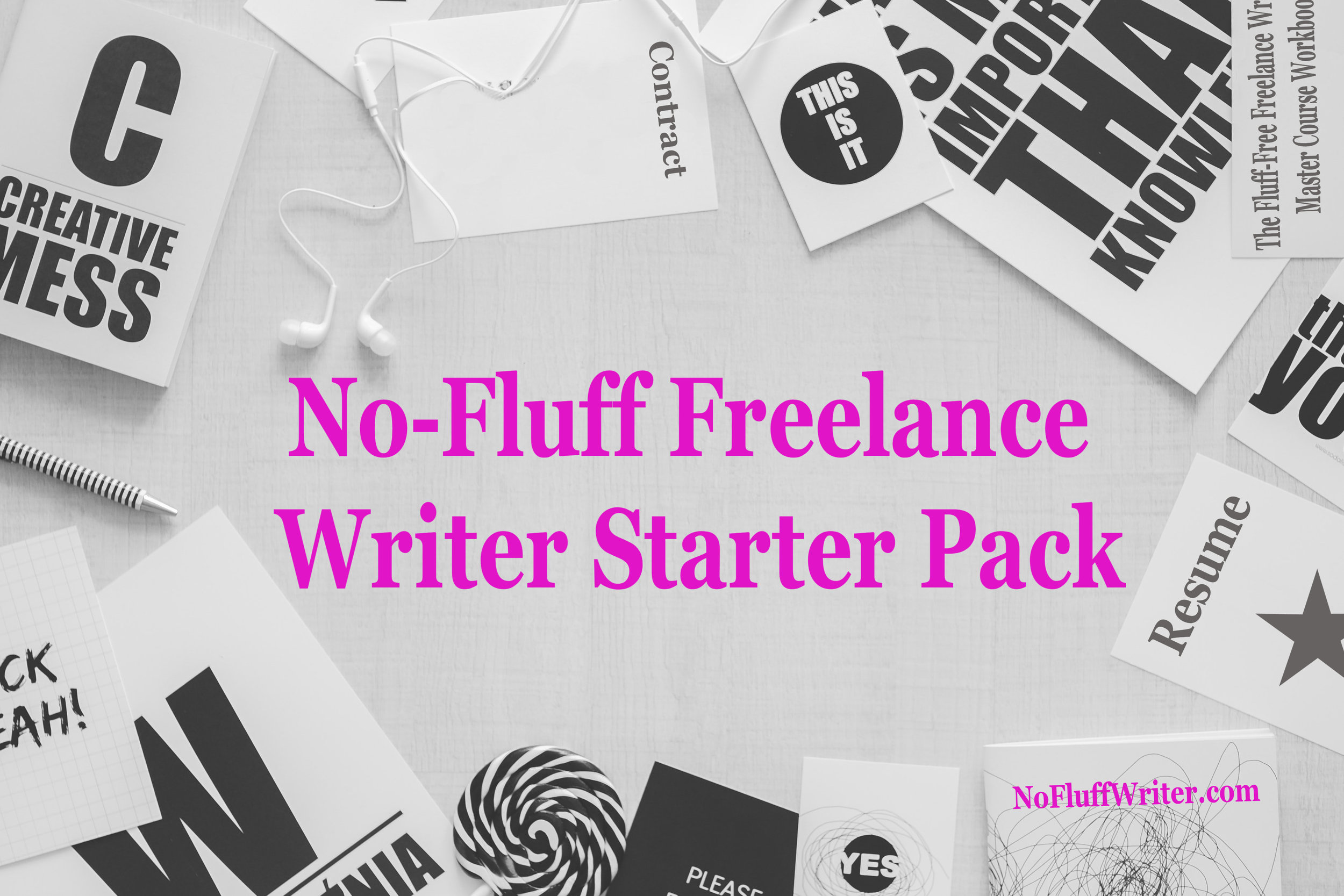
Just starting out as a freelance writer and want to cut the bull and get to the money making? Save time building your freelance writing business with the ultimate No-Fluff Freelance Writer Starter Pack. It’s on sale for $80, that’s 20% off!
Just starting out as a freelance writer and want to cut the bull and get to the money making? Save time building your freelance writing business with the ultimate No-Fluff Freelance Writer Starter Pack. It’s on sale for $80, that’s 20% off!
When I was starting out as a freelance writer, I had nothing. I felt fear rise up every time I realized I didn’t have something I needed that professionals would have. I need to write up a contract? I don’t know anything about that! Write code that prevents people from stealing my posts on my blog? Uh, sorry, I’m not that smart. Draw up an income spreadsheet for my taxes? Oh crap.
It took me years to gather together all the templates, spreadsheets, job hunting knowledge and more that I needed to run a successful business.
I don’t want my No-Fluffers to go through all that. So, I gathered it all together into one amazing collection. I would have given up my morning caffeine for this when starting out. (This shit is serious, folks!)

The No-Fluff Freelance Writer Starter Pack is my 20 years of experience crammed into one enormous, glorious package!
The collection includes:
Client contract template so you don’t need to worry about drawing one up – $100 value
The Fluff-Free Freelance Writing Master Course Workbook : The only course that gives you concrete, actionable information to building a successful freelance business without any fluff.
Cover letter template – $50 value
Ghostwriting proposal template – $25 value
Invoice template -- $10
No copy coding for articles and blogs (prevents crooks from stealing your work) – $25 value
An exclusive look at a resume that got me a gig at a huge company making $100 an hour -- priceless
Printable expense and income spreadsheets – $25 value
Example cover letter– $25 value
Exclusive information to help you market your business on social media -- $500 value
Article quality checklist to insure your articles are top-notch – $10
Digital Millennium Copyright Act (DMCA) takedown template letter – $100
How to Be a No-Fluff Writer video
No-Fluff Guide to Finding Freelance Writing Jobs
No-Fluff Manifesto wallpaper for your laptop and phone
How to Write an Article the No-Fluff Way Cheat Sheet
The Ultimate Social Media Tool Kit for Freelance Writers
Get it now before the price goes up! The kit will be delivered immediately to your inbox.

It Wasn't Luck: How I Became a Successful Writer
My career as a successful freelance writer has been anything but luck. So if not with luck, connections or money, how did I get where I am today? I'm going to tell you.

I posted this inspirational quote in my No-fluff Freelance Writing Group on Facebook: Not so controversial, right? One writer thought so:
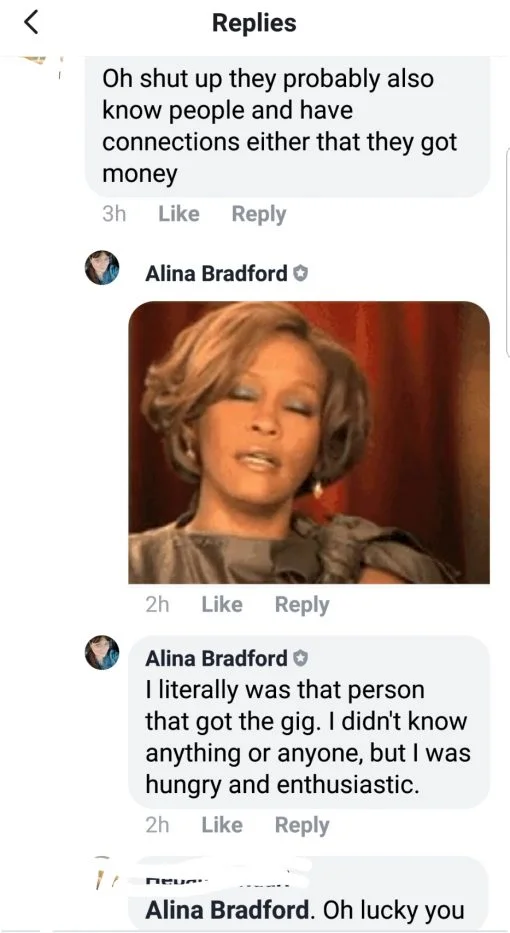
Now, getting told to shut up got under my skin, but what really got me is, "Oh lucky you." My career as a successful freelance writer has been anything but luck.
So if not with luck, connections or money, how did I get where I am today? I'm going to tell you.
Tenacity: I didn’t take no for an answer. If someone told me I wasn’t good enough, I just tried harder.
Reading: From the age of 11 or so I have read just about everything I could get my hands on about being a good writer.
Research: I learn everything I can on a topic before I write it. Being knowledgeable on a topic makes for good writing.
Politeness: I don’t tell people to shut up. I also say please and thank you. Politeness can get you a long way in any business, especially in this modern world. People like to be treated right.
Flexibility: Gig not work out? I don’t get bitter. I shake it off and move on to bigger and better things. Niche not making money? I switch to something with more promise.
Class: To quote the wonderful Michelle Obama, when they go low, we go high. Don’t trash people on the internet, even if you think they will never see it. Potential clients may see your rant and get turned off. (Notice how I’m not trashing the writer that told me to shut up? I’m turning it into a reflection moment, which is much better.)
Evolution: I’m constantly crafting myself as a writer. I grow, reshape, add to, subtract. The world of writing doesn’t stay the same and you shouldn’t either.
Want to know more about how I got clients? I put everything into a step-by-step guide called The Fluff-Free Freelance Writing Master Course Workbook.

The Secrets to Finding Writing Jobs
Finding paying freelance writing jobs on the internet is hard. You find a great gig, then realize they are only hiring on-site writers. Or you find a local freelancing gig and it doesn't pay. Grr. I feel your pain. Over the years, I've come up with some easy ways to dig up work that fits my niche, freelance lifestyle and pay requirements. I'm going to spill them right now.
Finding paying freelance writing jobs on the internet is hard. You find a great gig, then realize they are only hiring on-site writers. Or you find a local freelancing gig and it doesn't pay. Grr. I feel your pain. Over the years, I've come up with some easy ways to dig up work that fits my niche, freelance lifestyle and pay requirements. I'm going to spill them right now.

Hit Up Twitter
I love Twitter. It is so useful for gathering writing tips, networking and getting inspiration. It's also a great place to look for freelance work. Businesses and publications often post about open gigs. All you need to do to find the posts is to type some hashtags into the search bar.
Here are some to get you started:
#bloggerswanted
#writerswanted
#copywriterwanted
#bloggerjob
#bloggingjobs
#writtingjobs
#publishingjobs
#journalismjobs
#freelancewriterwanted
#remotewriterwanted
#fbloggerswanted (Fashion bloggers wanted)
#healthbloggerswanted
Search Google the Right Way
Searching for writing jobs on Google can bring up job posts from 2005 or jobs that are five states away and require on-site work. Such a waste of time!!! You can avoid all of the crappy job posts by searching smart. If you want to search a certain site, put site: in front of the site name, then add keywords in quotation marks. For example, I've had a lot of luck with this search: site:craigslist.org "remote writer. " Some sites to try other than Craigslist are:
Problogger
LinkedIn
Freelancewritinggigs.com
Glassdoor
Monster
Indeed
Some other terms you can try are: • "content writing companies" • "freelance writing companies"
To get newer job posts, add the date:
site:craigslist.org "remote writer " July 15th 2016
Now the secret to finding high paying jobs. Just add the type of payment you're looking for:
site:craigslist.org "remote writer " July 15th 2018 pays $220
site:craigslist.org "remote writer " July 15th 2018 $50 per hour
site:craigslist.org "remote writer " July 15th 2018 .50 per word
Successful writer Jennifer Mattern recommends this combination: writer and "compensation: * per article" site:craigslist.org (Replace the * with the monetary amount you want to be paid.)
If you want to search everywhere, just leave off the site and type in the rest of the search. This will bring up high-paying gigs from company job boards that most people never look at.
To get more great writing gig tips like these, read my book: The Fluff-Free Freelance Writing Master Course

7 Ways To Market Your Freelance Writing Business Online
If you’re ready to start pushing your business forward, you’re going to want to start marketing yourself. As a copywriter or website writer, the bulk of your work is done online, so it’s also a great idea to market yourself online. You can do that using these seven methods.
As a freelance writer, your job is more than just writing. In fact, you tend to wear many hats and that can often make you break out in a cold sweat (I hear you!). But you have to become okay with it...at least until you can hire an assistant.

So if you’re ready to start pushing your business forward, you’re going to want to start marketing yourself. As a copywriter or website writer, the bulk of your work is done online, so it’s also a great idea to market yourself online. You can do that using these seven methods.
With Your Website
The first thing that can act like a great marketing tool for your writing business is your website. So if you don’t already have one, you’re going to want to think about getting one. Your website can be your hub for samples of your work that can show prospective clients, listings of your awards, you blog and more.
And Your Own Store
You may even want to go one step further and have a website that is transactional too. With the right kind of website, like Tank Prints setup for network marketers, you may be able to offer a streamlined services to your customers like package deals.
Here’s how to set up your own store with Shopify:
SEO
While we’re talking about your website, you’re then going to want to think about the SEO, too. If you’re not currently ranking too well in search listings, this is going to be something that you need to start working on.
Whether you choose to do it yourself, or work with an agency, you will find that doing your keyword research and populating your site should help you to gain more organic traffic and custom.
Here's an in-depth SEO guide to get you started.
Guest Blogging
Another side of SEO is also guest blogging, and this can also aid with your traffic too. If you’re new to guest blogging, then you’re going to want to come up with a strategy that you can work with in your own time. Again, this is something that you can choose to work on yourself or hire an SEO expert to help you with.
Social Media
You’re also going to want to think about promoting yourself and your writing business on social media. This doesn’t always feel that easy to do, so coming up with a social content calendar can help you here. Not only should you look to identify what platforms you should work on, you should also try out different kinds of content to see what is going to work the best with your audience.
For example, my Instagram is full of quotes and helpful tips that my target audience (writers) would like. If your niche is tech, though, you could post short video reviews, eye-catching images of the newest gadget or images of you trying out a gadget. If your niche is pets, cute photos of your dog, care tips and funny animal videos may be the way to go. Give your people what they want and they will follow you. This will build your platform and present you as an expert to clients.
Advertising
Up next, there’s also advertising to think about. And when it comes to online advertising, you’re going to find that there are lots of different methods that you can work with. So, it may be in your interest to trial out a range of different methods. You may find that display advertising doesn’t give you as good results as PPC advertising. But you’re not going to know this until you try.
Affiliate Marketing
Then, you could also think about working with an affiliate marketing strategy. As a writer, it’s easy to see affiliate marketing as something that you should be making money from as a publisher. But when you’re a business, you can also set up your own campaign to help generate sales. This can be particularly relevant if you do sell your services as products on your site, or even if you have products such as ebooks and courses that you’ve created yourself.
Need help finding gigs? Here's my ebook on how to become a successful freelance writer, step-by-step.

5 Ways to Save Time in Your Freelance Writing Business
Time is money, writers. When you want to save more time, a few tweaks may be all you need.
Time is money, writers. Most of us are fully aware that this statement is true. The more time you have, the more productive you can be. However, many of us find that our time is taken up with unforeseen problems or small tasks that build up over time. So, if you’re sick of answering messages, writing social media posts or sitting in meetings, instead of getting to the real work, read on.

Organize, Organize, Organize
You can’t save time if you’re not willing to organize your time well. For example, in addition to planning a weekly meeting with clients, you can also call clients beforehand to find out if they’re still available. This way, the meeting can be cancelled if the client can no longer attend and you’ll know how long the meeting is likely to last.
Here are some videos that can also help:
Find Something That Works
Many people like to answer their emails and social media messages first thing in the morning as a way of getting them into the swing of the day. However, that may not work for you. Perhaps you prefer to dive straight into the larger projects and leave the smaller tasks until the end of the day. Maybe you’re finding that you need an assistant to take those smaller tasks off your hands so you can concentrate on the important stuff. Don’t worry about setting a tried and tested schedule for yourself- just do whatever works for you.
Make Use of Services
The busier you get, the more help you’ll need. If you can delegate to others, your time will be free to make money. It could be anything from a social media manager to a computer consultant. If you haven’t got the budget for hiring staff, you could make use of online tools. There are plenty of them to choose from and you can do anything from manage your schedule with an online calendar to time your social media posts.
Check out this post: 5 Incredible Software Programs All Business' Should Consider
Make Use of Templates
Whatever kind of documentation your business needs, you can bet there’s already a template for it. A quick online search should find you any kind of template you need. Whether you’re looking for accounting forms, an NDA agreement or employment application forms, you don’t need to spend your time creating them from scratch.
Of course, sending pitches and approaching people for work opportunities is a vital part of your day, since, without clients, you won’t have work. But it’s vital to make it as smooth a process as possible. Templates are your best friend, here.
The idea is to create a basic outline of who you are and what you do - along with some links to your previous work. This will allow you to adapt emails to the person you are approaching, but the bulk of the pitch is already done. Try it out - honestly, it will save you a lot of time!
My No-Fluff Freelance Writing Starter Pack is full of templates and other items that will save you a lot of time running your business.
Automate everything
Social media can be great for picking up work and driving business to your site. But it is also a huge time drain. Focus your efforts on automating your social media updates to avoid it taking up too much of your valuable time. There are plenty automating apps available - check out IFTTT or Tailwind.
Outsource when it makes sense
When you are freelancing, the temptation is to do everything yourself. You’ll build a website, do your SEO, start the marketing process and a whole lot more besides. However, as IT specialists Kumo point out, the reality is that you will be a lot more efficient by finding partners to do the hard work for you.
So, whether you want to host your site on the cloud or try out a new SEO techniques, find someone that can do it quicker, easier and better than you. The time - and, therefore, money - it will save you will not be insignificant.
Buy a notebook
Finally, the sad truth about being a writer of any kind is that it’s impossible to turn on the creativity like a tap. And while you might set aside writing hours every day, there is no guarantee of finding inspiration.
In fact, it’s more likely you will be struck with a fantastic idea just before you go to bed or when you are in the shower than during dedicated hours. Don’t waste time sitting around brainstorming when you could be writing.

The answer is simple, though. Buy a notepad and write down your thoughts when they happen. I use Keep Notes on my phone as well as OneNote for ideas because I can access them on my laptop, too.
A voice recorder is another option - anything, basically, that will help you remember your moment of inspiration and can give you a kickstart during your writing hours. I must admit, I'm a notebook horder.
One at a Time
Starting a new project before you’ve finished the last can be confusing. You may even find that you make mistakes and have to do the work over. Stick to one project at a time so you have clarity about what you’re doing. Never take on more than you can handle. It can be tempting to take on several projects because it means more money. However, promising something you can’t deliver will end up making you and your business look unreliable.
When you want to save more time, a few tweaks may be all you need.
For more tips on saving time and keeping your focus, check out 3 Ways to Be More Productive as a Writer.

Startup Success: How to Make it Possible
Here is a handful of tips to get you started so that you and your startup can start leaving those competitors far behind.
As you’re probably very well aware of, most startups struggle with making it happen during those first important five years. They run out of money, first of all, don’t quite understand the market - or they simply get pushed out of the way by someone bigger and stronger.
While you might not always be able to control all the factors that could make or break your startups, there are a few things you can do in order to make that success a bit more achievable.
Here’s a handful of tips to get you started so that you and your startup can start leaving those competitors far behind.

Building a customer profile
Sometimes, it’s easy to get carried away with the idea of a product or a service and believe it is for everyone. We might fall so much in love with our own business that we simply forget that the customers you’ve set your eyes on may not feel the same way - and it could prove to be detrimental to your startup.
Building a solid customer profile is something that requires time and knowledge. If you’ve never done this before and never attended a business school lecture in your life, you might want to consider handing this one over to someone who knows what they’re doing.
A professional will be able to map out exactly who you should propose your products to, how you should target them, and where you’re most likely to find them. It’s the kind of stuff that ensures your business the best possible start.
Outsource the right tasks
When you’re still fairly young and new to the game, it’s a good idea to save as much money as possible and avoid hiring too many people. You’d still like to get the job done, though, and this is where outsourcing comes it; you can learn more here if you’d like to read up on outsourcing for small businesses.
Tasks such as payroll, for example, bookkeeping and accounting are one of these. The work is more or less the same every week, and by not spending any more time on it in-house, you’ll free your hands and mind to focus on other things.
A lot of business owners realize the benefits of not handling these tasks themselves, either because they feel under-qualified or because they simply don’t have time, so they assign it someone else in the company.
Bootstrapping
Bootstrapping is, of course, another way to make sure that your startup doesn’t spend too much money. Focus on investing in the right places, give your business an edge that your competitors don’t have - and rely on excellence through a great team.

6 Major Disadvantages Of Becoming A Freelancer
Like most other things in life, freelancing is not without its downsides. If you’re thinking of taking the plunge, here are six disadvantages you must consider.
What is the first thing you think of when you imagine going freelance? For most, it’s one of the many advantages, such as the unlimited income potential or the flexible schedule. These benefits make going freelance an incredibly attractive idea, especially when your boss or work, in general, is getting you down.
However, like most other things in life, this venture is not without its downsides. If you’re thinking of taking the plunge, here are six disadvantages you must consider.

1. Poor Work-Life Balance
Most assume that being your own boss offers a better work-life balance than traditional work. Unfortunately, this is far from the truth. Because you tend to work at home, it becomes difficult to distinguish between your personal life and work time. This is especially true when handling inconsistent workloads. That being said, https://medium.com does offer some helpful advice.
2. The Initial Cash Investment
Like most other businesses, your freelancing venture may require an initial cash investment to get it up and running. This may be used to pay for office equipment, computer software, office supplies, insurance, and other must-haves. You’ll also need to invest in marketing to find clients. You can find funding to cover these costs, but, to avoid debt, many choose to save up instead.

3. A Lot Of Legwork
Working a traditional job means that projects are handed to you when you walk in the door. This isn’t the case for freelancers. You’ll have to find your own work, as well as wear lots of hats, including accounting and marketing. Thankfully, there are professionals out there, such as http://www.sabioit.com/ to lend a hand. They will manage your IT services, saving you the job.
4. Income Can Be Irregular
Your freelancing income depends entirely on the work that you do. This means that, if you don’t or can’t find any work for a while, you won’t get paid during this time. This inconsistency and instability can make it difficult for you to pay bills or prepare for the future. To boost your financial security, you should start to build an emergency fund to cover expenses when you’re out of work.

5. Lack Of Employee Benefits
Working for an employer means that you’ll receive certain benefits. Depending on the company, these could include paid days off, health insurance, overtime pay, and more. When you work for yourself, however, you’ll receive none of these, which can increase your living costs. With that in mind, you should aim to earn more than your previous income to combat these expenses.
6. Always Working By Yourself
Most freelancers work at home, which means that you’ll spend your working days completely alone. Although this does have its advantages, it can also get quite lonely, leaving you feeling isolated. To remedy this, you should make more of an effort to get out of the house each day. Head to the gym, grab a coffee, or just go for a walk, and try to speak to people along the way.
Freelancing is great, but it definitely isn’t easy. Before you jump into the life, you need to decide whether the positives truly outweigh the negatives.

5 Incredible Software Programs All Business' Should Consider
Running your own business can be incredibly hard work, so it's important you're doing absolutely everything you can in order to make your life easier. Whether it's outsourcing work, using software to automate processes or using external companies to assist with IT and security - every little can help. With that in mind, here are 5 incredible software programs all business' should consider.
Running your own business can be incredibly hard work, so it's important you're doing absolutely everything you can in order to make your life easier. Whether it's outsourcing work, using software to automate processes or using external companies to assist with IT and security - every little bit can help. With that in mind, here are 5 incredible software programs all business' should consider.

Social Media Scheduling Tools
Social media is an incredible tool for businesses looking to increase their visibility online. While it can do amazing things for a business’ growth, often entrepreneurs and small businesses don’t have the time to schedule things on a daily basis.
To help, there are lots of social media scheduling tools that are available - giving business owners a chance to spend 1-2 hours a month getting all of their scheduling out of the way. For tips and tricks on scheduling your social media, you can visit this guide here.
Email Marketing Software
If you’re planning on using email as part of your marketing strategy then email marketing software is probably the best way to go. Using dedicated programs you can set up an email system that will allow you to sign up new subscribers, give you a chance to segment people based on their interests, and allow you to create well-designed emails that you can send on a schedule. For those with little time, this is a great option.

Marketing Automation
If you want to take your email marketing a step further, marketing automation is a great route to take. You can use email marketing and other useful data to create targeted campaigns that send out automatically.
That means once you have set them up once, you never have to worry about them again. Whether it starts when someone buys a product, when they sign up to your newsletter or when they leave a review - you can keep them in your sales funnel for as long as you want.
IT Support And Assistance
If you’re looking for software that will help when it comes to all of your IT support, there are lots of different options you can choose from. Whether you want a dedicated email system, your own server or antivirus protection - you need to ensure you’re doing everything you can to support your IT systems. For more information on IT management solutions, you can visit this site here.
Accounting Software
If you’re not going to be hiring an accountant to help with your finances, finding an accounting software that works for you is important. You can find software that will send invoices, track payments and, at the end of the year, help you create your tax return.
If you’re lucky, you may even find that your perfect accounting software is available for free, as there are many unpaid options that will do everything a small business may need.
Are you looking to make your life as a business owner easier? What software you could you use? Let me know in the comments section below.

World Sleep Day: 61% of Americans Don’t Know About Circadian Rhythm
You know I like to report on the latest sleep studies. Sleep is just so darn important to a writer, and it’s often hard to get. Sleep Cycle, the best-selling alarm clock application, has today released the results of a new survey in tandem with some internal data.
You know I like to report on the latest sleep studies. Sleep is just so darn important to a writer, and it’s often hard to get. Sleep Cycle, the best-selling alarm clock application, has today released the results of a new survey in tandem with some internal data just in time for World Sleep Day.
The survey of more than 1,000 U.S. adults was conducted by Propeller Insights on behalf of Sleep Cycle in March 2019. It looked at how much Americans know about their circadian rhythm, the steps they take to protect it and how they are affected when it’s interrupted. The internal data also examined the impact of daytime sleep schedules on “shift workers.”

The Rhythm of the Night
The human body’s sleep-wake schedule — along with many other biological functions — is governed by 24-hour cycles that are collectively referred to as “circadian rhythms.”
Almost 4 in 10 Americans (39 percent) know about circadian rhythm. Of these, a majority (58 percent) actively take steps to protect theirs:
About half (49 percent) go to bed at the same time each night and eat meals on a regular schedule (48 percent)
43 percent keep specific evening routines
34 percent make it a point to get good exposure to daylight each day
33 percent dim the lights in the evening to prepare their bodies for sleep
32 percent make exercise a priority
Additionally:
60 percent feel their circadian rhythm is affected by their work-life balance
A full third (34 percent) say their partner’s sleep/wake schedule interferes with their circadian rhythm
The Early Birds and the Bees
Of Americans who care about their circadian rhythm:
71 percent of men and 52 percent of women sleep better after having sex
A full third of men (34 percent) and 19 percent of women have sex in order to enhance the quality of their sleep
Men are slightly more willing (23 percent) than women (20 percent) to turn down sex if it risks interfering with their sleep schedule
19 percent of men and 10 percent of women have put off having children because they don’t want their sleep disrupted

Forty-three percent of these Americans describe themselves as “night owls” (even though only 23 percent regularly go to bed after midnight) and 32 percent are early risers (27 percent are in bed by 10 p.m.).
More than three-quarters (80 percent) have noticed their circadian rhythm changing as they age: 39 percent report going to bed earlier and 30 percent stay up later.
Significantly more women (48 percent) than men (32 percent) report that, as they get older, they wake up more often during the night; 34 percent of women also struggle more with insomnia, compared to just 21 percent of men.
Women, Interrupted
What are the biggest enemies of circadian rhythm?
Americans who pay attention to their circadian rhythms rank stress (40 percent), lack of sleep (35 percent) and staying up too late (35 percent) above the usual suspects like travel (13 percent), daylight savings (18 percent) and blue light from technology (18 percent).

Women especially report suffering negative effects when their circadian rhythm is interrupted:
Women Men
Have less energy 62 percent 53 percent
Need more naps 35 percent 22 percent
Need to go to bed earlier 30 percent 24 percent
Eat more junk food 30 percent 23 percent
Have a hard time remembering things 28 percent 17 percent
A Hard Day’s Night
“Shift workers” — Americans who regularly work late-night or overnight shifts — are forced to sleep at hours in opposition to their natural circadian rhythm. How does this affect them?
Internal Sleep Cycle data that looked at more than 385,000 “days” of sleep for people sleeping between the hours of 3 a.m. and 9 p.m. found that people who regularly sleep during the day sleep longer and more deeply, on average, than people sleeping normal nighttime hours. But they also wake up in worse moods:
Shift workers sleep an average of 20 minutes longer (7 hours 49 minutes) than the rest of the population (7 hours 29 minutes)
They enjoy a higher sleep quality (78.29 percent) than the rest of the population (76.44 percent)
But their wake up mood is lower (56.43 percent) than regular sleepers (57.73 percent)
People who only ever sleep during daytime hours (as opposed to sometimes sleeping regular nights) have the worst wake-up mood of all the groups (56.15 percent)
About Sleep Cycle
Sleep Cycle is the world’s most popular intelligent alarm clock app that analyzes users’ sleep, records findings and wakes them during their lightest sleep phase so they feel rested and refreshed. The app generates nightly sleep reports, tracks long-term sleep trends, and logs how daily activities impact sleep quality. With millions of users worldwide, Sleep Cycle has also become the world’s richest repository of data on global sleep habits. The newly formed Sleep Cycle Institute puts this data in the hands of five multidisciplinary health and wellness experts to provide individuals and public policy makers with deeper quantitative insights into the relationship between sleep and overall health and well-being.
For more information — and real-time, interactive sleep data from around the world — visit https://www.sleepcycle.com/.

How Can Writing Be Therapeutic?
It’s no secret that getting out your worries, fears and dreams can make you feel better. For those that have no one to talk to, or for those that just like to put their ideas on the page, writing can be helpful. For more about therapeutic writing, I contacted Beth Carvin, CEO of JamBios. Here is what she had to share.

Woman using JamBios
It’s no secret that getting out your worries, fears and dreams can make you feel better. For those that have no one to talk to, or for those that just like to put their ideas on the page, writing can be helpful. For more about therapeutic writing, I contacted Beth Carvin, CEO of JamBios. Here is what she had to share.
What Does Therapeutic Writing Do?
Expressive writing is an acknowledged therapy with 200+ academic research studies scientifically proving results. Some of these are astonishing such as:
- improving the immune function by increasing white blood cells
- having fewer doctor visits for flu and upper respiratory conditions than those who wrote about ordinary events
- reduced work/task errors
- increased GPA of students
- improved lung function in asthmatics
- reduced irritable bowel symptoms
- lessened the distress of migraines
- increased rate of unemployed being hired
and of course, reduction of stress and anxiety and improved social relations and life enjoyment.
As you can see, these kinds of benefits can help a wide range of people. Most of us, even the happiest, have some emotional events in our past that we may not have completely worked through, even if we don't know it.
How Does it Work?
There are a variety of theories on why expressive writing works so well. Some researchers believe that it turns those painful life events from a sensory experience into a concrete narrative that our brains can then set aside. You can think of past painful experiences as being like a cloud or vapor that is always floating around our brains with no way for us to let them go.
They interfere with our working memory, the part of the brain that helps us perform tasks. Researchers believe that the language and structure of writing turn the untenable into something solid that can be stored appropriately. Once properly placed, these memories no longer use up our unconscious processing power.
How JamBios Can Make Writing Easier
The JamBios platform was developed for writing, sharing and saving life memories.
We've been surprised at how many people come to JamBios while dealing with various traumas, stress and illness. One user, Sunshine, came to JamBios while dealing with severe kidney disease. She would write stories about her life for her children while on the dialysis machines. (She has since received a kidney transplant and continues to write her memories.) Another, Sue, has written about past drug abuse and how she escaped from a low point in her life. She told us that in writing and sharing her stories it released her from the shame she had tucked away. We've had users writing about memory loss from traumatic brain injury, about severe depression and about simply not fitting in.
You can also magnify the positive benefits by sharing your personal writing with others. Whether you do so publicly or just with close family or friends, it further lifts the burden. The woman mentioned above who shared her writing on her past drug abuse stories was astonished at how much love and support she received. Even from her mother who did not know the extent of her journey.
But Writing is Not Just for People With Great Trauma
Many of us, myself included, find it stress reducing to write about our enjoyable memories from our past. When the news on television, in the newspapers and social media get to be overwhelming, it's a refreshing break to take 10 or 20 minutes to write and reminisce. After writing about my favorite first pet, or meeting my husband for the first time, or my (mis)adventures with skiing I always feel recharged and energized. Plus I get a burst of positive emotions when my sister contributes a memory to my story that I have forgotten or never new.
While writing does not replace other necessary treatments, it's a wonderful way to help ease mental burdens both large and small. It's free, it's fun and it is drug free.

Why You Have To Be Ready To Freelance Full-Time
Here’s a peek at what life is like as a full-time freelance writer.
To some people, he idea of going freelance is glamorous. No more boss. No more working hours. Way more freedom! And yes, while all of those things are true, the freelance world isn’t always that easy. Nor is it glamorous.
If you want to go freelance because you think you can work less and get paid more, you may be wrong. Sure, a LOT of freelance writers can do this. But, they get there after a lot of hard work. It’s not impossible, of course, but it does take time.
And this is why you have to be ready to go freelance - especially to make the leap full-time. Let’s take a look at what life will be like.

You’re On Your Own
So first of all, you need to recognize that now, it’s just you. There’s no boss guiding you or to ask for help. There’s no sales team or customer service team or finance team supporting you - you are all of them. So alongside the writing aspect, you need to also keep track of what you’re earning, sell yourself, and communicate with your ‘customers’ the editors, too!
Pitching Can Be Ruthless
Now, the world of freelance writing is largely made up of pitching day in, day out. If you want work, you need to ask for it. And it can be ruthless.
Of all the pitches you send, say 100, maybe a handful will come through. But, the more you practice, the better you’ll get. So you need to get comfortable with firing out pitch after pitch and coming up with a ton of different ideas for different publications and media outlets all of the time.
It’s Non-Stop

Another thing to be aware of, is that it’s kind of non-stop. You pitch, you write. You pitch, you write. You pitch, you write. And you get paid. You also market yourself, maybe you even blog too. But it’s kind of like one big cycle that you get yourself into. But it can be fun!
Don’t panic! Eventually you’ll get a stable of reliable clients and won’t need to pitch as often. It takes time, though.
You Get Back What You Put In
And it’s not all bad! Because if you love writing, you’re talented, and you have something to say, you’ll want to give this your all. And the harder you work, the more it will pay off for you. That’s the beauty of being freelance, your earning potential can be endless!
Nothing Is Guaranteed
And finally, it’s important for you to know that you’re never really guaranteed to be paid! There’s no set monthly payday! You’ll be paid when you’re paid, and sometimes you have to chase money down.
Yes, you have options such as BCashflow Positive for this, but you should really factor this into your budget. It’s why it’s so importantly to have a safety net of cash ready before you take the leap so that your living expenses are covered.
So, ask yourself - are you ready to go freelance? If not, what do you need to do to get into the position where it’s possible?

How to Get to Know Your Freelance Clients Better
So how do you change your listening routine so that you are where your customers are and speak their language? This graphic explains it.
If you've ran a freelance business a long time, you may think you know everything about your customers. What you might know about your customers, though, may not be up-to-date. For example, you might use old lingo that none of those customers have even heard of. You might not be hearing what they’re actually talking about, either—you might be missing the terms they use instead of your industry lingo.
And if you rely on your routine, you might miss out on the new places where those customers are, like a social media platform that you haven’t heard of, or even a competitor’s site that they check out from time to time.
So how do you change your listening routine so that you are where your customers are and speak their language? This infographic explains it.
Click To Enlarge

Via Salesforce