

Ladies, Make Sure You’re Getting the Right Nutrients to Fight Depression
Writers are prone to depression, particularly female writers. I'm no exception. Here's some help from Joy Stephenson-Laws JD. Joy is the founder of Proactive Health Labs (www.phlabs.org), a national nonprofit health information company that provides education and tools needed to achieve optimal health. She also is founding and managing partner of Stephenson Acquisto & Colman (www.sacfirm.com), one of the nation's leading health care law firms. Her most recent book is Minerals - The Forgotten Nutrient: Your Secret Weapon for Getting and Staying Healthy, available through Amazon, iTunes and bookstores. She is based in California.

Various credible sources including Harvard Health, states women are about twice as likely as men to develop major depression. It appears our biological or hormonal makeup may be partly to blame.
When We're More Likely to Be Depressed
There are certain periods during our lives when we are more susceptible to depression like before our period or after pregnancy.
Premenstrual Dysphoric Disorder (PMDD)
This disorder can occur a week or two before a woman’s period starts.
“PMDD is a serious condition with disabling symptoms such as irritability, anger, depressed mood, sadness, suicidal thoughts, appetite changes, bloating, breast tenderness, and joint or muscle pain,” according to the National Institute of Mental Health.
Perinatal Depression
“Perinatal depression is depression during or after (postpartum) pregnancy. It is much more serious than the ‘baby blues.’ The feelings of extreme sadness, anxiety, and exhaustion that accompany perinatal depression may make it difficult to complete daily care activities for a new mom and/or her baby,” the NIH reports.
It is one of the most common medical complications during pregnancy and the postpartum period, affecting one in seven women, according to The American College of Obstetricians and Gynecologists.
Perimenopausal Depression
“Perimenopause (the transition into menopause) is a normal phase in a woman’s life that can sometimes be challenging. If you are going through perimenopause, you might experience abnormal periods, problems sleeping, mood swings, and hot flashes,” according to the NIH.
Perimenopausal depression may be caused by changes in hormone (like estrogen) levels.
Oprah, the woman who does it all, openly discussed menopause and her experience with a hormone specialist.
But despite the likelihood of depression, it is a myth that it is ‘normal’ to feel depressed.’ There is nothing normal about depression. If we have symptoms of depression, we need to take it seriously and get help. And we need also need to take steps to be proactive so we reduce the likelihood of being depressed.
Nutrition to Fight Depression

nutrition for depression
And one way to reduce the likelihood of depression is nutrition.
Credible research shows that nutrition can play a key role in preventing and managing depression. As women we have to ensure we absorb adequate amounts of the right nutrients in order to increase our chances of not becoming depressed. Below are examples of nutrients we need to to be mindful of. Many of these nutrients can be obtained through a proper diet and/or supplementation (with medical supervision).
Magnesium
Several studies have shown an improvement in the severity of symptoms of depression when study participants were given 125-300 mg of magnesium with each meal and at bedtime. Foods containing magnesium include spinach, pumpkin seeds, yogurt, kefir, almonds, black beans, avocado, figs, dark chocolate and bananas.
Chromium
Many studies have been done to assess the benefit of chromium picolinate in depression. One study showed that 70 percent of those who took 600 mcg of chromium picolinate had improvement in their depressive symptoms, including emotional stability. Foods high in chromium include broccoli, free range eggs, sweet potatoes, corn, oats and grass fed beef.
Iron
Decreased levels of iron can result in apathy, depression and fatigue. Iron is also important for oxygenation of the brain and necessary for all its functions. Studies need to be done to find out how common iron deficiency anemia is in patients with depression, and once corrected, to determine which symptoms would be improved. In the meantime, if you are depressed you should check your iron levels. Keep in mind, many women tend to have a higher chance of iron deficiency due to losing blood during their menstrual cycles. Iron-rich foods include red meat, pork, poultry, seafoods, beans, spinach (and other leafy greens), peas, cherimoyas and iron-fortified cereals.
Selenium
Depression due to selenium deficiency has been established in at least five different studies. Depression may be the result of oxidative stress, which is why selenium may be helpful. Selenium is a powerful antioxidant. Numerous studies done on different populations and age groups suffering from depression showed improvement in mood and anxiety when given selenium. Overall, mood was also improved when selenium was given to those with depleted levels. Foods high in selenium include Brazil nuts, yellowfin tuna, halibut, sardines and chicken.
Zinc
This trace element is essential to the human body. It is involved in over 300 reactions in the body and is abundant in the brain. Many clinical studies have been done to determine the relationship between zinc and depression. Zinc levels are generally low in those with major depression. Zinc supplementation along with antidepressant therapy has been studied and has shown benefits. You can eat lamb, pumpkin seeds, grass fed beef, mushrooms, chickpeas, spinach and chicken to get more zinc in your daily diet.
Copper
This mineral is important in depression, because it is a component of the enzymes that metabolize the brain chemicals that help you respond to stress, feel happy and be alert. These enzymes, and the associated chemicals, are responsible for the causes and treatment of anxiety and depression. Several studies have been done on copper levels and depression, and there is an association between high levels of copper and lower rates of depression. Copper rich foods include sunflower seeds, lentils, almonds, dark chocolate, beef liver and asparagus.
B Vitamins
Deficiencies in various vitamins, including B vitamins are reported to have a negative effect on the brain. There are a total of eight B vitamins. There is a wide range of foods containing B vitamins. If you are vegan or vegetarian, you have to be especially proactive about making sure you get enough B12 (which is mainly found in animal foods).
Vitamin C
Various studies have suggested that depression may be a consequence of inadequate levels of vitamin C. It can usually be found in a variety of fruits and vegetables such as oranges, watermelon, green and red peppers, grapefruit, tomatoes, spinach, papaya, Brussels sprouts and cabbage.
Being nutritionally balanced puts our bodies in the best position to manage or beat depression. And when you consider being physically active is another way to combat depression, being nutritionally sound enhances our ability to be physically active.
Finally, it also important that we objectively assess our nutritional status on a regular basis throughout our lives. A great first step is getting a better idea of our nutritional status is by taking a comprehensive nutritional test and talking with your healthcare provider about our results. This way, if we have nutritional imbalances, we can work with a competent healthcare professional to make dietary changes and/or take quality supplements.

Time Management Advice For Small Business Owners
One of the most difficult aspects of project management is keeping on top of time management. A lot of small business managers make the mistake of overestimating when it comes to timelines and deadlines, which gets things off to a bad start, to begin with, as it sets up the project team for failure.

But, once you get the deadline right that is only the start of the process. You need to implement effective time management to make sure that everything runs smoothly. With that being said, read on for some top tips to follow.
Avoid micromanaging – Have faith that you have chosen the best team for the job, and let them get on with what they are good at. You can waste a considerable amount of time by getting into the finer details when it really is not necessary.
Make sure your meetings are productive – You need to extract true value from every meeting by identifying opportunities, issues, and risks, and getting the team to brainstorm ideas and solutions. It is also important to set a time for the meeting, say an hour, and stick to it, and make sure you have an agreed agenda beforehand.
Choose the right tools - Another important part of the project management process is ensuring you have the right software in place - software that is going to enable you to run your projects more efficiently and make more intelligent decisions. BPM cloud is a great example of the sort of solution that could help you to get more done in a shorter space of time.
Have an effective plan in place – You may be wondering what having an effective plan has to do with time management, but it is actually the most important point. A good plan will have regular milestones in place, giving all team members something to focus on. This means that everything is crystal clear, and you are thus going to spend much less team dealing with problems that occur because of a lack of clarity.
Make a to-do list and stick to it – More often than not, we waste time doing things that really are not of immediate importance. Email fixation is a modern-day issue, and it is a prime example of this. We constantly check our emails, replying to them as soon as we receive them, which can distract you from carrying out important tasks. This is why it is a good idea to create a daily to-do list. You can work through this list, which will ensure you remain focused on your goals for the day. This will drive further activity, as you tick things off the list.
Don’t do the work – A lot of small business managers fall into the trap of trying to do everything themselves. However, your full-time job is to manage the project, and you should have assigned team members to carry out all of the other roles. Of course, when a deadline is looming, it can be tempting to take over. But, you should avoid this at all costs. Focus on managing your team so they can get the job done.
Follow the tips above and you will achieve time management success!

Watch Out Writers, Fall Headache Triggers Are Coming
A change in seasons introduces many new environmental factors that can trigger additional migraine and headache, such as cooler weather, changes in barometric pressure and humidity levels, wind and allergens. Just what us writers need, right? Dr. Vincent Martin, director of the Headache and Facial Pain Center at the University of Cincinnati Gardner Neuroscience Institute and president of the National Headache Foundation, has the details on why your head may be hurting this month.

Changes in Weather
Weather changes are a common migraine and headache trigger, and the cooling temperatures in the fall are a primary trigger. While it is not clearly understood why this happens, there are a number of studies being conducted to understand this correlation. It has even been suggested that factors such as changing barometric pressure, humidity and temperature can be triggers. Since these factors tend to occur at the same time, it is difficult to pinpoint which is the culprit.
Allergens
Perhaps the most common headache and migraine trigger are allergens, and fall is full of ragweed and mold. Allergies will increase the amount of histamine our bodies produce when allergens are high, which can trigger migraine by inflaming sinuses. Individuals with migraine and headache should take a number of precautions during the fall to lessen the impact of allergies. A few ways are to use a HEPA air filter, mattress and pillow encasings and doctor prescribed allergy medications to reduce aggravation of the sinuses.
Daylight Cycle
The fall is also met with less daylight, and this commonly shifts sleep schedules. Maintaining a consistent sleeping pattern is essential for migraine and headache sufferers, as their chance of an oncoming attack significantly rises when the pattern is disrupted. Additionally, as days grow shorter, it tends to have a neurological effect on people, potentially triggering a migraine.
About National Headache Foundation The National Headache Foundation has furthered awareness of headache and migraine as legitimate neurobiological diseases for the past 48 years. They collect the most comprehensive information on headache and migraine and connect with patients, who have just begun to seek treatment or those who are looking for more options. Visit www.headaches.org for more information.

The Saga of Bogus SEO and Optimization Tactics
Okay, I want to shout it from the rooftops: Most of your SEO and optimization tactics are hugely, utterly wrong! I have talked with many website owners over the years, and it seems like they all have been drinking the same content Kool-Aid. You can't blame them for believing horrible optimization tactics. They were just hungry for some search engine love.
It's time to end the madness, though.
Okay, I want to shout it from the rooftops: Most of your SEO and optimization tactics are hugely, utterly wrong! I have talked with many website owners over the years, and it seems like they all have been drinking the same content Kool-Aid. You can't blame them for believing horrible optimization tactics. They were just hungry for some search engine love.
It's time to end the madness, though.

Cutts Says Cut it Out with the Article Directories
First, don't use article directories to build links. Oh, I've known so many people that have wandered into this trap...and then Google gave them the website smack down. Finally, Matt Cutts of Google confirmed what I had always suspected. Article directories are slimy, spammy places. Don't believe me? Take a look at this video:
Keywords Aren't as Important as You Think
Keywords were once the best way to draw search engine attention. That was a long time ago. It's time to get up to speed, people. Search engines are smart enough that they can figure out what your content is about without a liberal smattering of keywords. Just add great content to your site and people will come. Trust me. Here is a more in-depth article I wrote on the subject: You're Thinking Too Much About Keywords.
Guest Blogging Equals Trash...Most of the Time
If you are using guest blogs specifically for links, then put a fork in it, 'cause it's done! For the past year or two, all anyone could talk about is how valuable it is to guest blog. Cutts has revealed, though, if you're doing it for the links, then it's just spam search engines will penalize you for.
On the other hand, if you use guest blogs to add valuable, entertaining content to your site, then by all means, go ahead. Adding good content to your site is always a good idea.
End the Crapfest
A few weeks ago, I ran across a website owner that employed a "content editor" to look over all of the content he put on his site. This is a great practice! Search engines are cracking down on sites that consistently put up content with spelling and grammar errors. The only problem was his "content editor" was adding more problems to the site then she was fixing.
Moral of the story?
Yes, please, please, please check all of your content. Make that blog or article or webpage shine! If you want to hire an editor to do it for you, more power to you! Just make sure the "editor" is actually good at his job by checking references and testimonies. You'll find references and testimonies on my website and on my LinkedIn, for example. Have you been doing any of these optimization tactics? Well, throw all those suckers out the window. Next time, close your eyes and hum when someone tries to tell you a new SEO tactic. All you ever really need to draw people to your site is entertaining, well-written content.
Need some help? Feel free to contact me.

A Brief History of ASR: Automatic Speech Recognition
As a writer, you probably use automatic speech recognition when you're dictating ideas on your phone or using Google's dictating app. Here's how the technology came about.This moment has been a long time coming. The technology behind speech recognition has been in development for over half a century, going through several periods of intense promise — and disappointment. So what changed to make ASR viable in commercial applications? And what exactly could these systems accomplish, long before any of us had heard of Siri?

The story of speech recognition is as much about the application of different approaches as the development of raw technology, though the two are inextricably linked. Over a period of decades, researchers would conceive of myriad ways to dissect language: by sounds, by structure — and with statistics.
Early Days
Human interest in recognizing and synthesizing speech dates back hundreds of years (at least!) — but it wasn’t until the mid-20th century that our forebears built something recognizable as ASR.
asr
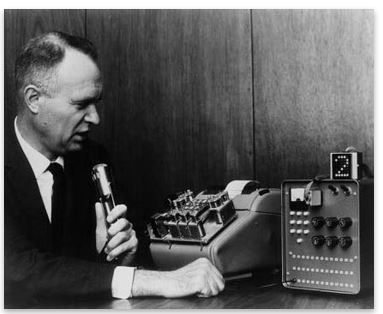
1961 — IBM Shoebox
Among the earliest projects was a “digit recognizer” called Audrey, created by researchers at Bell Laboratories in 1952. Audrey could recognize spoken numerical digits by looking for audio fingerprints called formants — the distilled essences of sounds.
In the 1960s, IBM developed Shoebox — a system that could recognize digits and arithmetic commands like “plus” and “total”. Better yet, Shoebox could pass the math problem to an adding machine, which would calculate and print the answer.
Meanwhile researchers in Japan built hardware that could recognize the constituent parts of speech like vowels; other systems could evaluate the structure of speech to figure out where a word might end. And a team at University College in England could recognize 4 vowels and 9 consonants by analyzing phonemes, the discrete sounds of a language.
But while the field was taking incremental steps forward, it wasn’t necessarily clear where the path was heading. And then: disaster.
automatic speech recognition
October 1969 —The Journal of the Acoustical Society of America
A Piercing Freeze
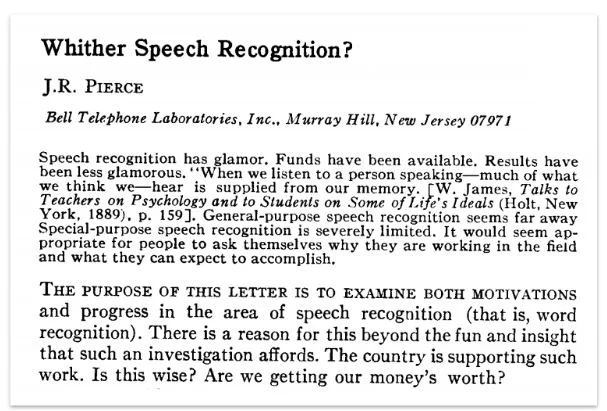
The turning point came in the form of a letter written by John R. Pierce in 1969.
Pierce had long since established himself as an engineer of international renown; among other achievements he coined the word transistor (now ubiquitous in engineering) and helped launch Echo I, the first-ever communications satellite. By 1969 he was an executive at Bell Labs, which had invested extensively in the development of speech recognition.
In an open letter³ published in The Journal of the Acoustical Society of America, Pierce laid out his concerns.Citing a “lush” funding environment in the aftermath of World War II and Sputnik, and the lack of accountability thereof, Pierce admonished the field for its lack of scientific rigor, asserting that there was too much wild experimentation going on:
“We all believe that a science of speech is possible, despite the scarcity in the field of people who behave like scientists and of results that look like science.” — J.R. Pierce, 1969
Pierce put his employer’s money where his mouth was: he defunded Bell’s ASR programs, which wouldn’t be reinstated until after he resigned in 1971.
Progress Continues
Thankfully there was more optimism elsewhere. In the early 1970s, the U.S. Department of Defense’s ARPA (the agency now known as DARPA) funded a five-year program called Speech Understanding Research. This led to the creation of several new ASR systems, the most successful of which was Carnegie Mellon University’s Harpy, which could recognize just over 1000 words by 1976.
Meanwhile efforts from IBM and AT&T’s Bell Laboratories pushed the technology toward possible commercial applications. IBM prioritized speech transcription in the context of office correspondence, and Bell was concerned with ‘command and control’ scenarios: the precursors to the voice dialing and automated phone trees we know today.
Despite this progress, by the end of the 1970s ASR was still a long ways from being viable for anything but highly-specific use-cases.
Markov model
The ‘80s: Markovs and More
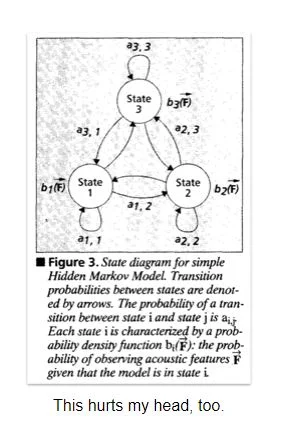
A key turning point came with the popularization of Hidden Markov Models(HMMs) in the mid-1980s. This approach represented a significant shift “from simple pattern recognition methods, based on templates and a spectral distance measure, to a statistical method for speech processing”—which translated to a leap forward in accuracy.
A large part of the improvement in speech recognition systems since the late 1960s is due to the power of this statistical approach, coupled with the advances in computer technology necessary to implement HMMs.
HMMs took the industry by storm — but they were no overnight success. Jim Baker first applied them to speech recognition in the early 1970s at CMU, and the models themselves had been described by Leonard E. Baum in the ‘60s. It wasn’t until 1980, when Jack Ferguson gave a set of illuminating lectures at the Institute for Defense Analyses, that the technique began to disseminate more widely.
The success of HMMs validated the work of Frederick Jelinek at IBM’s Watson Research Center, who since the early 1970s had advocated for the use of statistical models to interpret speech, rather than trying to get computers to mimic the way humans digest language: through meaning, syntax, and grammar (a common approach at the time). As Jelinek later put it: “Airplanes don’t flap their wings.”
These data-driven approaches also facilitated progress that had as much to do with industry collaboration and accountability as individual eureka moments. With the increasing popularity of statistical models, the ASR field began coalescing around a suite of tests that would provide a standardized benchmark to compare to. This was further encouraged by the release of shared data sets: large corpuses of data that researchers could use to train and test their models on.
In other words: finally, there was an (imperfect) way to measure and compare success.
Consumer Availability — The ‘90s
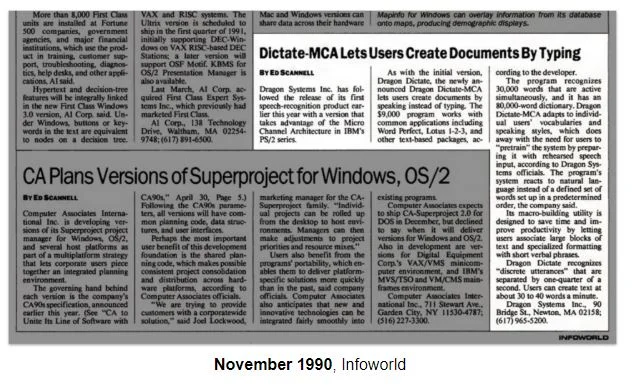
For better and worse, the 90s introduced consumers to automatic speech recognition in a form we’d recognize today. Dragon Dictate launched in 1990 for a staggering $9,000, touting a dictionary of 80,000 words and features like natural language processing (see the Infoworld article above).
These tools were time-consuming (the article claims otherwise, but Dragon became known for prompting users to ‘train’ the dictation software to their own voice). And it required that users speak in a stilted manner: Dragon could initially recognize only 30–40 words a minute; people typically talk around four times faster than that.
But it worked well enough for Dragon to grow into a business with hundreds of employees, and customers spanning healthcare, law, and more. By 1997 the company introduced Dragon NaturallySpeaking, which could capture words at a more fluid pace — and, at $150, a much lower price-tag.
Even so, there may have been as many grumbles as squeals of delight: to the degree that there is consumer skepticism around ASR today, some of the credit should go to the over-enthusiastic marketing of these early products. But without the efforts of industry pioneers James and Janet Baker (who founded Dragon Systems in 1982), the productization of ASR may have taken much longer.

wither speech recognition
Whither Speech Recognition— The Sequel
25 years after J.R. Pierce’s paper was published, the IEEE published a follow-up titled Whither Speech Recognition: the Next 25 Years⁵, authored by two senior employees of Bell Laboratories (the same institution where Pierce worked).
The latter article surveys the state of the industry circa 1993, when the paper was published — and serves as a sort of rebuttal to the pessimism of the original. Among its takeaways:
The key issue with Pierce’s letter was his assumption that in order for speech recognition to become useful, computers would need to comprehend what words mean. Given the technology of the time, this was completely infeasible.
In a sense, Pierce was right: by 1993 computers had meager understanding of language—and in 2018, they’re still notoriously bad at discerning meaning.
Pierce’s mistake lay in his failure to anticipate the myriad ways speech recognition can be useful, even when the computer doesn’t know what the words actually mean.
The Whither sequel ends with a prognosis, forecasting where ASR would head in the years after 1993. The section is couched in cheeky hedges (“We confidently predict that at least one of these eight predictions will turn out to have been incorrect”) — but it’s intriguing all the same. Among their eight predictions:
“By the year 2000, more people will get remote information via voice dialogues than by typing commands on computer keyboards to access remote databases.”
“People will learn to modify their speech habits to use speech recognition devices, just as they have changed their speaking behavior to leave messages on answering machines. Even though they will learn how to use this technology, people will always complain about speech recognizers.”
The Dark Horse
In a forthcoming installment in this series, we’ll be exploring more recent developments and the current state of automatic speech recognition. Spoiler alert: neural networks have played a starring role.
But neural networks are actually as old as most of the approaches described here — they were introduced in the 1950s! It wasn’t until the computational power of the modern era (along with much larger data sets) that they changed the landscape.
But we’re getting ahead of ourselves. Stay tuned for our next post on Automatic Speech Recognition by following Descript on Medium, Twitter, or Facebook.
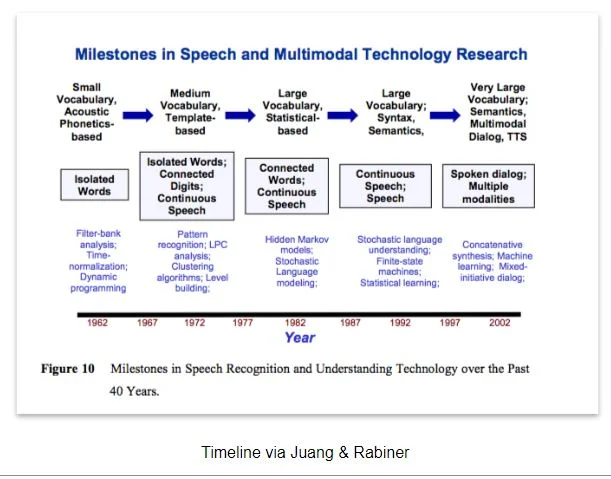
speech recognition timeline

15 Tutorials for Creating Amazing Content for Websites
how to write better content
Do you know how to write content for websites? Here is a list of my top 10 articles on creating website content that rocks.
How to Edit Your Site Copy: Commas, Quotation Marks and Semicolons
20 Free Ways to Get Photos and Multimedia Content for Blog Posts and Articles
Here are some bonus videos to help you out with your content quest, as well:

A Few Things Every New Freelance Writer NEEDS to Know
If you want to make a living as a freelance writer, there are some things you need to consider before you start. Fail to follow a few things that are considered the norm in the industry, and you may be doomed to failure before you have written your first piece.

Good Access To Resources
There is more to producing a piece of work than the actual writing. In any one day you could be tackling 3 or 4 different subjects. To write effectively about them, you need to understand them. You need access to good resources for research purposes. You may think you know a subject inside out, but things develop and change all the time, and you should never write a piece assuming you know it all.
Part of this is ensuring you have a good Internet connection, or you will not be able to find the information you need. Next, look for information from trusted sites. Government and university websites are ideal. Zoos, museums, trusted news sites and Consumer Reports are good sources, too. Be sure that the site is unbiased and doesn't have an affiliation with a product for the best information.
Good images are also important. Here are 20 Free Ways to Get Photos and Multimedia Content for Blog Posts and Articles.
Insurance
This might not seem relevant, but what if you have a break-in and your computer is stolen? You should have home based business insurance, as no device means no money is earned. This relatively inexpensive insurance that will pay for you to get up and running again much quicker.
Edit, Edit and Edit Again
Editing the piece you have written is crucial. Walk away from it for a bit and come back with fresh eyes. There are also programs available that will check your work for obvious errors, but they won't turn it into a good piece of copy, that is up to you.

editing
Don’t Miss Deadlines
Never miss a deadline, as these are vital for some of the people you will be working for. Clients don't ask to have your piece by a certain day and time for no reason, there are often other things that need to be done after you have finished. They may have to add links, images or videos and these can all take time to source.
Accept Feedback With A Smile
You could send the same piece of work, as a freelance writer, to two different people and one love it and the other hate it. This could be for several reasons. Each piece has to be suitable for the place it will be published, whether that is online or in print. You may get negative feedback if an article is the wrong tone or aimed at the wrong audience. All these things should have been part of the brief you were originally given, and if you don't follow that you should expect negative feedback.
Don’t take it personally though. Look at is as part of your learning curve to becoming a freelance writer, and remember what has been said. It could be useful in other pieces you do.
Freelance writing needs a strong work ethic as you could find you have very little one day and need to work 20 hours the next. It is the nature of the beast, but one that can easily earn your living if you are prepared to work at it.
Here are some more tips:

Profitable Tips For The New Freelancer
It can often pay to consider how to profit when first taking on a freelancing role. Freelancing is often stereotyped as a career path for lazy students who cannot spend an hour of the day outside of their pajamas, perhaps eating cereal as they work on their editing commission.

While there are likely people out there like this right now that fit that stereotype to the T, this is not the vast majority of working freelancer portfolios.Most freelancers have to double down on self-promotion, self-confidence and the willingness to sustain and impress repeat clients. This does not mean that the income stream is ever guaranteed. If you find yourself in this position and wish for a little extra cash flow in your favor, you may consider taking on these attitudes and habits for doing so:
Starting In Your Free Time

Starting in your free time is perhaps one of the wisest steps you can take as you build your reputation. It might be that you already have a skillset that you can apply, but before you gain clients and complete a few jobs, you will have little to offer and little clients interested in you. This means that taking the time before you quit your day job to refer to your side hustle in the evenings can help you keep your standard of living while also working hard to build your clients.
This arrangement won’t last years. Just a temporary period of this can help you prove yourself without financial worry, even if you might be a little pressed for time. If you have the funding or the will then, by all means, it could be worth making this your full-time gig immediately, but don’t jump into that with haste unless you are sure in more ways than one.
[bctt tweet="Profitable Tips For The New Freelancer #freelancing #business" username="alinabradford"]
A Home Side Income
It can be that as you establish your main freelancing desires, you decide to nurture a home side income. You may decide to tutor beginners in your freelancing skill, allowing you a secondary form of income instead of just trying to secure standard jobs through reputation alone. You may also decide to make the use of sitting at home all day working on your craft, by focusing on Algo trading as a hobby, an automated investment portfolio management system that can help you manage your bonds and stocks with a degree of finesse, and educate you on how these systems work. It’s not hard to see why diversifying your skillset through methods like this can make you a more rounded person, even if you were initially only targeted to complete your one artistic endeavor. It’s good to have side hustles.
Quality vs Quantity Of Clients
While you may want to establish many clients in the early days to build your reputation (this is a good option,) sometimes it might pay to ensure you only take on good jobs that you can really utilize your flair in to help build your unique offering, and develop your testimonials to an impressive degree with larger names. If you ever have the choice between one excellent and well-known client and two lesser known ones, decide if quantity or quality is more important to you. There is no right answer, but carefully thinking how they might benefit your operation could help you in the long run.
With these simple tips for the new freelancer, you will surely start with the best attitude to hand.

Success With Money | 5 Bad Money Habits That You Can Easily Change
Freelance writers, are these simple money mistakes keeping you from achieving financial success and true wealth?Let’s take a look at five of the most common money mistakes. Are you guilty of these bad habits? Is there room for improvement? Change might not be as hard as you think. Financial success begins with taking small steps. Doing one right thing with your money today can make a world of difference to the security of your tomorrow.

5 Bad Money Habits To Change Today
Guest article by Beau Henderson
Bad Habit #1: Waiting to save until you are making more money.
Saving money isn’t a function of your paycheck, it’s a lifetime habit. You don’t wait to save until you feel rich; you do it to get rich. Waiting only cheats you out of the money you could be earning due to the magic of compound interest.
Change your mindset to paying yourself first. Start now with whatever amount you can afford, and treat it like you would any other important bill that needs to be paid. If you have a 9-to-5, take advantage of any free money offered through your employer and contribute to your 401(k) or IRA. Have an amount deducted from every paycheck and put it on auto-pilot for success. If you never see the money, you’ll soon learn how to live without it.

success with savings
Bad Habit #2 Putting emergency expenses on the credit card.
This habit is a trap that leads to a vicious cycle of mounting debt. The only people who benefit are the credit card companies who receive billions each year in interest payments.
The solution starts with the establishment of a simple emergency fund. Open a savings account you can easily access – one different from your retirement or long-term savings goals – and start putting away money every month. To fund your emergency account, make only the minimum payments due on your credit cards. Put the rest into your emergency savings account. Continue until you have accumulated one month’s worth of living expenses in your emergency fund, and then tackle that debt.
Bad Habit #3 Saving for your kid’s college expenses before saving for retirement.
Whenever the subject of retirement comes up, I hear the question, “But what about saving for my child’s college education?” This concern leads to confusion and feelings of overwhelm. A lot of people end up so paralyzed, they don’t save anything at all.
The solution starts with the realization that while you can finance a college education, you can’t finance your retirement.We all want to give our kids the best start we possibly can, but the situation is a lot like flying in an airplane during an emergency. You have to put on your own oxygen mask before helping your children. Take care of your retirement first. That will put you in a stronger position to help others.
Bad Habit #4 Keeping the majority of your retirement savings in the bank.
This is a bad habit created by fear. While the FDIC does insure the base amount of your savings, it doesn’t protect against inflation and the rising cost of health care. The average cost of a one-bedroom stay in an assisted living facility unit rose 4.26 percent from 2008 to 2013, while the rate of inflation rose just 1.64 percent over the same time period.* If you are relying on the banks to keep your money safe, then chances are you’re going backward when it comes to your retirement savings.
Cure yourself of this fear by getting some education about investment alternatives. Insurance companies have developed newer products designed to give retirees with both safety and a rate of return that can keep up with the rising cost of health care.

successful freelance writer
Bad Habit #5 Spending 100 percent of every paycheck.
It has become the norm in our culture to finance a lifestyle we can’t really afford. The banks tell us we qualify for loans and we accept their numbers. This puts us in a position of needing every penny of every paycheck just to pay the bills and keep the lights on.
Adopt a new habit of living below your means. Even though the bank says you qualify, go by your numbers instead. Even though you can afford a new car, buy a used one and put the remaining funds in an emergency savings account instead. It doesn’t matter whether you earn $20,000 a year or $200,000, you will become wealthy if you keep to this simple rule: live on less than you make.
*Reference:
About Beau Henderson
Beau Henderson is the Bestselling Author of several books including The RichLife: Ten Investments for True Wealth, The Roadmap to a RichLife, The 5 Thieves That Will Steal Your RichLife, The RichLife Stewardship Principle and Masterful Communication For Success With Business and Life with Dr. Bill Lampton. He holds a degree in Psychology from the University of Georgia as well as the designations of Retirement Income Certified Planner, National Social Security Advisor, Certified Long-Term Care, Master Certified Success Coach and Certified Master Behavioral Analyst, in addition to his role as CEO of The RichLife Advisors. As a media contributor, Beau’s message of the RichLife has been featured in media outlets including Fox, The Huffington Post, Wall Street Journal, Reuters, CNBC, and MarketWatch.
Website: http://www.richlifeadvisors.com/ and http://beauhenderson.com/
Hey Carries! Enter to Win 2 Tickets for the Sex and the City Tour
Hey Carries! Enter to Win 2 Tickets for the Sex and the City Tour

I've been in business for 20 years! Guess who else is having her 20th anniversary? The world's most famous fictional writer, Carrie Bradshaw! For this occasion, I'm giving away two tickets to the Sex and the City Hotspots Tour.
Here's more information on the tour:
"On this guided Sex and the City tour, follow in the footsteps of Carrie, Samantha, Charlotte, and Miranda – you’ll drink where they drank, shop where they shopped, and gossip where they gossiped. This Sex and the City tour includes more than 40 locations from the show! Whether you’re a Sex and the City fan eager to learn more about your favorite show or a tourist looking for an entertaining way to see Manhattan’s best neighborhoods, the Sex and the City Hotspots tour is a must-do!"

Tour "Haute" Spots
Visit the site of Carrie and Big’s wedding rehearsal dinner
Walk past Carrie’s famous brownstone stoop
Hop into the Pleasure Chest where Charlotte buys her “Rabbit”
Scout the bar owned by Steve and Aidan
Reminisce Miranda’s embarrassing underwear moment in the Village
Venture into the trendy neighborhood, MePa, where the girls frequent
Pass the café where Samantha invites the girls to Abu Dhabi
Get some retail therapy like Carrie & Co. at Greenwich Village boutiques
Indulge in cupcakes like when Carrie confides in Miranda about Aidan
The upscale restaurant where Samantha Jones met her senior citizen millionaire
The storied jeweler where Charlotte York picked her engagement ring
The New York Public Library, site of the would-be wedding of Carrie and Big
The chi-chi department store where the ladies discussed Alexander Petrovsky
The quaint church where Samantha wooed “the Friar”
ABC Carpet & Home, where Charlotte and Bunny McDougal fought over a bed
Carrie’s brownstone apartment stoop
The expensive men’s clothing store where Miranda took Steve shopping for a new suit
The shop where Charlotte bought her “Rabbit”
Aidan’s Furniture Company
The Bakery where Carrie and Miranda ate cupcakes
Charlotte’s gym
Boutiques along Bleecker Street – these could include Marc Jacobs, Ralph Lauren, Marc by Marc Jacobs, Toosh, James Perse, Brunello Cucinelli, Fresh, Lulu Guinness, Creed, Mulberry, Olive and Bette, and more!
And more!
The winner will be drawn on August 1st, 2018 and will be notified by email. One entry per person.

Travel Writers: How to Keep Your Data Safe While You Travel
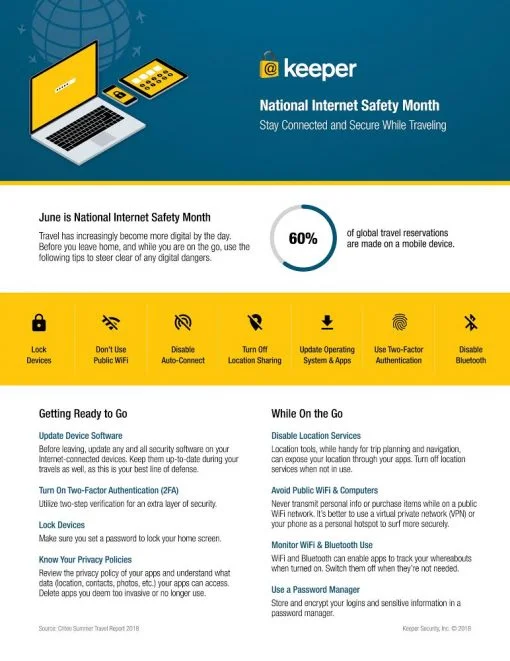
Writers, keep your data safe while on assignment. Here’s how.

June is Internet Safety Month. While you're traveling, it's important to keep your data safe. Keeper created this cool infographic that highlights some recommendations for travel writers or anyone else that will be traveling this summer.

Are Flexible Schedules the New Freelance for Writers? 30 Companies Hiring for Flexible Schedule Jobs in 2018
Are flexible schedules the new freelance for writers? FlexJobs offers their insight and the top 30 companies that hire with flexible schedules. This list may be a treasure trove for writers that want a full-time job with the flexibility of freelancing.

Are flexible schedules the new freelance for writers? FlexJobs offers their insight and the top 30 companies that hire with flexible schedules. This list may be a treasure trove for writers that want a full-time job with the flexibility of freelancing.
Having a flexible schedule is one of the most desired types of flexible work arrangements, second only to remote work, and well ahead of part-time and freelance jobs. Fortunately, jobs that offer flexible schedules are available across industries and career levels. To highlight the diversity of companies that hire for flexible schedule jobs, FlexJobs has compiled the top 30 companies hiring for flexible schedule jobs in 2018. This list is based on an analysis of over 50,000 companies and looks specifically at their flexible schedule job posting histories in FlexJobs’ database between January 1 and May 31.
These 30 companies represent a wide variety of industries, such as education, finance, human resources, and healthcare. Auditor, bookkeeper, email marketing manager, fundraising associate, occupational therapist, and senior HR specialist are just a few of the diverse flexible schedule job titles currently available at these companies.
“While facing a tight labor market, employers need to think strategically about how they can attract and retain top talent, and recognize how much people across all demographics value work flexibility,” said Sara Sutton Fell, founder and CEO of FlexJobs. “With improved work-life balance, decreased stress, and better overall health, workers absolutely prioritize flexible work arrangements, and smart companies, like the ones featured on this list, are making more and more of these types of positions available,” Sutton Fell concluded.
A “flexible schedule job” refers to jobs that allow workers to vary their hours and mostly be in control of the hours they work.

30 Companies Hiring for Flexible Schedule Jobs in 2018:

King and Prince Resort: The Ideal Writer's Retreat
During the month of May I had the pleasure of traveling to the lovely St. Simons Island on the coast of Georgia. While I was there, it struck me that this place is an ideal spot for a writer's retreat.
During the month of May I had the pleasure of traveling to the lovely St. Simons Island on the coast of Georgia. While I was there, it struck me that this place is an ideal spot for a writer's retreat. Driving in, I noticed the blunt lack of commercialism. You won't find super stores or billboards lining the streets. What you do find is pretty island cottages in bright colors and homey shops that specialize in everything from mead and other honey products, like Savannah Bee Company, to fine glass art, like at Pain in the Glass.


Nestled in with these shops are fun restaurants that feature local cuisine that will blow your mind. I loved the delicious down-home food at Gnat's Landing and the gourmet delights at Georgia Sea Grill.


Overall, the downtown area is a great place to walk around all day long. (Though I wish I had some trekking poles.) If you can make it past all of this awesomeness to get to the beach, you'll find the crown jewel of St. Simons Island, The King and Prince Resort. It's the only resort on the island with beachfront views and a great place for writers to escape to.

What I love most about King and Prince is there aren't distractions to get caught up in. Just sea and quiet in a historical building that is a member of the Historic Hotels of America and is named to the National Register of Historic Places. No neon signs. No crazy beach parties. No buildings higher than four-stories. Just the feeling of solitude, even when the resort is full of people.

When you're caught up in writing, you don't need to rely on fast food delivery. There is room service, but I prefer the completely lovely ECHO restaurant found on the first floor. You can choose to sit beachside at one of the picnic tables while you eat and write in your notebook, shaded by a large umbrella.

One morning I did just that, and it was blissful. The sand is white and the tides are incredible. Because of its location on the coast, the island's tides are massive and a fascination to watch while you brainstorm or daydream.



The inside of the resort is just as great for daydreaming. There are gorgeous stained glass windows on the second floor with a cute little sitting room where I found myself each morning. If you can't find inspiration to write while showered with morning light beaming through colored glass, we can't be friends.

There are other little sitting nooks hidden all over the property where you can write and relax. Here are just a few that I found.




Overall, the King and Prince provides just the type of setting that creatives need to think and write. I was fully inspired every day I was there.

Signs You've Found The Perfect Business For You
Whether you’re somebody who just wants to get out of the rat race by starting a successful venture, or somebody who considers themselves a budding entrepreneur and just wants something to start them off, you need to know what signs to look out for to know that you’ve found the perfect business. Here are some pointers that should help you to figure it out.
Finding the perfect business for you can take a lot of research, brainstorming and going backwards and forwards. Whether you’re somebody who just wants to get out of the rat race by starting a successful venture, or somebody who considers themselves a budding entrepreneur and just wants something to start them off, you need to know what signs to look out for to know that you’ve found the perfect business. Here are some pointers that should help you to figure it out.

You Feel Excited a Lot of the Time
If you’ve come up with an idea and you feel excited about it a lot of the time, you can feel fairly confident that you’ve found a business you should pursue. Feeling excited at the start of any business venture is normal, so you need to make sure that this feeling of excitement isn’t just going to wear off after a short while. See if you can be sensible through the excitement and listen to your intuition. Does this business idea feel right to you?
You Have What it Takes to Succeed in the Industry
In any industry, you’re going to need a few things to make sure you can succeed. A little knowledge of the industry will go a long way, of course, but remember that you don’t need to know absolutely everything to get started. If you wait until that moment, you’ll be waiting a very long time! You also need to be passionate about the industry and the idea, as well as have some kind of skill. If you can combine all of these things, then you should feel good about starting a business.
You Can Make Contacts
Oftentimes, it’s not what you know, it’s who you know. If you know you can make contacts in the industry that you’re thinking of pursuing, then it could be a good idea to go with it. Making contacts, even with suppliers is a great way to save money and get your business off to a fantastic start. Whether you’re looking for a supplier of vertical water storage tanks or you just need some office furniture, making contacts in the industry will help you to get to where you want to be.
You’re Always Coming Up With Ideas
Being a business owner is all about coming up with new ideas to keep your business moving forward, and to ensure that it won’t die. If you can’t seem to stop coming up with ideas, this is a great sign that you’ve found your ideal niche!
You’re Willing to Accept the Not so Great Stuff
In every industry, there are some not so great things that you’ll have to put up with. It doesn’t matter if you're working at your dream job, you’re going to come up against some challenges and some things that you just don’t enjoy as much. Think of the things you’ll likely have to deal with in this industry and whether you’re willing to accept them. If you are, you know you’ve found the perfect business for you!

How Freelancers Can Learn from Green Hair
You need to be like green hair, my freelance writing friends. Story time!
You need to be like green hair, my freelance writing friends. Story time!
When my daughter was in elementary school she decided she wanted green hair. Since we’ve always encouraged our daughters to be themselves, her dad spent all evening lovingly coloring her hair.
The next day, I got a phone call from my daughter’s teacher. The green hair caught the eye of a bully and he was harassing my little girl. I was sad for my daughter, but what the teacher said next floored me. “She really needs to change her hair back to blond so she doesn’t distract the other students.” So, basically, my daughter needed to conform to make the bullies comfortable and quiet. A white-hot rage welled up inside of me. Our world is seriously fucked up, I thought to myself.


Your freelance writing dream is a lot like green hair. It’s different. People are uncomfortable with different and, more than likely, family and friends will give you hell over your decision. Why can’t you just have a nice, stable normal job like everyone else? Get your head out of the clouds and come back down to Earth, they’ll say.
Ignore them!!!

Your job in this life isn’t to make people comfortable with your personal choices. The choices you make for yourself are meant to do one thing: make you happy. If you love putting words on blank screens or filling pages of notebook paper with ideas, go for it! You do you. Luxuriate in the feeling of being weird and free.

Is Your Business's Branding Up To Scratch?
Is your branding good enough. Probably not. Here’s how to find out.
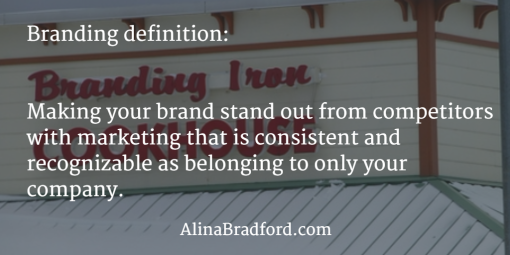
Branding definition
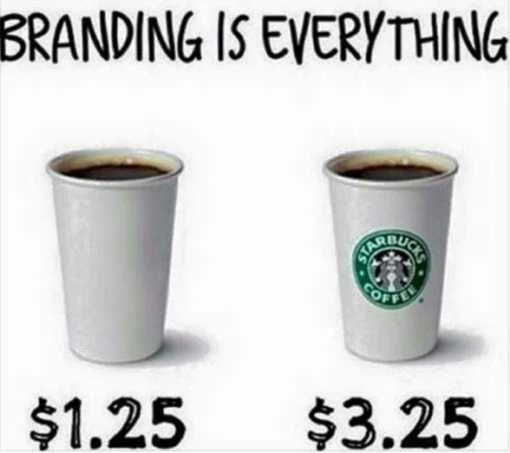
When it comes to setting up your own business, it falls to you to figure out where your priorities lie. Of course, every business owner is going to have a different set of priorities to those around them, and it's often easy to fall into the trap of focusing your energy in the wrong places.
After all, your instinct may be to focus on the areas of your business that interest you or that you're skilled in, but that just leads to things being neglected. One of the most tragically neglected parts of many smaller businesses is their branding. Without high-quality branding, no-one is going to take your business seriously. With that in mind, here are some ways to get your branding up to scratch.
Understand design trends
branding tips
One of the most common mistakes that a lot of businesses make with their branding is that they try to latch on to current design trends as though that's going to immediately make their branding better.
However, the truth is, the key is to try and understand them so that you can figure out what it is that makes them popular in the first place. That way you'll be able to use those same ideas in your own branding, rather than just creating branding that is derivative of your competition.
Use different media

branding image
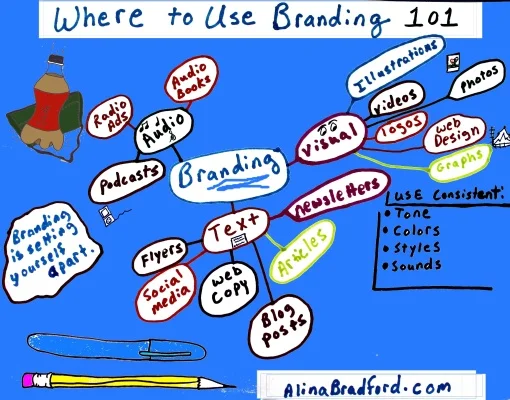
In the modern era, there are now more different types of media than ever before. Your branding needs to be able to function properly no matter what medium you're using at any given time. Whether it's social media posts, customized labels, or a giant billboard next to the highway, being able to create branding that works across a variety of different media is pretty much essential.
Of course, this means that you have to consider how people will interact with your branding. Think about whether your branding is just as effective when looked at for a moment compared to when it's looked at for a longer period of time. Or perhaps how good it looks when blown up to giant proportions.
Outsource it
where to use branding
Even if you know what it is that you want from your branding, that doesn't necessarily mean that you're going to be able to turn that into a reality. If that's the case, the best thing that you can do is to outsource your branding to an expert designer or design team. Sure, handing over parts of your business can be pretty scary, but it can also be one of the very best ways to not only create the best possible branding, but also to free up your mind to focus on other areas of your business.
It's understandable that a lot of small businesses tend not to focus enough on their branding. After all, not everyone can be a graphic designer and most smaller businesses don't have the kind of budget for a design team. However, this side of your business is simply too important to allow it to fall by the wayside. If you do, you're letting down your entire business.

Clear Communication Is The Key To Success In Freelancing
Poor communication can not only undermine your credibility as a freelancer, it can scare clients away resulting in a sustained pattern of lost earnings. In order to ensure that your communicate clearly and efficiently for freelancing success, it’s vital that you learn to...
Lots of people give up the day job for a freelancing career and never look back and it’s not hard to see why. The freedom to set your own hours, work at your own pace and choose through design or plain old trial and error which practices and processes work for you is understandably appealing. Most freelancers also appreciate being able to work autonomously, without having to get their every creative decision or artistic flourish signed off by a committee of managers and board members. But while freelancing allows us to take our career and our destiny into our own hands, we must be mindful of bad habits and poor practices that can harm our career prospects.

In lieu of the systems of training and professional development our salaried friends enjoy, freelancers must be true autodidacts, constantly learning new ways to make their practices more effective and efficient.
Nowhere is this better exemplified than in the world of communication. All freelancers, even those who work remotely, must be in a perpetual state of communication with clients, sources, contacts and others on whom they rely on a daily basis. Poor communication can not only undermine your credibility as a freelancer, it can scare clients away resulting in a sustained pattern of lost earnings. In order to ensure that your communicate clearly and efficiently for freelancing success, it’s vital that you learn to...
Choose a communications platform that works for you
Lots of freelancers feel that they come across best in person or over the phone, but these are rarely the most efficient means of communication. Cold calls from clients are a pet hate amongst veteran freelancers and while communicating over the phone can be advantageous to freelancers, it’s important to make sure that phone calls, skype calls and face to face meetings are scheduled as much as possible to allow for optimal time management.
Email is all well and good but it’s rarely the most efficient form of communication due to its lack of immediacy. As you’ll see from this post, many businesses are embracing the immediacy of text messaging to facilitate efficient business communications. There’s no right or wrong here, it’s simply a matter of what works for you.
Proof read your communications with the client in mind
When composing outbound communications to clients or when applying for freelance positions it’s important to read them with the client in mind. Is your use of language needlessly elaborate? Is your communication written with brevity and efficiency of communication? Bear in mind that the person reading it is likely to be very busy and won’t have time to pore over lengthy emails. While s smattering of technical jargon is good for showing that you know your onions, using too much of it can make you seem smug, while going OTT on the acronyms may alienate some clients.
Build value in your invoices
Finally, an oft overlooked form of communication with your clients is your invoicing. Your invoice isn’t just how you get paid, it’s an important part of your communications. Does the client know that they’re getting their money’s worth? Have you included any discounts or anything you’ve thrown in for free on your invoice? If your client recognizes the value in what they’re paying for, they’ll be much more likely to invite you back.
Just starting out and need some good advice? Check out my book:
The Fluff-Free Freelance Writing Master Course Workbook

Steal This Trick to Get More Twitter Followers
Social media marketers use this trick and you can too.
Social media marketers use this trick and you can too.
Having a legion of Twitter followers is a status symbol, but it's also a way people morph themselves from mere individuals to influencers and tastemakers. Many of the people with massive followings you see on Twitter didn't get them organically. They either purchased followers, which I don't recommend, or they used the "follow for followers" method. You can do the later to boost your following without any money.

get twitter followers
A little disclosure: I'm a social media manager for some of my clients. Not only have I been behind the scenes of brand accounts, but I've also attended many social media marketing seminars that teach the follow for followers technique. People who abuse the technique can get their accounts shut down, but as long as you follow the steps properly, you won't have a problem.
The Steps to Getting More Twitter Followers
The follow for followers process is pretty simple. First, find someone on Twitter that posts a lot of things that you like to post and has a lot of followers. You probably already follow someone on Twitter that you love and would love to emulate. This will be your target.
Next, go to their profile and click where it says their follower number below their header photo. This will take you to a list of their followers. These followers like what your target post, so chances are, they will like what you post, too.
Conveniently, beside the name of each follower is a follow button. Stretch out your clicker finger, because it is going to get a workout. Follow 100 of these target followers and stop. Wait around 5 minutes and follow another 100. I know one marketer that follows 1,000 people per day, per account, but 200 to 400 is safer and it still gets results.
Do this every day for 10 days.
Now Do a Purge

starbrew not following back tool
When the 10 days are up, you'll have a lot of new followers, but you will be following way more people than are following you back. After 10 days if a person isn't following you back, it's unlikely that they are going to. Many of your unfollowers will be inactive accounts or bots. So you need to do a purge.
Unfortunately, you can't manually unfollow people in any organized way on Twitter, so sign up for Crowdfire and StatusBrew. Each tool allows you to unfollow 100 people per day using a free account.
If you use both tools, you will be able to unfollow 200 people per day to purge your non-followers. To do this, go to the "not following back" tools and change the settings so that it is displaying your oldest non-followers first. Now start unfollowing.
followers on Twitter
To make the process easier, you can automate it using a tool called Jooicer. For a few bucks a month you can set up this tool to automatically follow people who are interested in topics you post. It will also automatically unfollow people who don't follow you back. I've tried it on one of my accounts and I'm not hating the results.
Keep Your Account Safe
There are some things to remember when using this method. When an account is following and unfollowing large amounts of people in a short period of time, it may think that the account has been hacked or that it is controlled by a bot. In most cases, Twitter will just make you change your password, but accounts can get shut down. So, to avoid this, take a break in-between batches of 100 follows and 100 unfollows.
Don't Be Shifty
There's a practice among some that I call "Twitter baiting." It uses the follow for followers technique, but instead of just unfollowing people who didn't follow them back, these people unfollow everyone, usually as soon as the person follows them back. These sneaky tweeters know that most people will keep following a person even when they are unfollowed only because most people don't keep track of who follows them and who doesn't.
If you're trying to build a community of Twitter followers, this practice is a big no-no. You want to be able to see what your followers post so you can get an idea of what they want to see you post. If you're not following them, you won't get this valuable information.
Plus, people get wise to this practice over time and word may spread that you're a spammer. That's not a great way to build a following.

i have more twitter followers than
The Results
Granted, the follow for followers technique is a boring process, but it offers big returns. If you do this process every day for ten days, you'll be impressed at how well your numbers grow. The results usually follow a 2:1 ratio. For every 200 people you follow, you will gain around 100 followers. By the end of 10 days you'll have 1,000 new followers. If you keep this up, you can amass around 6,000 followers in two months.
Something I've noticed is you get unexpected Twitter followers that you didn't follow. My theory is, when people are following you back Twitter adds you to the "Who to Follow" list on the pages of the followers of your new followers. I call these bonus followers.
The best part is, your new Twitter followers won't just be random people. They will be people who like what you like and will actually interact with you and share your posts. Sharing posts will attract new followers and soon your Twitter account will be growing on its own.

How to Apply for Freelance Writing Jobs Quickly
Okay, you've seen the places I look for freelance writing jobs and you've seen how I weed out the best paying jobs. Now I'm going to show you how I apply for the freelance jobs quickly. The secret is that I use templates I customize for each gig.
Okay, you've seen the places I look for freelance writing jobs and you've seen how I weed out the best paying jobs. Now I'm going to show you how I apply for the freelance jobs quickly. The secret is that I use templates I customize for each gig.
For example, one of my niches used to be fitness and healthy eating. So, I wrote a cover letter that goes over all of my expertise in this area. When I applied for jobs in this niche, I just tweaked the cover letter a bit and copy and paste it into an email. I'd change out writing clips, too, according to what type of articles or blogs the client is looking for. One out of five tries, my templates usually brought in a client. I bet you want to see one of my templates. Here's one of my old ones that got me a lot of gigs:
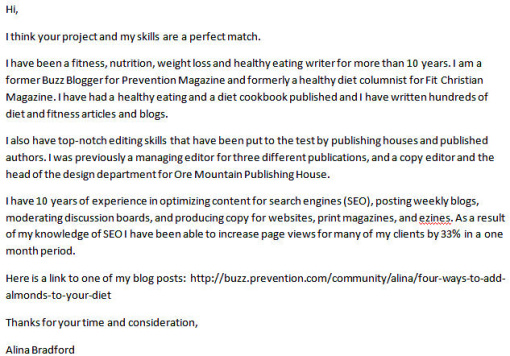
It's as simple as that. I also had a resume that is customized to the fitness and healthy eating niche to go with the template. This part is very important because you don't want to send a general resume with a targeted cover letter. They just won't mesh and your client will be confused. Or bored. Or both.
Do you use templates or other quick way to apply for freelance writing jobs? Let me know!
.

How to Quickly Weed Through Freelance Writing Job Ads
Today, I'm going to show you how I weed through freelance writing ads quickly everyday to find the real gems.
When I need a new freelance gig I usually find one in a few day's time. Is it because I have really low standards? No. I get great new gigs quickly because I've gotten job hunting down to a science. A while back, I posted my list of job hunting sites.
Today, I'm going to show you how I weed through them quickly everyday to find the real gems.
First, I scan job lists for keywords that target my niches.
I only click on ads with titles that aren't generic like, "Looking for Writer" or "Freelance Writer Needed."
Then, I click on the job link and look to see if it is an on-site job or telecommute.
If it's on-site I toss it. I quickly look for the per word, per article or per job rate.
If it's too low I toss it. If I haven't tossed it yet, I actually read the ad. If it asks for too much work for the fee I toss it.
If by some chance the ad makes it to step four I will actually apply for it.