

4 Skills You Should Develop Before Starting Your Own Business
If you have dreams of starting your own business, one way you can be sure of success is to make sure you work on developing the appropriate skills - anybody can start a business these days, but that doesn’t mean they are going to be good at it, or that it’s going to succeed! Below, we’ll take a look at four skills you should develop before starting your own business.

Financial Management
One of the most important skills you’ll develop is financial management. This is because you’ll need to forecast your cash flow and sales, as well as monitor your profit and loss. Being financially literate is essential!
Communication
Communication is something you’ll be doing with your potential investors, suppliers, employees, and clients. This will help you to improve your business and ensure you build strong relationships. Make sure you work both on how you speak and how you use your body language to communicate.
Time Management And Delegation
Being able to delegate is one of the most important things that a business owner will learn to do. Feeling like you don’t want to let go of control is normal but you’ll only be shooting yourself in the foot. When you delegate effectively, you’ll be able to focus on the tasks you’re best at.
Writing Skills
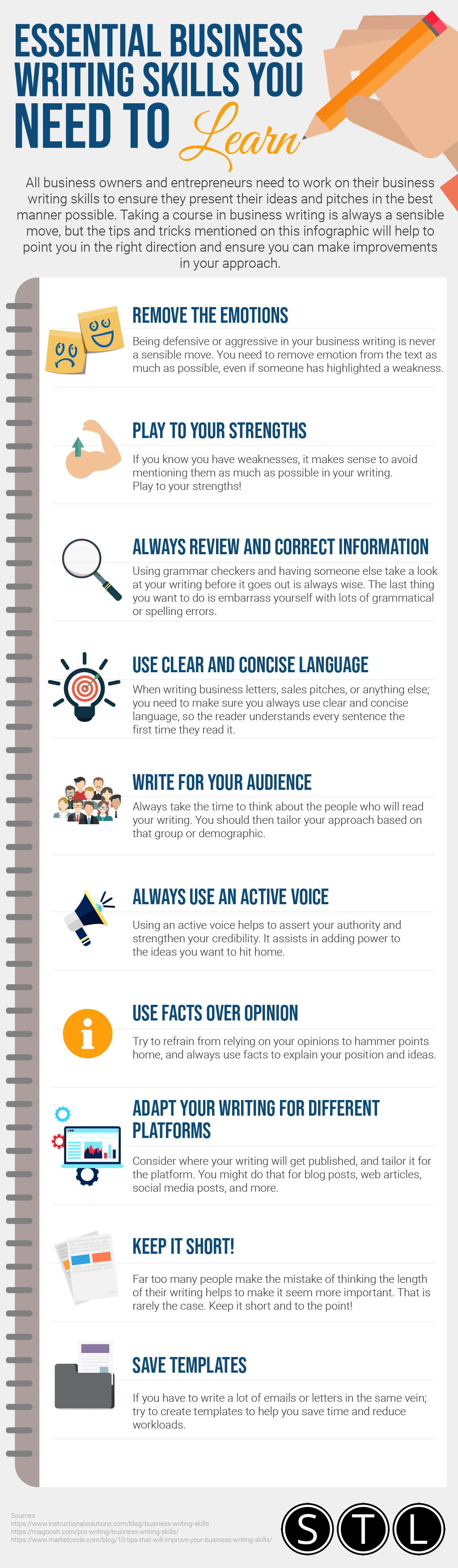
Writing skills are a must, whether you’re writing a blog post or putting together that all important business plan. There are lots of ways you can improve your writing skills - the infographic below can give you a few hints and tips.

How to Come Up With A Winning Product Idea Every Time
Coming up with a winning product idea every time is no accident. You need to make sure you’re using the right method to come up with your ideas so that you can be sure they are worth pursuing. Below, you’ll find a few ideas that will help you out.

Take A Close Look At Your Old Ideas
Start by taking a closer look at your old ideas - you never know, there might be something there you haven’t made use of yet. You could blend the old and the new, or you could modernize an old idea. You might even realize you overlooked a winner in favor of something else. Keep a list of your ideas somewhere safe.
Start Brainstorming
Brainstorming can help you to get everything out of your brain and onto paper. Get as many ideas as you can out of your head - you could even get a partner and bounce ideas off each other. Set a timer for a sense of urgency if you dare! You could easily come up with 20 new ideas this way, and then you can explore them more in detail to see which ones are worth pursuing.
Come Up With Add Ons To Past Products
If you don’t have a brand new idea, why not come up with an idea to improve your best selling products? You can do this by coming up with something that compliments them. Add ons can be great ideas too!
Find Problems Worth Solving
Finding problems worth solving is how you really come up with a fantastic idea. What problems do you encounter every day? What problems do the people you know encounter? Can you come up with solutions to these problems? This is a really simple way to come up with a great idea. Just make sure you read through the american trademark guide to ensure nobody steals your great idea before it’s set in motion.
Interview 10-20 Potential Customers
By interviewing potential customers, you can answer the question: is this a problem worth solving? Before you spend any money developing your product, interview potential customers so they understand the problem you’re attempting to solve - this is before you tell them about the features, pricing, or even how it’ll change their lives.
These are best carried out in person and should be up to 60 minutes in length. Remember, a problem needs to be high on a customer’s priority list if they are going to be interested. Many entrepreneurs start off by talking about a description of the product and features, however, it’s usually more effective if you understand the problem thoroughly to make sure the product as a whole doesn't miss the mark.
Ask the following questions to determine whether the problem is important enough to solve:
How much money will be made/saved with the solving of this problem?
Where is the problem on your priority list?
What is most frustrating about your current solution?

How to get refunds for flight delays, cancellations or lost luggage
Airlines have been in the news a lot lately for losing baggage, kicking people off of flights and overbooking. If you feel like you’ve been treated unfairly during a trip, these tips will help you get you what you deserve.

Check with your credit card company
If the airline is giving you the runaround, there may be an easier way. Some credit card companies cover unexpected travel expenses if you booked using their card. To see if you have this option, check your card through the Sift app (iOS) or website. You can also call your credit card company to ask about benefits. A free hotel room to wait out your layover, reimbursed tickets and more may be in the cards.
Document everything
Remember, your phone is your best friend during trips, so be sure to use it. Before your trip, take photos of your bags and their contents, just in case your bags are damaged or lost.
If you’re denied boarding due to overbooking or are asked to disembark a flight for a bizarre reason, document everything with your phone, including:
Extra expenses that result from the disruption, such as fees for hotels, new tickets and meals
Boarding passes
Baggage claim tickets
Original booking confirmations
Submit a PIR (Property Irregularity Report)
A good scanning app like Abbyy Fine Scanner or Evernote Scannable or CamScanner can help you make clear, readable copies of all of your documents.
Know your flight rights
No matter what the airlines may tell you, you have the right to a timely trip and there are rules that govern this concept. For example, US law says that you’re covered when a flight is overbooked, though how much is owed to you depends on the discretion of the airline. The European law EC 261 also requires airlines to compensate within 14 days of the departure date. The Montreal Convention provides airline passengers with certain rights to compensation on international flights between more than 120 nations, including the United States and Europe. You’re covered for extra hotel night stays, canceled reservations and more.
To get compensated, talk to the airlines at the gate desk as soon as you find out your flight will be delayed or the flight has been overbooked. Airlines have built-in compensation plans for when things don’t work out like they should.
Some things they may offer are:
Free rental car or shuttle service
Free hotel stay
Upgrade to a first-class flight
A ticket refund
Payment for time lost

…And your luggage rights
So the airlines got you there, but not your luggage? Here’s what to expect:
· If your bags are damaged the carrier is responsible, but they will go about repairing, replacing or compensating you for the bag as they see fit. Be sure to ask for a copy of their policies upfront. No matter what, be sure not to leave the airport without filling out and turning in a Property Irregularity Report (PIR).
· If your luggage is late, the airline must provide you with up-to-date information on where your bags are. They can also replace essential items that were in your bags, like toiletries, according to National Association of Citizens Advice, to help you out until your bags show up.
· If your luggage is lost and you’re flying domestically, your airline’s liability under the US Department of Transportation regulations is thousands of dollars per passenger. You’ll need to fill out an initial lost-luggage form and a second claim in which you show proof of your loss to collect.

Get Your Dream Job: A Quick Guide
If you want to stop wasting your time in a post that you don't love and where are underappreciated, you have come to the right place. In fact, below, you can find some simple, actionable advice about how to find your dream job. Read on to find out more.

Picture sourced at Pixabay - License CC0
Step 1: Know what you want
First of all, you really have to know what you want out of a job. A task that may seem a lot easier than it actually is. After all, there are so many different factors involved included salary, the skills you use, the type of people you will work with, the working environment, and even the hours. You must have a very firm grasp of what you will and will not accept before you start your job search.
Step 2: Know what you need
Once you have begun to narrow the field, establish what skills and qualifications you will need as a person to be able to get your dream job. For example, if you want to be a surgeon, it's no good dropping out of high school and not completing your GED. In fact, you will need many advanced qualifications and training for this role.
Of course, if you aren't willing to commit yourself to the education and cost needed to get it, it may mean that your choice isn't quite a dream job after all. You may need to go back to step one and rethink your options.
Step 3: Utilize helpful resources
After making sure you have all of the skills and qualifications, you will need to land your dream job, you’ll need to find some vacancies to apply for. Happily, this is a particularly easy step as there are lots of resources that can help you do this.
One is to use social media sites like LinkedIn to build a network of people already working in your dream field. You will be one of the first to know when a new position becomes available.
Additionally, use an agency that specializes in the area in which you are looking. For example, if your dream job is to drive a big rig up across the country, all you need do is use search terms like 'trucking jobs near me,' and you can find agencies that will be able to help you.
Step 4: Brush up on your interview skills
Finally, don't forget that even when you have found that dream position to apply for, you will at some point need to succeed in an interview. To that end, be sure to brush up on your interview skills such as active listening, and think up a few questions to ask as well.

9 Tips for Providing Amazing Customer Service
In my early days as a writer, I worked on the side as a customer service rep for Direct TV and a few other smaller companies. I learned a lot about good customer service while I was there and have added to that file of knowledge with the following years of running my own business. Today, I'd like to share my findings with you.
In my early days as a writer, I worked on the side as a customer service rep for Direct TV and a few other smaller companies. I learned a lot about good customer service while I was there and have added to that file of knowledge with the following years of running my own business. Today, I'd like to share my findings with you.

Remember FISH
During my training for Direct TV, we were forced to watch The Fish! Philosophy video. I found it surprisingly helpful, even after I laughed at the name. It is a customer service technique often used to train new employees at call centers to create a less stressful work environment and a better experience for the customer.
The theory was first created by John Christensen after watching how the employees of Pike Place Fish Market treated their customers. With a change of attitude, the little fish market increased their sales by 400% in 20 years. Using their four techniques, businesses can give good customer service, all while improving their own work life.
1. Choosing Your Attitude
This concept is the first major step to changing how you relate to customers and how you feel about your job. Choose to approach your day positively. Don't focus on the negative aspects of your business; focus on the things you enjoy. For example:
Remember how happy it makes you when a customer thanks you for your hard work.
Keep in mind the feeling of satisfaction you get when a caller hangs up the phone and you know you did your best to help them.
Think about the co-workers that you enjoy working with.

Remember FISH for better customer service.
Part of choosing a happy attitude is being able to set aside personal problems when you arrive at work. Here are some things to try before your shift begins:
As soon as you get to work, put yourself into "work mode" by getting your work area set up. Put away personal items and adjust your chair. You get the idea.
Take five deep, cleansing breaths. As you breath out, visualize pushing out the stress and worries. This sounds silly, but it really works.
The University of Cardiff in Wales found that people who smiled, even when they weren't happy, became happy. So, when you are in a bad mood, try smiling anyway. You may find that after a while your attitude matches your facial expression.
If you choose to go to work with a positive attitude every day, then it will shine through in your conversations with customers.
2. Play at Work

Pike Place Fish Market found that throwing fish, yelling and being silly energized them and their customers. As a customer service representative I didn't have a lot leeway on how much I could play at work, but you can. Have fun with the customer. For example, inject a little fun into your lines.
Instead of saying:
"How can I help you today?"
Try:
"How can I help you on this fine winter's day?
Or:
"It's a beautiful day inside my cubicle. How can I improve your day?"
Customizing your standard opening can put the customer at ease and can make you feel creative.
3. Make Someone’s Day
Many people dread calling a business to complain as much as they dread the dentist. You can turn an unpleasant experience into a good one simply by helping them with a happy voice and genuine concern. Caring about your customers can make all the difference.
4. Be Present

The key to caring is being present. Being present means that you pay attention to what your customer is saying. It is natural to want to tune out and focus on something else when your customer is angry or rude. I've been guilty a time or two! In these cases, just remember the customer isn't mad at you, personally, he's mad at the situation. Listen to what the customer has to say and don't interrupt. Interrupting may cause you to miss an important piece of information.
Also, some people aren't very good at articulating how they feel or the problem they are facing. Sometimes they will come to a conclusion in a roundabout way that doesn't make sense to you. Still, you need to pay attention so that you can connect the dots.
Once your customer is finished speaking, show them you care by repeating back to them the points you understood. Then, ask if you missed anything. For example,
"Okay, Ms. Smith, let me make sure that I understand your problem. You said that your cable was working fine this morning, but now when you turn on the television there is only a blue screen and you made sure that your cable box is on. I'm I on track so far?"
I've actually said that at least a dozen times in real life.
Your customer will appreciate that you are taking the time to listen and understand. Plus, you will benefit because you will be better prepared to address the problem.
Customer service is a high-stress position. Choosing a positive attitude, playing at work, making someone's day and being present are all great techniques that lead to good customer service. Give them a try and you will find your customer service scores rising and your job satisfaction growing, as well.
Five Steps to Defusing an Angry Customer without Blowing Your Fuse
As a call center representative, I came across angry customers on a daily basis. You wouldn't believe some of the things I've been called. Simple techniques such as staying calm and using an even tone can make a big difference. These techniques can calm the customer while leading to a more productive conversation and the ability to retain a customer.
Good customer service incorporates these five steps, below.
1. Listen

You can usually determine the emotions of a customer within the first few seconds. When you come across an angry customer, it is important to simply listen to them before trying to defuse the situation. The customer may just want to vent his frustration. Sometimes, after a person is given the chance to express extremely ticked off feelings, things will calm down and he will allow you to solve the problem with no further trouble.
It may be helpful to jot down the major points of the customer's problem on a notepad. Angry customers tend to go on tangents. Oh, man, do they go on tangents! Keeping notes will help you to find an answer to the problem more efficiently and has the added benefit of maintaining your focus.
Of course, if the caller is threatening, using violent language or swearing, follow your company's policy guidelines. Don't have those? Make some and be sure to write them down and put them in your business' policy file. (Don't have a policy file? Facepalm. Get one right away!)
It's perfectly alright to hang up or to ask a customer to leave if they are screaming profanities or threatening you. Don't feel bad. You don't need customers like that!
2. Remain Calm
It is important to stay calm during a call or customer confrontation to prevent the situation from escalating. Here are a few tips to try:
Focus on using an even tone while you speak. Using an agitated or angry tone will simply infuriate the person even more.
Remember that the customer isn't angry at you. It is the situation that is making her angry.
Take a few deep breaths to calm your nerves while the customer is talking.
3. Repeat Information

When your customer has finished talking, it is important to make her feel as if you are on her side. One way to do this is to apologies about the problem, and then repeat an abbreviated version of the customer's story. This is where your notes can help since they will allow you to hit on the pertinent points without going on a tangent and you will be sure to accurately relay the information.
Repeating the major points of the customer's story will not only make him feel you are listening, it will also give the customer a few moments to calm down. You may be surprised at how much calmer the customer will seem when he starts talking again.
4. Avoid the Hold Button
Many new customer service representatives will often put an angry customer on hold, believing that the hold time will allow the customer a moment to calm down. I have found that to be completely and utterly the wrong move. Being on hold usually makes people even madder, escalating the situation. Think about it. Do you like being on hold when you call a company? Does it calm you down? No, I didn't think so.

Some customers believe that hold time allows representatives to talk trash about the customer without being heard. Others believe that they are put on hold so that the representative doesn't have to deal with the problem. A customer's imagination will have plenty of time to think up negative reasons for the hold time. Believe me, I've been accused of these!
Instead of putting the customer on hold while you research the problem, keep him on the line. Talk to the customer. Let her know exactly what you are doing to solve their problem. For example,
"It seems to me that you may have a billing error. I'm pulling up your bill, Ms. Jones, and taking a look. I see that you where billed on the first of the month and the payment was made automatically through your credit card. You said you changed your method of payment, so now I am going to take a look at the notes on your account to see when that change was made."
Talking to your customer throughout the process is calming. She will feel you care enough to stay with her throughout the entire process.
5. Give Your Caller Options
Once you have researched the problem, now it is time to take action. Tell your customer what his options are and how soon each option can be implemented. A lack of control can enrage the customer even further, so, if possible, make sure to offer more than one option.
Dealing with customers are part of owning a business. Listening, using the FISH method, staying calm, repeating information, avoiding the hold button and giving your customer options are all vital to making your customers happy and keeping them coming back for more.
Need someone to write interesting, informative SEO content for your site? You’ve come to the right place.

How To Improve Your Patient Experience
When it comes to a medical clinic, the patient experience is a part of your success. To remain relevant and important in the eye of the patient, a medical practice needs to up their game in this respect.
When it comes to a medical clinic, the patient experience is a part of your success. To remain relevant and important in the eye of the patient, a medical practice needs to up their game in this respect. They need not be constantly busy with no one answering the phone. They need to offer the best services at the right price. They need to protect their data so patients can feel confident using the service at all.

So, with that in mind, let’s take a look at ways a medical clinic can improve:
Start Answering The Phone. Whether you need to look into putting a new phone line or two or you need to think about VoIP instead, you need to make sure that you have enough people actually able to help patients at the busiest times of day.
Protect Data. It’s something that we mentioned above, but your healthcare IT needs to top notch. Medical data is some of the most sensitive in the world, and your clinic does not want to be one that is known for leaking data into the public domain
Be Polite. One of the basics of patient care: be nice. Patients are the ones paying the bills, right? Wouldn't you want to ensure that they are enjoying the service you are providing? As basics go, you need politeness and manners - it speaks to a good bedside manner, even if you’re not working at the bedside!
Present Well. No one wants to walk into a medical clinic to see trash on the floors, dirty walls, greasy chairs. As a medical clinic, you need to think about the impression that you are giving, and cleanliness is imperative.
Be Contactable Online. Your website needs to encourage patients to sign up, and give your patients another way to contact you. The more available and contactable you are, the better the reviews you will get from your patients.
Offer Thanks. Manners maketh the medical center. If you are thanking your patients for attending appointments, for filling forms, for their time and business, they’re going to want to come back to you again and again. Don’t put aside the importance of manners and how they acn work for you in your favor.

4 Ways To Improve Employee Engagement In Your Business
These are some of the best ways to improve employee engagement in your business.
Engaged employees are a lot rarer than most business owners realize. Engaged employees are the people that really care about the success of the company and they’re willing to go the extra mile to help you push the business forward. If you have a team of well engaged employees behind you, your business will thrive.

Unfortunately, that’s easier said than done and most business owners find that engagement is a big problem for them. If you feel the same, these are some of the best ways to improve employee engagement in your business.
Keep Them In The Loop
Often, employees are not really invested in the overall success of the business because they don’t really see how they fit in with that. They come in, do their work, and go home, without ever really understanding the impact that they make.
But every single employee contributes to the success of a business and it’s important that your team knows this, which is why you need to keep them in the loop. When you hold staff meetings, you need to talk to them about the overall performance of the business and the individual successes that different departments are making. It’s also important that you trust them enough to let them know when things aren’t going so well. When they can see the big picture, people are far more likely to be engaged in the business.
Reward Them
People need to feel that they are getting something back when they put the work in. If they don’t get rewarded for going the extra mile, why should they bother? That’s why you need to give them tangible rewards for their work, like an employee of the month award, for example. Get some trophies or plaques (you can find some great ones at https://www.edco.com/employee-recognition-awards) and single out the people that are really going above and beyond. When other employees see that you reward people that are engaged in the business, it will encourage them to come to work with the same attitude. A bit of competition between team members will also boost productivity as well.
Offer Opportunities For Advancement
Giving people new opportunities and helping them to develop as a person is a great way to give back and show them that you are invested in them. When people feel that the company cares about them, they will be more engaged in the overall success of the business. It’s also a great way to improve employee retention, so it’s important that you are offering promotions to your top team members.
Choose The Right Managers
Hiring the right managers is vital if you want to improve employee engagement. People will dread coming to work if they have a manager that is always breathing down their neck and micromanaging everything that they do. A good manager is somebody that can motivate a team well but also identify a person’s strengths and give them the opportunity to use those skills in the workplace. Visit https://smallbusiness.chron.com/employers-hire-good-manager-37482.html for some great tips on choosing the best possible managers for your business.
As long as you can make these changes in your business, you should see a big improvement in employee engagement.